
Reviewed · ANGKOR WAT TOURS
Angkor Wat Admission Ticket
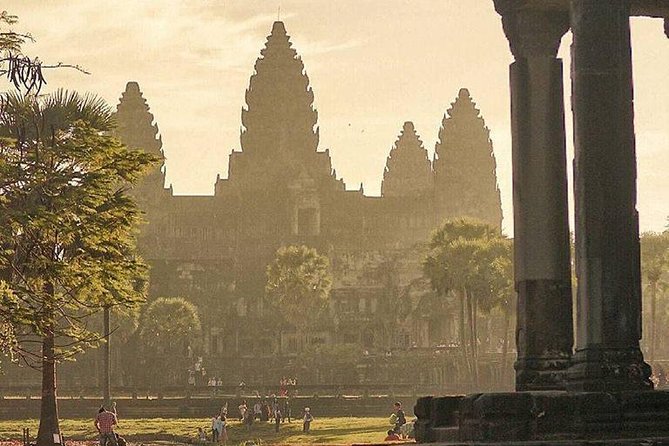
Sunrise is too precious for a ticket queue. This Angkor pass lets you choose a 1, 3, or 7-day option and have the printed ticket delivered to your hotel the evening before your visit. I like the simple handoff and the chance to go straight to Angkor Wat before dawn, and I like that the ticket arrives with your name and photo already printed.
The tradeoff is price. The listed cost is $59 per person, while the official one-day ticket price is shown as $37, before service charges. If the ticket office is quiet, buying directly may save money. The delivery service earns its fee mainly through convenience, early-morning peace of mind, and help arranging the pass before you arrive.
In This Review
- Key points to know before booking
- What you are actually buying in Siem Reap
- The biggest win: getting to Angkor Wat before sunrise
- Angkor Wat: begin with the great centerpiece
- Angkor Thom and Bayon: faces, gates, and scale
- Ta Prohm and the smaller temples nearby
- Preah Khan and Neak Pean: two very different visits
- Banteay Srei and Banteay Samre: detail over size
- The Roluos group: Bakong, Lolei, and Preah Ko
- Pre Rup, Phnom Krom, Phnom Bok, and the quieter climbs
- Kbal Spean and Beng Mealea need careful planning
- Price, value, and the honest drawback
- Photos, rules, and small details that matter
- Should you book the Angkor ticket delivery service?
- FAQ
- How is the Angkor pass delivered?
- Do I need to send a photo after booking?
- Is transportation included?
- Is a tour guide included?
- Do children need an Angkor ticket?
- Are Phnom Kulen and Koh Ker covered?
Key points to know before booking
- Hotel delivery at about 6 pm: Your pass is delivered to the hotel front desk under your name the evening before the selected visit date.
- Three useful validity choices: Select a 1-day, 3-day, or 7-day pass, with the information also listing a 2-day ticket among the available options.
- Sunrise-friendly planning: You can head directly to Angkor Wat instead of first visiting the ticket office.
- A ticket service, not a guided tour: Transport, a tuk-tuk, car, food, drinks, and a guide are not included.
- Photo required for every ticket: You must email passport-style photos after booking, or the pass will not be issued.
- A real convenience surcharge: The official prices are listed as $37 for one day, $62 for three days, and $72 for seven days, before the service fee.
What you are actually buying in Siem Reap
This is best understood as an admission-ticket delivery service, not a sightseeing tour. You arrange your own transport and temple order, then show your personal pass at the entrance points around Angkor Archaeological Park.
That distinction matters. The itinerary names a long list of temples, but no vehicle or guide is included. You can hire a tuk-tuk, car, minivan, bus, or guide separately. The experience gives you the key that opens the park, not the person who explains every carving.
The ticket is delivered to your hotel front desk at around 6 pm, usually on the evening before the visit. Several bookings were delivered earlier than expected, and some passes were waiting at the hotel before check-in. Still, I would not treat early delivery as guaranteed. If the pass has not arrived, contact the operator, Green Era Travel, through the supplied contact method.
The printed pass has your photo on it and is not transferable. Keep it with you. Guards may ask to see it each time you enter a temple area, so the lanyard supplied with some tickets is genuinely useful. It saves you from digging through a wallet or day bag every hour.
More Angkor Wat tours we have reviewed:
- Angkor Wat Sunrise or Sunset Tour with Guide from Siem Reap
★ 5.0 · 12,109 reviews - Siem Reap: Angkor Wat: Small-Group Sunrise or Sunset Tour
★ 5.0 · 9,444 reviews - Siem Reap: Angkor Wat 2-Day Tour with Sunrise and Sunset
★ 4.9 · 4,429 reviews
The biggest win: getting to Angkor Wat before sunrise
The strongest reason to pay for this service is timing. Angkor Wat sunrise often means leaving Siem Reap very early, and nobody wants to add a stop at the ticket office before reaching the reflecting pools and temple towers.
With the pass already in hand, you can leave the hotel and go directly to the park. That gives you a cleaner start and removes one uncertain step from a tightly planned morning. It is especially helpful if you have only a day or a day and a half in Siem Reap, or if a late arrival leaves little time to arrange tickets in person.
The pass is valid from sunrise to sunset, on your own arrangement. That does not mean every temple must be visited in one heroic sprint. It means you can build your day around the places that interest you, pause for lunch, and return to another temple if your ticket duration allows.
You should still plan your transport and guide in advance. This booking does not pick you up at the hotel, despite pickup being offered in the general tour details. The inclusions specifically exclude transportation. Confirm exactly what your booking includes before paying.
Angkor Wat: begin with the great centerpiece
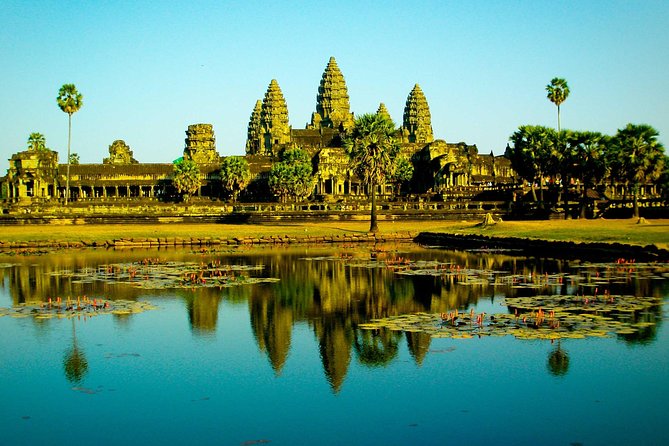
Allow about two hours for Angkor Wat itself. This is the complex most people picture, with its broad moat, long causeway, galleries, towers, and scenes carved into sandstone.
At sunrise, the atmosphere is part of the appeal, but the early start also comes with practical costs. You will be standing or walking in low light, and the day can become long quickly. Wear supportive shoes, as one eight-hour temple day proved for at least one visitor. Shoulders and knees should be covered, both for cultural respect and to meet the park’s clothing rules.
The ticket gets you inside, but it does not explain the Hindu dedication to Vishnu, the temple’s later Buddhist use, or the meaning of the carved scenes. A guide can add a great deal here. Guides are available in several languages, and the supplied information names guides such as Vantha, Bob, Sok, and Mr Ho in connection with temple visits. If interpretation matters to you, arrange one separately rather than expecting the admission pass to provide it.
Angkor Thom and Bayon: faces, gates, and scale
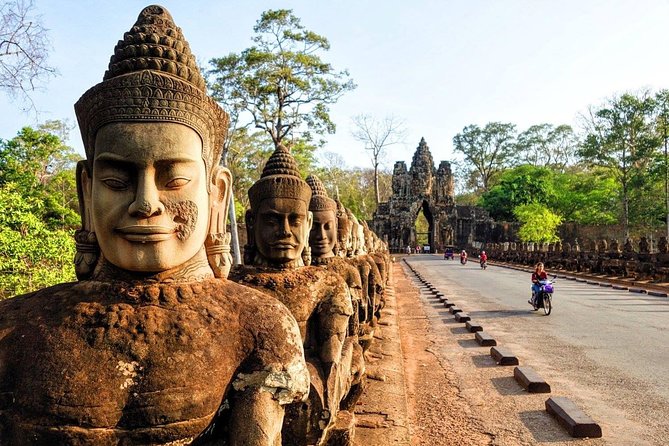
Set aside roughly an hour and 20 minutes for Angkor Thom. This was the last major capital of the Khmer Empire, established in the late 12th century by King Jayavarman VII.
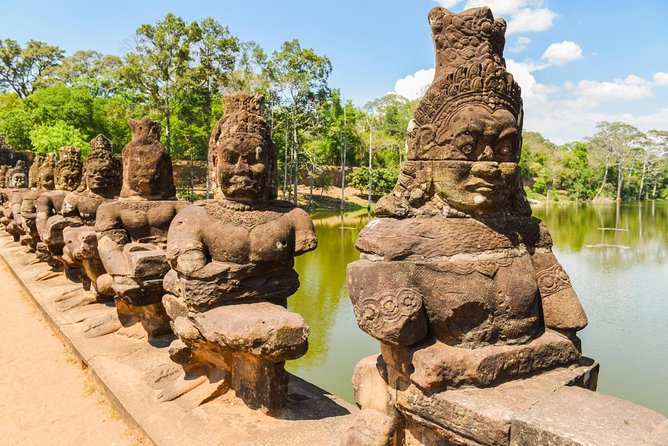
The enclosure gives you a sense of urban scale, not just a single shrine. Within it, the Bayon deserves about an hour. Its towers carry the famous serene stone faces, while the lower galleries show detailed scenes of daily life and warfare.
This pairing is efficient because Angkor Thom and Bayon belong to the same broad visit. A guide is particularly useful at Bayon, where the carvings can look crowded until someone points out the stories and small human details.
Baksei Chamkrong, near Phnom Bakheng Hill, takes about 30 minutes. It is a small Hindu temple dedicated to Shiva, and its modest size makes it a useful contrast after the monumental scale of Angkor Wat and Angkor Thom.
A few more trips worth weighing up
- From Siem Reap: Kampong Phluk Floating Village Tour by Boat
★ 4.9 · 6,979 reviews - Sunset tour of Kampong Phluk stilts home village on the Tonle Sap
★ 5.0 · 4,865 reviews - Siem Reap: Kampong Phluk Floating Village Tour with Boat
★ 4.9 · 3,843 reviews - Siem Reap: Full-Day Angkor Wat Guided Tour with Sunset
★ 4.9 · 3,803 reviews
Ta Prohm and the smaller temples nearby
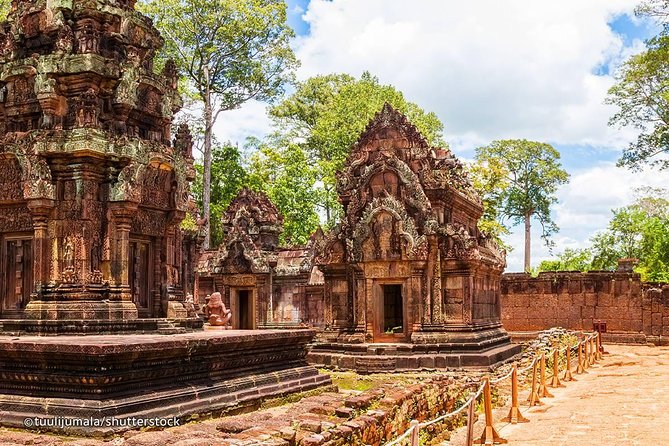
Ta Prohm takes about an hour and is widely known as the Tomb Raider temple. Its appeal comes from the way trees and stone share the same space, with roots crossing walls and galleries.
The setting is memorable, but do not expect solitude at the most photographed spots. Give yourself time to look beyond the famous tree. The temple’s original name was Rajavihara, and it was built in the late 12th and early 13th centuries in the Bayon style.
Ta Keo, on the small circuit, takes around 40 minutes. This steep temple mountain may feel plain beside Ta Prohm, yet its sandstone construction and strong geometric form are worth seeing.
Prasat Kravan is a compact stop of about 30 minutes. Its five reddish brick towers sit on one terrace, and the brick reliefs make it different from the larger sandstone temples.
Ta Som takes about 40 minutes. It is another late 12th-century temple associated with Jayavarman VII, and its smaller scale can make it a calmer change of pace after the major monuments.
Srah Srang, the Royal Bath, takes about 20 minutes. This reservoir is more about open space and water than enclosed galleries. It works well as a short pause during a busy temple circuit.
Preah Khan and Neak Pean: two very different visits
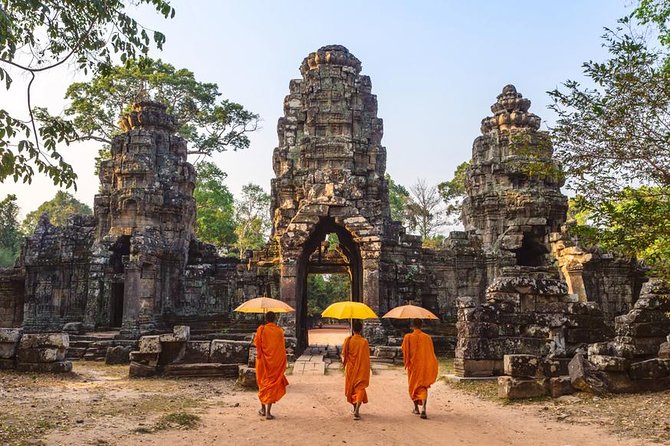
Preah Khan deserves about an hour and 20 minutes. Built in the 12th century for Jayavarman VII in honor of his father, it combines long corridors, courtyards, carved details, and partially ruined spaces.
I would not rush this one. It is large enough to reward patient walking, but that also makes it tiring in hot weather. A guide can help you understand how the temple related to the surrounding Jayatataka reservoir.
Neak Pean takes about an hour. The temple sits on an artificial island in the Jayatataka Baray, reached by a raised walkway. Its water-centered design gives you a different experience from the enclosed temple mountains.
These stops work well together, but they are not quick roadside snapshots. Allow time for walking between the vehicle drop-off and the monuments, and carry water. Food and drinks are not included.
Banteay Srei and Banteay Samre: detail over size
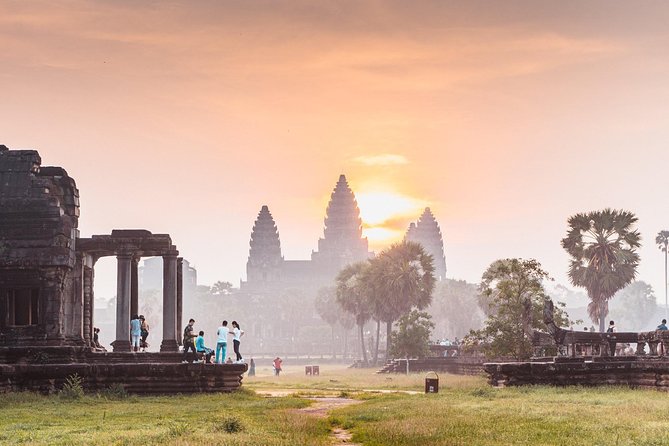
Banteay Srei, often called the Ladies Temple, is a 10th-century shrine dedicated to Shiva. It is about 25 kilometers northeast of the main Angkor group and takes roughly an hour to visit.
Its smaller scale is part of the charm. The pinkish stone and finely cut decoration reward close looking more than grand panoramas. The extra distance means it should be planned as part of a wider route, not added casually at the end of an already exhausting day.
Banteay Samre takes around 40 minutes. Located east of the East Baray, it was built during the reigns of Suryavarman II and Yasovarman II in the early 12th century. Its enclosed layout and careful proportions can feel more manageable than Angkor Wat.
If you want a full day of major monuments, these two can fit into a private car or tuk-tuk plan. If you are traveling by tuk-tuk, ask about the route and extra riding time before setting out.
The Roluos group: Bakong, Lolei, and Preah Ko
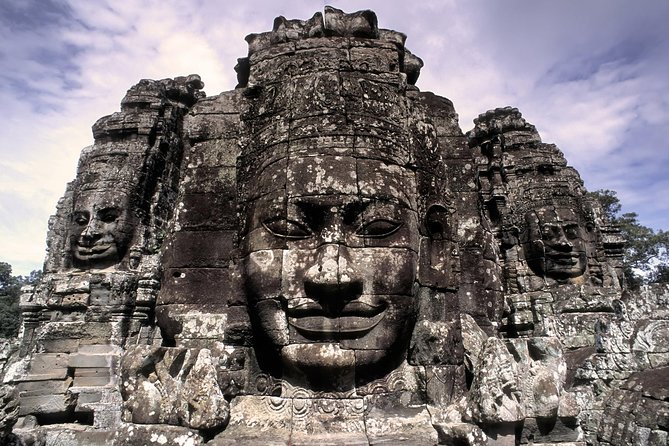
Bakong takes about an hour and is described as the first sandstone temple mountain built by Khmer rulers at Angkor. It lies about 15 kilometers from central Siem Reap.
Preah Ko takes around 30 minutes. It is located in the Roluos area between Bakong and Lolei, and the approach is from the east.
Lolei takes about 25 minutes and is the northernmost of the three Roluos temples. These earlier monuments help you see how Khmer temple design developed before the great central complexes most visitors know.
The Roluos group is a good reason to choose a multi-day pass. Trying to squeeze Angkor Wat, Bayon, Ta Prohm, Banteay Srei, and Roluos into one day can turn a fascinating visit into a hot architectural checklist.
Pre Rup, Phnom Krom, Phnom Bok, and the quieter climbs
Pre Rup takes about 30 minutes. Built as the state temple of Rajendravarman and dedicated in 961 or 962, it is a brick, laterite, and sandstone temple mountain.
Prasat Phnom Krom is about 12 kilometers southwest of Siem Reap and requires around two hours in the supplied schedule. The hill is also described as a strong viewpoint, so this stop offers more than another set of towers.
Phnom Bok Temple takes about two hours. It sits on a hill northeast of the Eastern Baray and is one of a group of three mountains with similar temple layouts.
Both hill sites require more physical effort than a flat temple stop. The instructions call for moderate physical fitness, and you should take that seriously. They may suit you if you want wider views and less focus on the main circuit, but they are poor choices when you are already worn out from an early sunrise.
Kbal Spean and Beng Mealea need careful planning
Kbal Spean is listed with a visit of about three hours in one part of the schedule and four hours in another. It lies in the Kulen Hills and follows a 150-meter stretch of riverbed with Angkorian-era carvings.
The varying time estimate tells you what you need to know: this is not a quick temple stop. Allow a large part of the day and ask your transport provider about the route. The information also lists Kbal Spean among stops with free admission, but Phnom Kulen requires a separate ticket. Confirm the exact entry requirements for your planned route.
Beng Mealea is about 40 kilometers east of the main Angkor group and takes roughly two hours. Its admission is listed as free in the supplied itinerary, while the general exclusions warn that some sites outside the standard park require separate tickets. Do not assume every distant temple is covered by the Angkor pass. Phnom Kulen and Koh Ker are specifically excluded.
Price, value, and the honest drawback
At $59 per person, this service is not the cheapest way to enter Angkor. The official prices provided are $37 for one day, $62 for three days, and $72 for seven days, with service fees added to those figures by the operator.
That creates an odd pricing picture. The one-day pass carries a large convenience premium, while the three-day and seven-day figures are much closer to the listed official rates before fees. Check the exact total for your dates and pass length.
I think the fee makes the most sense in three situations:
- You want to see sunrise at Angkor Wat without handling tickets first.
- You arrive late, have a late-afternoon flight, or have limited time in Siem Reap.
- The official online system is not working and you want a local contact handling the pass.
It makes less sense if you have a relaxed schedule, can easily visit the official ticket office, or are watching every dollar. One booking found no ticket queue on the day of the visit, which shows the risk: you may pay for convenience that turns out not to be necessary.
Photos, rules, and small details that matter
Send passport photos for everyone in your booking after payment. Include your booking reference when emailing the photos. The operator has contacted people through WhatsApp to request missing photos, but you should not rely on reminders.
Children under 12 do not need a national park ticket, but they must show a passport to prove their age. Passes cannot be refunded, changed, or transferred, and they are valid only between the printed start and end dates.
Follow the park code: respect monks and signs, do not touch carvings, litter, smoke, or give money or candy to children. Commercial filming, professional photography, and drones require a permit from the APSARA National Authority.
Should you book the Angkor ticket delivery service?
Book it if time matters more than the lowest price, especially for a sunrise visit or a short stay. The strongest part of the service is simple: a personal pass arrives at your hotel, often early, and you can head for the temples without another errand.
Skip it if you have plenty of time and prefer buying at the official office. Also skip it if you expect a guide, transport, or a complete temple tour, because none of those are included.
For most first visits, I would choose the pass length that matches your actual schedule, send the photos immediately, arrange a tuk-tuk or car separately, and reserve a guide if you want the carvings to make sense. The delivery is useful. Angkor itself is the reason to go.
FAQ
How is the Angkor pass delivered?
The printed pass is delivered to your hotel front desk under your name, generally around 6 pm on the evening before your planned visit. Some passes may arrive earlier.
Do I need to send a photo after booking?
Yes. You must email a passport-style photo for every person in the booking. The pass will not be issued if the required photo is not received.
Is transportation included?
No. You must arrange your own tuk-tuk, car, minivan, bus, or other transportation to the temples.
Is a tour guide included?
No. A guide is not included, though guides can be hired separately in several languages.
Do children need an Angkor ticket?
Children below 12 do not need a national park ticket, but they must show a passport to prove their age.
Are Phnom Kulen and Koh Ker covered?
No. Phnom Kulen and Koh Ker require separate tickets and are specifically excluded from this Angkor pass.
Just added around Siem Reap
- Private Battambang Full-Day Guided Tour★ 4.5 · 3 reviews
- Kulen Mountain, Beng Mealea and Banteay Srei Full Day Tour★ 5.0 · 3 reviews
- Kompong Pluk Tour★ 5.0 · 3 reviews
- Private 3 Day Tour to Discover the ancient temples★ 5.0 · 3 reviews
- Kulen National Park Ticket -Waterfall & 1000 Lingas★ 5.0 · 3 reviews
- Cambodia: Absolute Traditional Dance Show with Buffet Dinner★ 5.0 · 3 reviews
- Border Transfer (Siem Reap to Laos/Laos to Siem Reap)★ 3.5 · 3 reviews
- Beng Melea, Rolous Group & Kompong Phluk Floating Village★ 5.0 · 3 reviews
Angkor Wat Tours, compared.

Angkor Wat Sunrise or Sunset Tour with Guide from Siem Reap
Read our review →
Angkor Wat: Small-Group Sunrise or Sunset Tour
Read our review →
Angkor Wat 2-Day Tour with Sunrise and Sunset
Read our review →

Angkor Wat Sunrise tour with Small – Group and Guide tours
Read our review →
Angkor Wat Highlights and Sunrise Guided Tour from Siem Reap
Read our review →
Angkor Wat Sunset Small Group Tour with Lunch Included
Read our review →