
Reviewed · ANGKOR WAT TOURS
Angkor Wat & Bayon: the Smiling Temple
Angkor is better at bicycle speed. This five-hour ride gives you Angkor Wat and Bayon with time for forest paths, old walls, and quiet temple approaches. I like the maximum group size of 10, which keeps the ride personal, and I like that a guide, Trek mountain bike, helmet, lunch, coconut water, and drinking water are included. The main catch is that the $50 price does not include the $37 Angkor temple pass or transport to the meeting point.
This is a gentle outing rather than a cycling test. Most people can take part, but the heat, some off-road riding, and the ride back to Siem Reap can matter, especially for young children or anyone unused to warm-weather cycling. One family needed a tuk tuk arranged for the children, and another group stopped early because of the heat, with the company sending a car.
In This Review
- Key points before you book
- Why a bicycle works well at Angkor
- Meeting in Siem Reap at 7:30 am
- Angkor Wat, the morning centerpiece
- The South Gate of Angkor Thom
- Climbing Angkor Thom’s protective wall
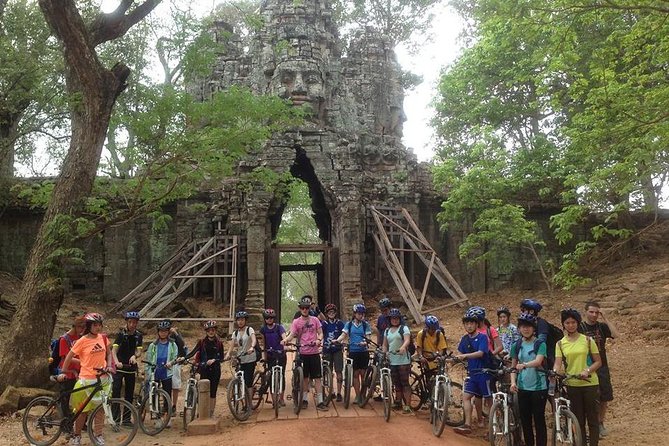
- The West Gate and its unfinished character
- Bayon and its 216 smiling faces
- Quiet trails, flowers, and the ride itself
- How the $50 price compares with what you receive
- Families and less confident cyclists
- What to pack and what to wear
- Should you book this Angkor bicycle tour?
- FAQ
- How long does the Angkor bicycle tour last?
- What time does the tour start?
- Where does the tour begin?
- Where does the tour finish?
- Is the Angkor temple pass included?
- Is hotel pickup included?
- What equipment is provided?
- Is lunch included?
- How many people can join the tour?
- Can most people take part?
- What happens if I need to cancel?
Key points before you book
- Five hours on two wheels: The route links Angkor Wat, Angkor Thom, Prasat Chrung, and Bayon at a relaxed pace.
- Small group by design: A maximum of 10 people gives you a better chance to hear the guide and ride without a large convoy.
- The temple pass costs extra: Budget $37 for one day of Angkor entry, in addition to the $50 tour price.
- Quiet paths add real value: Forest trails, butterflies, flowers, and natural sounds provide a break from the main temple roads.
- Morning helps with the heat: The 7:30 am start gives you a better chance of enjoying the ride before the day becomes difficult.
- Family plans need a little care: The company arranged a tuk tuk and a car when riders could not complete the cycling route, but that support should not replace sensible preparation.
Why a bicycle works well at Angkor
Angkor is spread across a large area, and the journey between temples is part of the experience. From a vehicle, you cover the distance efficiently. On a bicycle, you notice the shade, trees, flowers, butterflies, and changes in the road beneath your wheels.
I like this format because it slows the day down without turning it into a hard athletic outing. The description makes clear that this is a non-professional, non-adventurous ride for people of different fitness levels. You are not signing up for a race or a technical mountain-bike challenge.
That said, easy does not mean effortless. You will be outside for roughly five hours, and some of the route is off road. Hot weather can change the plan quickly. Bring sunscreen, sunglasses, and a camera, and drink the provided water before you feel thirsty.
The 7:30 am start is useful for more than scheduling. Cambodia’s heat can make a long ride much harder later in the day. An early departure also gives you a better chance of enjoying the natural sections before the sun becomes intense.
More Angkor Thom and Bayon tours:
- Siem Reap Tour: Angkor Wat Sunrise, Bayon, Ta Prohm, Banteay Srei
★ 5.0 · 931 reviews - Angkor Wat Private Driver Tours to Angkor Wat Sunrise, Angkor Thom & Ta Prohm
★ 5.0 · 98 reviews - Angkor Wat Sunrise and Angkor Thom Sunset Tour
★ 5.0 · 89 reviews
Meeting in Siem Reap at 7:30 am
You meet Angkor Cycling Tour on Taphul Road in Siem Reap. Hotel pickup and drop-off are not included, so you need to arrange your own way to the start and back from the finish.
The tour returns to the same meeting point. This is simple if you are staying nearby or have arranged local transport, but it adds one practical task to your morning. Allow enough time to reach Taphul Road without rushing. The experience is a mobile-ticket activity, and confirmation is provided when you book.
At the start, the included equipment is a premium Trek mountain bike and helmet. The bike matters here because parts of the route leave smooth paved roads. A proper mountain bike should make the off-road sections more comfortable than a basic city bicycle, though you should still expect uneven surfaces.
A small group of no more than 10 people is another useful feature. Your guide can keep the pace together, explain what you are seeing, and respond if someone needs a break. With a larger group, a quiet stop or question can easily get lost.
Angkor Wat, the morning centerpiece
The ride heads toward Angkor Wat, the best-known temple in the complex and one of the ancient world’s celebrated wonders. This is the point where the scale of the site becomes clear. The approach is not just a transfer between stops. It gives you time to arrive gradually, with the temple setting unfolding around you.
Your guide provides historical background as you ride and as you stop. That support is important at Angkor, where carvings, walls, galleries, gates, and towers can blur together without some direction. A good explanation helps you notice why the site matters instead of simply collecting photographs.
The cycling approach also changes the rhythm. You are not stepping out of a vehicle, taking a quick look, and moving on. You have a few hours to let the setting register, with the road, trees, and temple grounds forming one connected outing.
Angkor entry is not included. The required one-day pass is listed at $37, so your direct cost becomes $87 per person before transportation to the meeting point. That is not a cheap half-day, but the tour does cover the bicycle, helmet, guide, lunch, coconut juice, and drinking water.
The South Gate of Angkor Thom
From Angkor Wat, the route continues to the South Gate of Angkor Thom. This gate is described as the most appealing defensive wall area of Angkor Thom, and it gives the ride a different focus from the grand temple architecture.
Here, you can pay attention to the city’s protective design and the way the route moves through the old capital. The stop helps connect the separate temples into a larger place with entrances, walls, and planned approaches.
The route toward the gate also shows why cycling is useful. You can enjoy the distance between major monuments instead of treating it as empty time. The guide’s commentary gives the ride a purpose, while the peaceful setting keeps the morning from feeling like a checklist.
More Angkor Wat tours we have reviewed:
- Angkor Wat Sunrise or Sunset Tour with Guide from Siem Reap
★ 5.0 · 12,109 reviews - Siem Reap: Angkor Wat: Small-Group Sunrise or Sunset Tour
★ 5.0 · 9,444 reviews - Siem Reap: Angkor Wat 2-Day Tour with Sunrise and Sunset
★ 4.9 · 4,429 reviews - Siem Reap: Full-Day Angkor Wat Guided Tour with Sunset
★ 4.9 · 3,803 reviews
Climbing Angkor Thom’s protective wall
The itinerary includes a climb onto Angkor Thom’s protection wall and a visit to Prasat Chrung. This is one of the more unusual parts of the route because it shifts your view away from the most famous temple faces.
From Prasat Chrung, you get a broad view over the surrounding area. The stop is about seeing Angkor from the defensive edge rather than from the central temple paths. It gives the day a sense of space and helps explain how the ancient city was arranged.
You should take the word climb seriously, even though the ride is presented as leisurely. The exact difficulty is not stated, and the route includes off-road riding, so anyone with limited mobility or low confidence on uneven ground should ask the provider before booking. The general note says most people can participate, but that is not the same as saying every section will feel easy for everyone.
This portion may also be less comfortable in extreme heat. If the morning becomes too hot, the sensible choice is to slow down or stop rather than push through for the sake of completing every planned point.
The West Gate and its unfinished character
The West Gate of Angkor Thom is described as the never-restored gate. That detail gives it a different feel from heavily visited, better-known temple areas.
A restored monument can look polished and complete. An unrestored gate lets you see a rougher side of the site, where age and weather remain part of the visual story. Your guide’s explanations are especially useful here because the significance of a less famous gate may not be obvious at first glance.
This is also a good place to appreciate the route’s quieter aim. The tour is not only about stopping at the two biggest names. It adds smaller and less polished points that help you see Angkor as a large ancient city rather than a pair of famous photographs.
Bayon and its 216 smiling faces
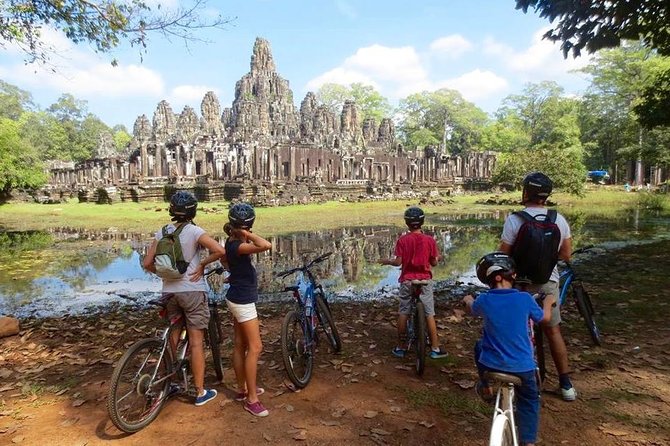
Bayon is the second major temple on the route after Angkor Wat. Its 54 towers and 216 smiling faces create a very different mood from Angkor Wat’s broad grandeur.
The carved faces appear across the towers, and the effect is strongest when you move through the temple and see them from changing angles. Some faces seem to watch from above, while others emerge as you pass through the stonework. This is the kind of place where a guide can help you understand what to look for before you start taking pictures.
Bayon also makes a strong final temple stop because it is visually distinct. You have seen Angkor Wat’s monumental form and Angkor Thom’s gates and wall. Bayon then brings the focus close, to carved expressions and crowded stone towers.
The site remains an active spiritual place for Buddhist worship, prayer, and meditation. Wear clothing that covers your shoulders, and avoid shorts or skirts above the knees in sacred palace areas. Respectful dress is not just a rule to remember at the entrance. It helps you move through the site with proper respect for the local community.
Quiet trails, flowers, and the ride itself
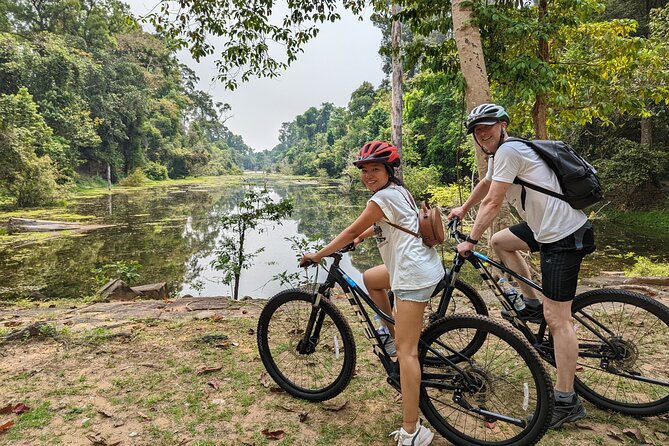
The best part of this outing may be the stretches between monuments. The route uses lesser-used trails where you may see butterflies and flowers and hear more natural sounds than temple traffic.
I like that the bike is treated as a way to experience the setting, not only as transportation. You can stop, look around, and listen. The peaceful sections offer a useful counterpoint to the fame of Angkor Wat and Bayon.
Still, you should be ready for road variety. One direct account of the outing cautions that some biking is off road. That can mean a more interesting route, but it may also bring dust, bumps, and slower progress. Wear practical clothing and shoes suitable for pedaling and walking around temple grounds.
The supplied water, coconut juice, and lunch also matter more than they might on a short city ride. Five hours in the Cambodian heat is a long morning outside. The coconut juice provides a pleasant local refreshment, while lunch means you do not have to arrange a separate meal during the outing.
Specific dietary needs should be shared when booking. The information does not specify the lunch menu, so you should not assume a particular dish or special diet can be handled without advance notice.
How the $50 price compares with what you receive
The $50 tour fee covers several items that can add up when booked separately: an English-speaking guide, Trek mountain bike, helmet, lunch, coconut water, and drinking water. You are paying for a planned route and local explanation, not just a bicycle rental.
The extra $37 temple pass changes the calculation. At $87 before transport, this is best viewed as a guided Angkor day component rather than a budget bicycle outing. The value improves if you want a guide, equipment, food, and a route that includes smaller points such as Prasat Chrung and the West Gate.
The maximum of 10 people also supports the price. A small group usually makes it easier to maintain a comfortable pace and ask questions. If you only want to see Angkor Wat and Bayon as quickly as possible, a private vehicle or a basic self-guided plan may suit you better. If you want the journey between the temples to be part of the day, the bicycle format earns its keep.
The experience has a 4.9 rating from 47 reviews, with 100 percent recommending it. Those figures suggest strong satisfaction, but the practical limits are clear: heat, off-road sections, and the distance back to Siem Reap can affect how much you complete.
Families and less confident cyclists
The tour is described as suitable for most fitness levels, and the ride is leisurely rather than adventurous. That makes it more approachable than a serious cycling excursion.
Families should still think carefully about children’s stamina. One family found that its children could not manage the ride back from the temple, and the leader arranged a tuk tuk home. That is encouraging evidence of flexibility, but it also shows that the return leg can be the hardest part for young riders.
On another very hot day, the group did not finish the full route and the company sent a car to collect them. I would treat that as a useful sign of practical support, not as a guarantee that every change will be available on demand. Ask about your group’s needs before setting out.
If everyone can ride comfortably for several hours in warm weather, this could be a fine family outing. If your children are very young, consider contacting the provider first and asking about the likely route, breaks, and backup transport.
What to pack and what to wear
Bring a camera, sunglasses, and sunscreen. Pure drinking water is included, but you should still use it regularly, especially during the off-road portions and any climb to the wall.
Dress respectfully for Angkor. Shorts and skirts above the knees and bare shoulders are prohibited in sacred palace areas. Lightweight clothing that covers your shoulders and knees will help you meet the standard while keeping you more comfortable in the sun.
A helmet is included, so you do not need to bring one. The Trek bicycle is also supplied. You should focus on suitable clothing, sun protection, and any personal dietary information that the guide needs to know.
Should you book this Angkor bicycle tour?
Book it if you want Angkor Wat and Bayon combined with a slower, greener route through the temple area. I would especially recommend it to people who like seeing the spaces between famous monuments, want a small group, and prefer a guide to explain the old city as they ride.
Think twice if you dislike heat, uneven paths, or several hours of outdoor activity. Families with small children should also plan a backup option for the return journey. The tour can be adapted in difficult conditions, but you should not count on completing every section if the weather turns harsh.
At $50 plus the $37 temple pass, the price is fair for a guided ride with equipment, food, and drinks. You are paying for a fuller morning at Angkor, not simply a transfer between temples. For an active but gentle introduction to Angkor Wat, Angkor Thom, and Bayon, this is a strong choice.
FAQ
How long does the Angkor bicycle tour last?
The tour lasts approximately five hours.
What time does the tour start?
It starts at 7:30 am.
Where does the tour begin?
The meeting point is Angkor Cycling Tour on Taphul Road in Krong Siem Reap.
Where does the tour finish?
The activity ends back at the meeting point.
Is the Angkor temple pass included?
No. The one-day Angkor temple pass costs $37 and must be paid separately.
Is hotel pickup included?
No. Hotel pickup and drop-off are not included.
What equipment is provided?
A premium Trek mountain bike and helmet are included.
Is lunch included?
Yes. Lunch, coconut water, and pure drinking water are included.
How many people can join the tour?
The group has a maximum of 10 people.
Can most people take part?
Yes. Most people can participate, and the ride is described as leisurely and suitable for all fitness levels. Some off-road riding and hot weather may make the route more difficult.
What happens if I need to cancel?
You can receive a full refund if you cancel at least 24 hours before the experience start time. Cancellations or changes made less than 24 hours before the start are not accepted for a refund.
Just added around Siem Reap
- Private Battambang Full-Day Guided Tour★ 4.5 · 3 reviews
- Kulen Mountain, Beng Mealea and Banteay Srei Full Day Tour★ 5.0 · 3 reviews
- Kompong Pluk Tour★ 5.0 · 3 reviews
- Private 3 Day Tour to Discover the ancient temples★ 5.0 · 3 reviews
- Cambodia: Absolute Traditional Dance Show with Buffet Dinner★ 5.0 · 3 reviews
- Kulen National Park Ticket -Waterfall & 1000 Lingas★ 5.0 · 3 reviews
- Border Transfer (Siem Reap to Laos/Laos to Siem Reap)★ 3.5 · 3 reviews
- Siem Reap Countryside Sunset Vespa Tour or Tuk Tuk★ 4.5 · 3 reviews
Angkor Wat Tours, compared.

Angkor Wat Sunrise or Sunset Tour with Guide from Siem Reap
Read our review →
Angkor Wat: Small-Group Sunrise or Sunset Tour
Read our review →
Angkor Wat 2-Day Tour with Sunrise and Sunset
Read our review →

Angkor Wat Sunrise tour with Small – Group and Guide tours
Read our review →
Angkor Wat Highlights and Sunrise Guided Tour from Siem Reap
Read our review →
Angkor Wat Sunset Small Group Tour with Lunch Included
Read our review →
Full-Day Angkor Wat Sunrise Private Tour with Guide from Siem Reap
Read our review →Browse the lists this tour appears in