
Reviewed · ANGKOR WAT TOURS
Angkor Wat Private Day Tour
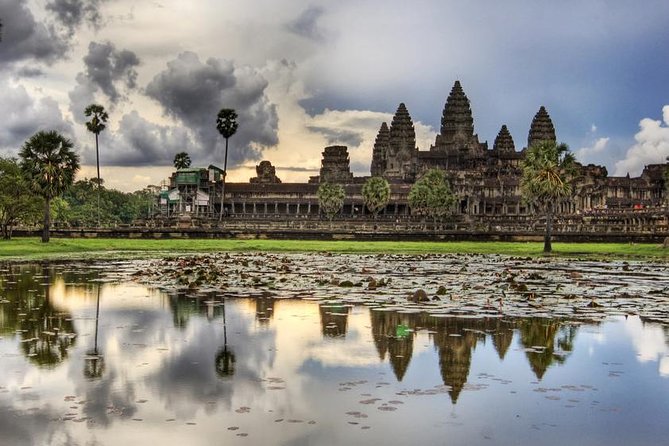
Ancient faces wait in the forest. This private Angkor Wat day tour gives you a full eight-hour look at Cambodia’s best-known temple complex, with a private guide, air-conditioned vehicle, cold water, and a sunset finish. I like the personal pace and the chance to ask questions as you go. I also like that the route includes Bayon, Ta Prohm, Banteay Kdei, and Angkor Wat rather than stopping at only the headline temple.
The main catch is the price of admission, which is not included in the $45 cost. The 9:30 a.m. start also means you will not see sunrise at Angkor Wat, and a long temple day can feel tiring, especially with roughly eight hours on the road and among the ruins.
In This Review
- Key points at a glance
- A private route through Angkor’s biggest sights
- Bayon and the stone faces of Angkor Thom
- Ta Prohm and the roots around the ruins
- Banteay Kdei for a quieter change of pace
- Three hours at Angkor Wat, ending with sunset
- What the private setup adds
- Is $45 a good value?
- Who should book this day tour?
- Practical details before you book
- Should you book the Angkor Wat Private Day Tour?
- FAQ
- How long does the Angkor Wat private day tour last?
- What time does the tour start?
- Which temples are included?
- Is the tour private?
- Are entrance tickets included?
- Are meals included?
- What happens if I need to cancel?
Key points at a glance
- Four major temple stops: See Bayon, Ta Prohm, Banteay Kdei, and Angkor Wat in one organized day.
- Private guide and vehicle: Your group travels alone, making it easier to ask questions or adjust the pace.
- Sunset at Angkor Wat: The final three-hour visit is planned around watching the sun dip near the temple complex.
- Good guide feedback: Se, K.K., and Noy are praised for clear English, warmth, flexibility, and strong temple knowledge.
- $45 before entrance fees: The tour price covers transport, guiding, cold water, and cold towels, but not temple tickets or meals.
- Useful for a short stay: A layover in Siem Reap can still fit this full-day visit, provided your timing is sound.
A private route through Angkor’s biggest sights
Angkor is not one temple. It is a vast archaeological area with separate monuments spread across a broad circuit. That makes a private vehicle useful. You are not working out each transfer yourself, and you can move between the sites in air-conditioned comfort.
This tour starts at 9:30 a.m. and lasts about eight hours. You have an English-speaking guide with you throughout, along with a private vehicle for your group. That setup matters at Angkor, where the heat, walking, and sheer amount of carved stone can quickly wear you down.
The route gives you four distinct experiences. Bayon brings the famous stone faces. Ta Prohm offers roots and ruined galleries. Banteay Kdei gives you a quieter monastic site in a similar style. Angkor Wat then provides the grand finale, with time set aside for sunset.
The private format is also helpful if you are traveling with family. One booking included a father and son who felt they would have seen far less without a guide and driver. That is a fair point. Angkor can be visited independently, but planning the route, finding each entrance, and understanding what you are seeing takes time.
More Angkor Wat tours we have reviewed:
- Angkor Wat Sunrise or Sunset Tour with Guide from Siem Reap
★ 5.0 · 12,109 reviews - Siem Reap: Angkor Wat: Small-Group Sunrise or Sunset Tour
★ 5.0 · 9,444 reviews - Siem Reap: Angkor Wat 2-Day Tour with Sunrise and Sunset
★ 4.9 · 4,429 reviews
Bayon and the stone faces of Angkor Thom
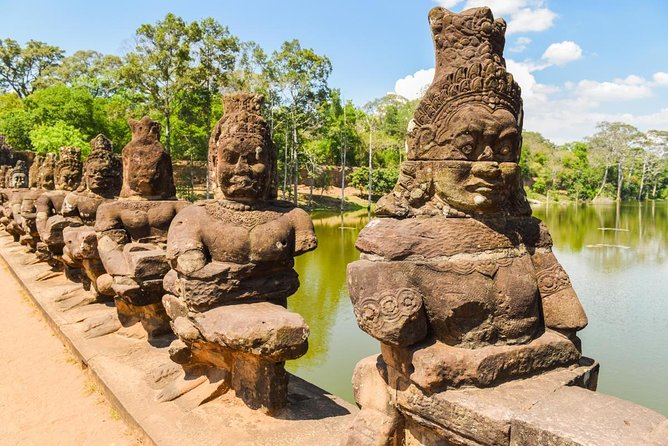
Your first major stop is Bayon Temple, reached through the south gate of Angkor Thom. Allow about two hours here, since this part of the route includes more than a quick look at the central monument.
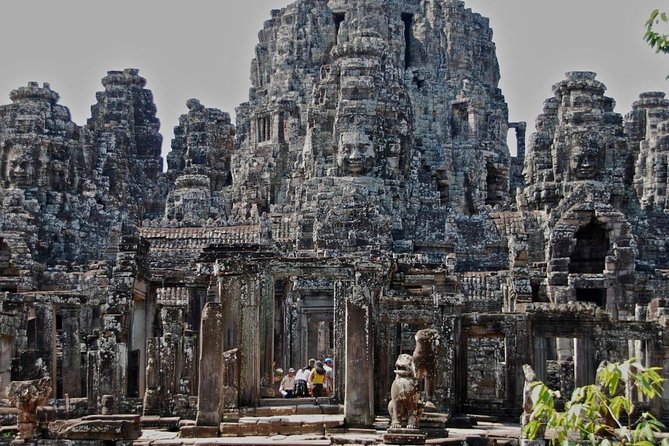
Bayon is known for its towers and large carved faces linked with the bodhisattva Avalokitesvara. The stated figures are striking: 54 towers and 216 faces. As you walk among the galleries, the faces appear from different angles and distances, creating one of Angkor’s most memorable visual effects.
The site rewards slow looking. You will see the temple first as a dense cluster of gray towers, then notice individual carvings, passageways, and reliefs as you get closer. A guide can help you separate the temple’s layout from its many details instead of leaving you to photograph everything and remember little.
The two-hour allowance is generous compared with a basic photo stop, but it also sets the pace for the rest of the day. You are not rushing through Bayon in 20 minutes. If you prefer a short list of famous sights, this may feel long. If you want context and time to look closely, it is a good beginning.
The south gate of Angkor Thom adds another layer to the visit. Rather than treating Bayon as an isolated ruin, the route places it within the wider royal city. Your guide can explain the connection between the gate, Angkor Thom, and Bayon as you move through the area.
Ta Prohm and the roots around the ruins
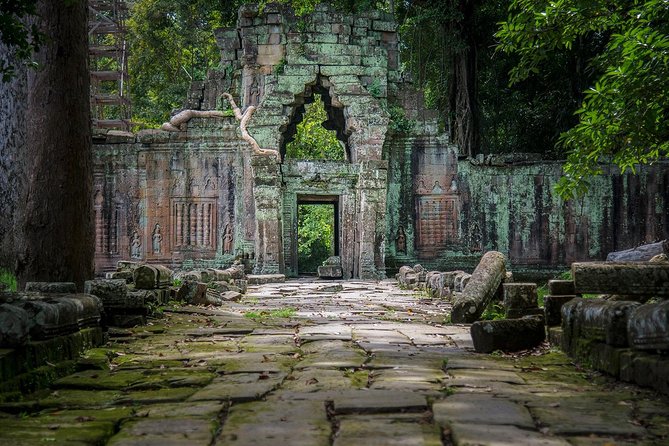
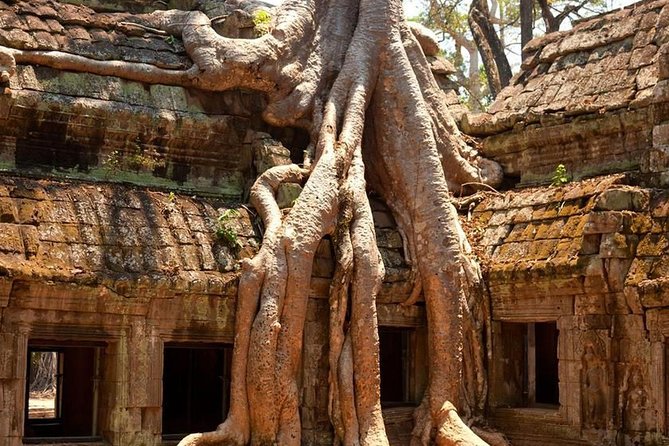
The next stop is Ta Prohm, with about two hours to explore. This is the temple many people picture when they think of Angkor: stone galleries partly overtaken by trees, with huge roots wrapping around walls and doorways.
Ta Prohm’s appeal comes from the tension between construction and nature. The temple was built as a major religious complex, yet its present character comes from the trees and roots pressing into the masonry. You get a strong sense of age here, even before your guide explains the site.
The temple is often called the jungle temple or tree temple. Those names make sense once you see the roots embracing the ruins. The setting is visually different from Bayon, so the route does not feel like four versions of the same monument.
Two hours gives you room to notice the small details, not just the largest roots. You can look at carved stone, narrow corridors, and the way the trees change the shape of the site. Still, Ta Prohm is one of the most famous stops on the circuit, so it may feel more crowded than Banteay Kdei. The private tour does not mean the temple itself belongs only to your group.
This is also where a guide adds real value. The ruins can be dramatic but confusing. With someone explaining what you are looking at, the fallen stones and altered walls become part of a story rather than a collection of striking pictures.
Banteay Kdei for a quieter change of pace
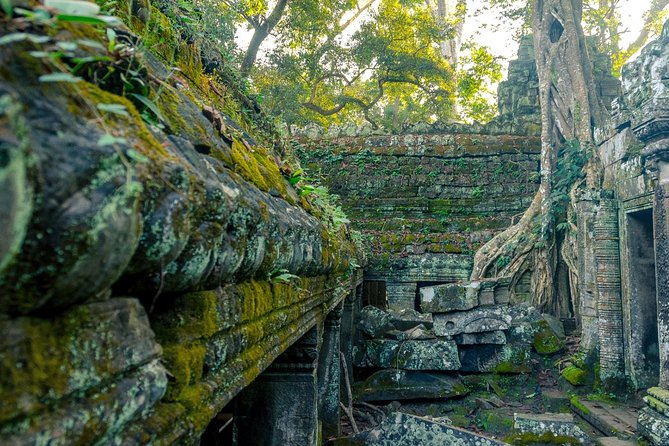
Banteay Kdei receives about one hour. Built by King Jayavarman VII in the late 12th century, it was a monastic complex in a style close to Ta Prohm.
The temple is largely unrestored. That gives it a rougher appearance than the more famous monuments, with less of the polished visual order you may find at a better-preserved site. For some people, that is the point. You get a clearer impression of a ruin still marked by time and weather.
After two hours at Bayon and two more at Ta Prohm, Banteay Kdei offers a change of scale. You can focus on the layout, the worn stone, and the relationship between the temple’s buildings without trying to absorb another enormous landmark.
The one-hour visit is brief, but it fits the role of this stop. Banteay Kdei is not presented as the main event. It is a useful middle chapter before the long final visit to Angkor Wat.
A few more trips worth weighing up
- From Siem Reap: Kampong Phluk Floating Village Tour by Boat
★ 4.9 · 6,979 reviews - Sunset tour of Kampong Phluk stilts home village on the Tonle Sap
★ 5.0 · 4,865 reviews - Siem Reap: Kampong Phluk Floating Village Tour with Boat
★ 4.9 · 3,843 reviews - Siem Reap: Full-Day Angkor Wat Guided Tour with Sunset
★ 4.9 · 3,803 reviews
Three hours at Angkor Wat, ending with sunset
The final stop is Angkor Wat, with about three hours planned around sunset. This is the longest portion of the day, and that makes sense. Angkor Wat is the site most people have come to see, but it is too large to appreciate in a quick pass.
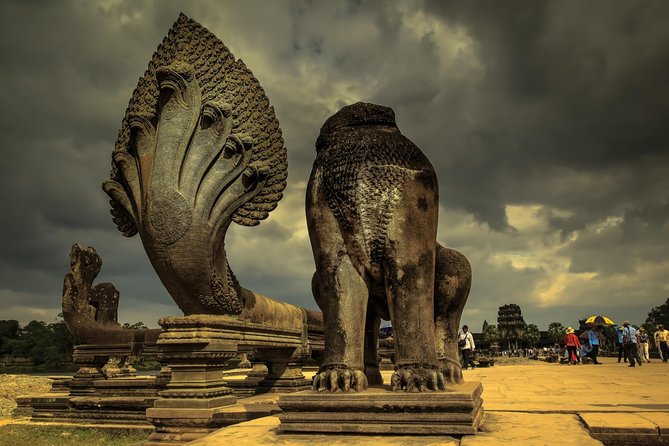
The temple is a UNESCO-listed World Heritage Site and one of Southeast Asia’s most important archaeological sites. The scale is the first thing you notice. Then come the galleries, towers, carved surfaces, and carefully arranged spaces that make the complex more than a single photogenic facade.
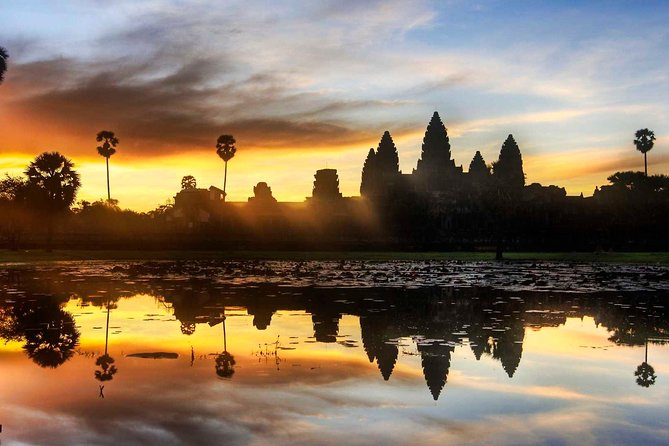
Your guide can help you use the three hours well. You may want to see the main structure, learn about its place in Cambodian history, and still leave time to watch the changing light. The sunset element gives the day a clear ending instead of finishing with an ordinary drive back to Siem Reap.
Sunset is never something you can fully control. Clouds, haze, and the season affect the view, so you should treat it as part of the plan rather than a guarantee of a perfect sky. Even so, having the final stop built around late-day light is a strong choice.
The 9:30 a.m. start means this is not a sunrise tour. That may suit you if you prefer a slower morning or want to avoid an extremely early departure. If sunrise over Angkor Wat is your main goal, this is the wrong schedule.
What the private setup adds
The strongest practical feature is that only your group participates. You are not tied to the needs of a large bus group, and your guide can speak directly with you rather than addressing a crowd.
That matters when you have different walking speeds in your group. It also helps if you want more explanation at Bayon but less time at another stop. The tour is described as personalized, and the feedback attached to the service supports that impression.
Guides named in past bookings include Se, K.K., and Noy. Se is associated with a flexible day that covered four temples and included a stop for Khmer food. K.K. is praised for being welcoming and informative, while Noy is noted for clear English and an easy manner.
Those names do not guarantee who you will receive. The useful point is that guide quality appears to be central to the experience. Angkor is much more rewarding when the person beside you can explain the carvings, temples, and wider story in a way you understand.
The private vehicle also gives you a break between sites. The included air-conditioning is especially welcome after walking through exposed stone courtyards. Cold water and a cold towel are small inclusions, but they are practical ones in a hot temple complex.
Is $45 a good value?
At $45 per person, the tour offers a fair package if you value a private guide and transport. You are paying for an organized day across four sites, an English guide, an air-conditioned vehicle, water, and towels.
The important qualification is that entrance tickets are not included. Meals are not included either, though one past outing included a lunch stop at a Khmer restaurant. Treat that as a possible part of the guide’s flexibility, not as something covered by the stated price.
The final amount will therefore be higher than $45 once you add the required temple admission and food. The tour still makes sense for people who want a simple, guided day and do not want to arrange a driver, route, and explanations separately.
Group discounts are offered, which may improve the value if you are booking for several people. Since this is a private activity, the per-person rate is easier to justify when shared by a small group rather than paid by one person alone.
The tour is booked about eight days ahead on average. That suggests you should not leave it until the last minute if your Siem Reap dates are fixed, especially if you want a particular day.
Who should book this day tour?
I would look closely at this option if you have only one full day in Siem Reap. It is also suited to a short stopover. One booking came from someone with a layover before continuing to Vietnam, and the full-day route worked as a way to see several key temples in limited time.
Families may also find it useful. A private vehicle, a dedicated guide, and control over the pace are easier than trying to keep a mixed group together. Children must be accompanied by an adult, and the activity is suitable for most people.
You should think twice if you dislike long sightseeing days or prefer to explore at a very slow pace. Four temples, several hours of walking, and an evening finish require energy. You may also prefer a shorter or more specialized tour if smaller, lesser-known monuments matter more to you than the main Angkor circuit.
The tour is best for someone who wants the major sights explained in plain English, with transport handled from start to finish. It is less suited to someone whose top priority is sunrise, a quiet temple experience, or a fully self-directed day.
Practical details before you book
The start time is 9:30 a.m., and the total duration is about eight hours. Pickup is offered, but the supplied details do not specify the exact pickup area, so confirm the meeting arrangement when you book.
Bring a plan for food since meals are not included. You can also ask your guide about a lunch stop, as a previous day included a Khmer restaurant. Do not assume that meal is part of the tour price.
Admission tickets are separate and should be budgeted before you arrive. The tour confirmation is issued at booking, and free cancellation applies when you cancel at least 24 hours before the local start time. Cancellations inside that window are not refunded, and late changes are not accepted.
The service has a perfect five-star rating from 25 reviews, with 100 percent recommending it. That is a small sample, but the pattern is clear: the most praised elements are the guides, the friendly service, the clear English, the flexible approach, and the amount you can see in one day.
Should you book the Angkor Wat Private Day Tour?
Book it if you want four major temples, a private guide, and an air-conditioned vehicle without building the day yourself. The $45 starting price is reasonable for the service, but remember to add entrance tickets and meals.
I especially like it for first-time visitors, families, and anyone working with a short Siem Reap stay. The guides Se, K.K., and Noy have been praised for the qualities that matter most here: clear communication, warmth, flexibility, and useful explanations.
Skip it if sunrise is essential, if you want a very short temple visit, or if you prefer to set every stop and time yourself. For most people seeking a focused first look at Angkor, though, the private format and sunset ending make this a sensible day out.
FAQ
How long does the Angkor Wat private day tour last?
The tour lasts approximately eight hours.
What time does the tour start?
The stated start time is 9:30 a.m.
Which temples are included?
The route includes Bayon Temple, Ta Prohm, Banteay Kdei, and Angkor Wat.
Is the tour private?
Yes. Only your group participates in the activity.
Are entrance tickets included?
No. All entrance fees are excluded from the tour price.
Are meals included?
No. Breakfast, lunch, and dinner are not included.
What happens if I need to cancel?
You can receive a full refund if you cancel at least 24 hours before the local start time. Cancellations or changes made within 24 hours are not accepted, and the amount paid is not refunded.
Just added around Siem Reap
- Private Battambang Full-Day Guided Tour★ 4.5 · 3 reviews
- Kulen Mountain, Beng Mealea and Banteay Srei Full Day Tour★ 5.0 · 3 reviews
- Kompong Pluk Tour★ 5.0 · 3 reviews
- Private 3 Day Tour to Discover the ancient temples★ 5.0 · 3 reviews
- Kulen National Park Ticket -Waterfall & 1000 Lingas★ 5.0 · 3 reviews
- Cambodia: Absolute Traditional Dance Show with Buffet Dinner★ 5.0 · 3 reviews
- Border Transfer (Siem Reap to Laos/Laos to Siem Reap)★ 3.5 · 3 reviews
- Best Taxi Siem Reap to Battambang – English Speaking Driver★ 4.5 · 3 reviews
Angkor Wat Tours, compared.

Angkor Wat Sunrise or Sunset Tour with Guide from Siem Reap
Read our review →
Angkor Wat: Small-Group Sunrise or Sunset Tour
Read our review →
Angkor Wat 2-Day Tour with Sunrise and Sunset
Read our review →

Angkor Wat Sunrise tour with Small – Group and Guide tours
Read our review →
Angkor Wat Highlights and Sunrise Guided Tour from Siem Reap
Read our review →
Angkor Wat Sunset Small Group Tour with Lunch Included
Read our review →