
Reviewed · ANGKOR WAT SUNRISE TOURS
Angkor Wat Sunrise Experience with Breakfast
Angkor Wat rewards early risers. This $23 shared tour gets you to the temple before dawn, then adds Ta Prohm, Bayon, and breakfast near Srah Srang in one well-planned morning. I like the small group of up to 10 people and the mix of famous monuments with a local village stop. I also like that air-conditioned transport, water, towels, guide service, breakfast, and hotel transfers are included.
The main drawback is the 4:30 to 5:00 a.m. pickup. You will need an early night, and sunrise is never guaranteed. One review notes that cloudy weather hid the sunrise, though the temple visit and guide still made the outing worthwhile. You must also pay the separate Angkor Pass fee of $37.
In This Review
- Key points before you book
- Why the 4:30 a.m. start is worth it
- Angkor Wat in the first light
- Breakfast beside Srah Srang
- Ta Prohm and the power of the trees
- Angkor Thom and Bayon’s stone faces
- What the shared transport adds
- The real price, including the Angkor Pass
- Who will enjoy this morning most
- Should you book the Angkor Wat sunrise tour?
- FAQ
- What time is hotel pickup?
- Is the Angkor Pass included?
- How long does the experience last?
- What temples are included?
- Is breakfast included?
- How many people can join the group?
Key points before you book
- Sunrise starts before 5 a.m.: The early pickup gives you time to buy your Angkor Pass and reach the temple before dawn.
- Three major temple stops: You visit Angkor Wat, Ta Prohm, and Bayon, with a short photo stop at Angkor Thom.
- Breakfast at Srah Srang: The morning meal takes place in a village near the reservoir, adding a glimpse of everyday Cambodian life.
- Maximum 10 people: This is a shared tour, but the group limit is more manageable than a large coach outing.
- Practical comforts included: Air-conditioning, bottled water, cool towels, breakfast, and hotel pickup and drop-off are provided.
- Budget price, extra entrance fee: The tour costs $23 per person, but the $37 Angkor Pass is not included.
Why the 4:30 a.m. start is worth it
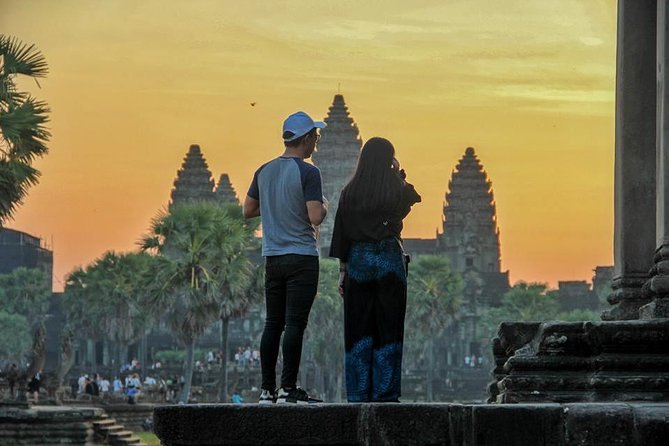
Angkor Wat is most famous at sunrise for good reason. In the dim light, the temple’s five towers appear behind the reflecting pool, and the first colors of morning slowly shape the stone. Even when clouds cover the sun, the early arrival gives you a quieter, cooler start than visiting later in the day.
Your pickup is scheduled between 4:30 and 5:00 a.m. The group first stops to buy the Angkor Pass, then continues into Angkor Archaeological Park. The timing is practical, but not leisurely. If you need a slow breakfast, extra coffee, or a long time to get ready, this outing will test your discipline.
The sunrise viewing and first exploration of Angkor Wat take about two hours. That is enough time for a first look at the main temple, but not enough for an exhaustive study of every gallery and carved panel. I see this as a strength for a one-day introduction. You get the essential experience without spending the entire morning in one enormous monument.
Bring a phone or camera, but keep your expectations sensible. The sunrise may be spectacular, muted, or hidden by clouds. The tour still has value on a gray morning because Angkor Wat itself is the main attraction, and the guide can explain the temple’s design, religious role, and Cambodian history.
More sunrise starts at Angkor Wat:
- Angkor Wat Sunrise or Sunset Tour with Guide from Siem Reap
★ 5.0 · 12,109 reviews - Angkor Wat Sunrise tour with Small – Group and Guide tours
★ 5.0 · 3,655 reviews - Full-Day Angkor Wat Sunrise Private Tour with Guide from Siem Reap
★ 5.0 · 2,920 reviews
Angkor Wat in the first light
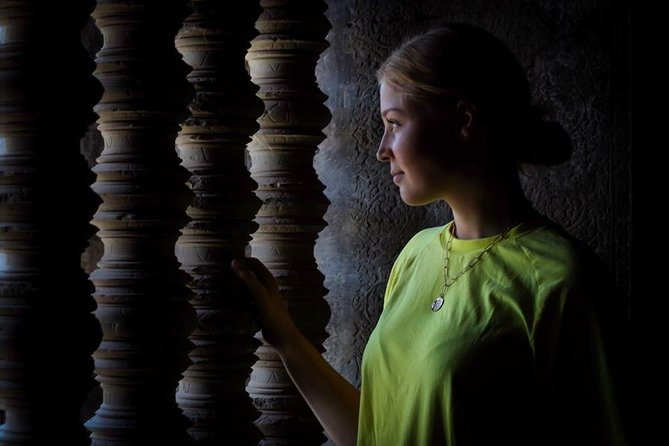
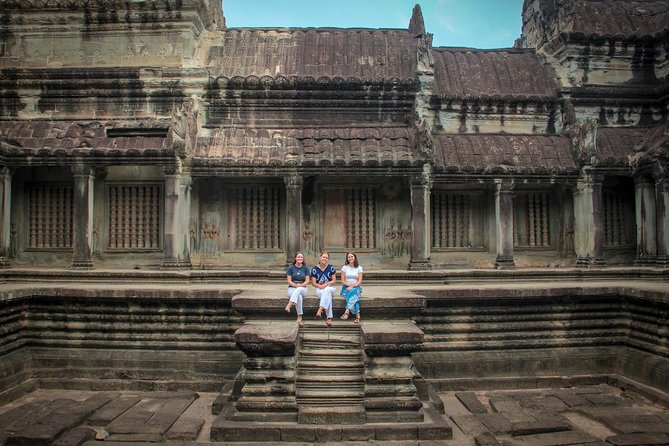
After sunrise, the guide leads you into Angkor Wat for a closer visit. Built as a Hindu temple and later used as a Buddhist religious center, it is more than a photogenic row of towers. Its galleries, courtyards, and stone reliefs show the scale and ambition of the Khmer Empire.
A good guide matters here. The names praised in the feedback include Phrem, Vone, Chy, John, Devid, Chanra, and Youk Makara. Specific guides may vary, but the strongest pattern is clear: visitors valued clear explanations of Cambodian history, mythology, culture, and local life.
Guide Phrem was praised for explaining the temple’s past in a kind and easy-to-follow way. Mr. Chy received particular praise for detailed introductions, helping with photographs, and offering water and cool towels during the hot hours. Mr. John was also noted for his local community knowledge and photography help.
You should expect some walking on temple paths and stone surfaces. The available details do not give a precise walking distance or state the condition of every stairway, so wear practical shoes and be ready for an active morning. Dress respectfully for a religious site, with shoulders and knees covered.
Breakfast beside Srah Srang
The next stop is Srah Srang, where you pause for about an hour for breakfast in a nearby village. This is a welcome change of pace after the early temple visit. Instead of moving directly from one monument to another, you get time to sit, eat, and see a little of daily life outside the grand stone complexes.
Breakfast is included, while lunch and other drinks are not. The experience description presents it as a traditional Cambodian breakfast, but it does not specify the exact dishes. If you have allergies, dietary restrictions, or strong food preferences, ask for details before booking rather than assuming the menu will suit you.
Srah Srang is also interesting because the setting changes with the season. One account noted that the village was not floating during the dry season, but still found the local daily life worth seeing. That detail is useful: the atmosphere may differ depending on water levels and weather, so do not book this stop expecting one fixed scene.
The hour here helps break up the morning. It also gives you a chance to cool down before Ta Prohm. Still, this is not a separate full village tour. The stop is brief and supports the temple program rather than replacing a dedicated community or floating-village visit.
Ta Prohm and the power of the trees
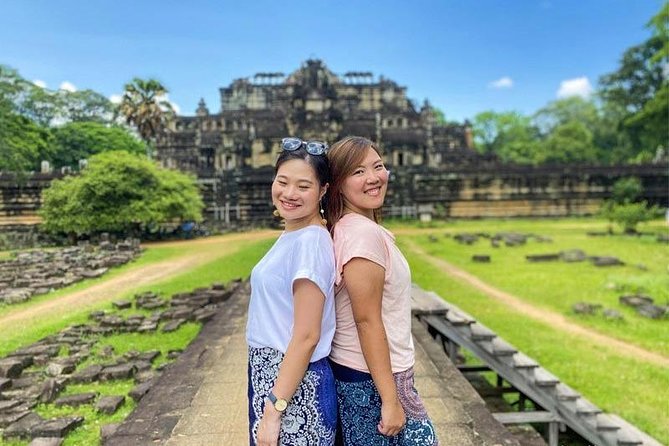
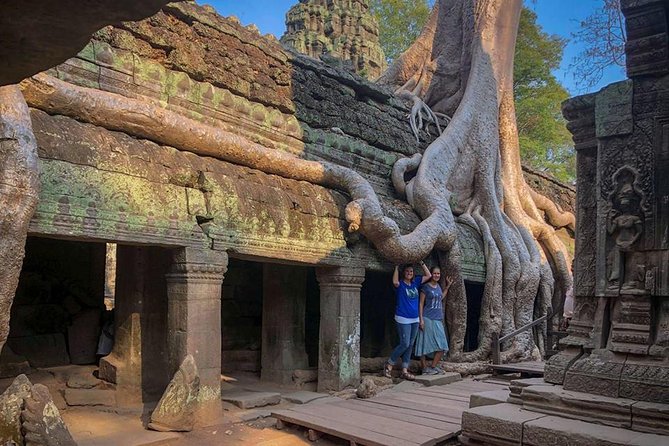
Ta Prohm is the temple many people picture when they think of Angkor’s jungle ruins. It has been left in its original state in parts, with enormous tree roots pressing over walls and doorways. The result is dramatic, but the real appeal is the tension between careful Khmer stonework and the force of nature.
You have about an hour here. That is enough to see the most striking sections and listen to the guide explain the site, but it is a quick visit if you want to linger over carvings or take many photographs. The temple can feel more intimate than Angkor Wat, with enclosed passages and root-covered structures creating a different mood.
This stop also helps justify the tour’s three-temple format. Angkor Wat gives you monumental design, Ta Prohm gives you atmospheric ruins, and Bayon later supplies its famous carved faces. You are not seeing three versions of the same temple.
Photography can be tricky at Ta Prohm. Tree roots, narrow passages, shade, and groups moving through the site may limit the time you have for a perfect picture. Guides who help with photos, as Mr. Chy and Mr. John were praised for doing, can make a real difference.
More Angkor Wat tours we have reviewed:
- Siem Reap: Angkor Wat: Small-Group Sunrise or Sunset Tour
★ 5.0 · 9,444 reviews - Siem Reap: Angkor Wat 2-Day Tour with Sunrise and Sunset
★ 4.9 · 4,429 reviews - Siem Reap: Full-Day Angkor Wat Guided Tour with Sunset
★ 4.9 · 3,803 reviews - Angkor Wat Highlights and Sunrise Guided Tour from Siem Reap
★ 5.0 · 3,213 reviews
Angkor Thom and Bayon’s stone faces
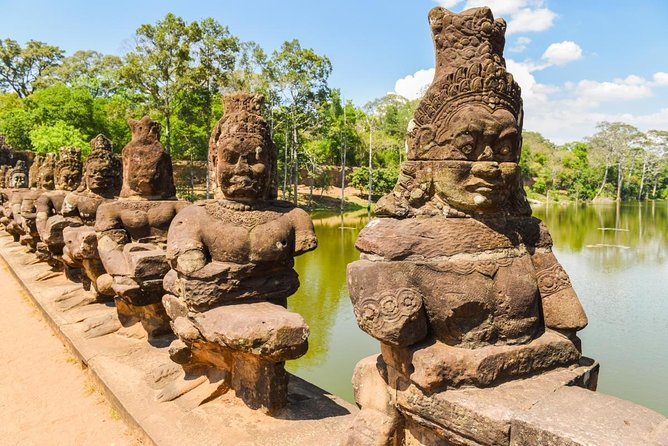
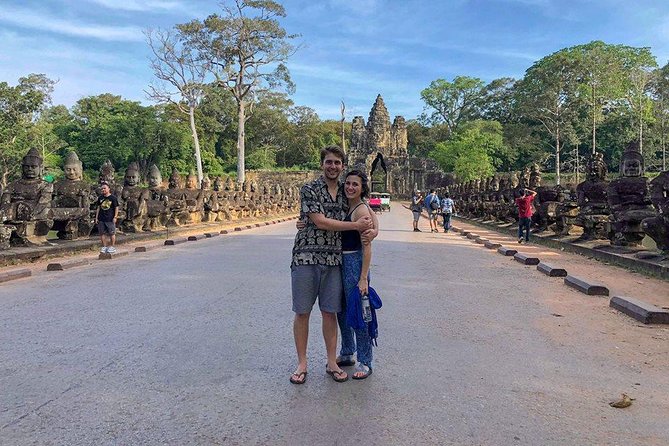
The tour makes a short, 15-minute stop at the Victory Gate of Angkor Thom for photographs. It is a small part of the day, but it gives you a sense of the fortified city that once surrounded Bayon and other important structures.
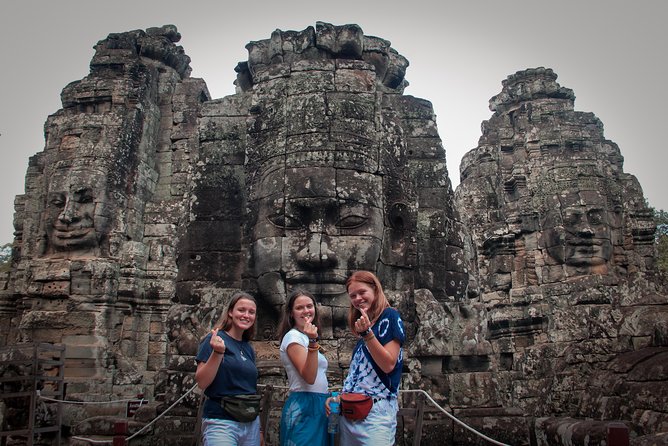
Next comes Bayon Temple, with about 45 minutes for the visit. Bayon is known for its serene carved faces, which look out from the temple’s towers in several directions. The faces are often associated with King Jayavarman VII, the ruler linked to the temple’s construction and to Mahayana Buddhist building projects.
The supplied description also identifies Bayon as a surviving monastery that served worship, education, and administration. That makes the monument easier to understand. It was not simply a ceremonial pile of stones. It had religious and public functions within a large royal center.
Forty-five minutes is enough for an introduction, especially with a guide pointing out the main features. It is not enough to inspect every carving or explore Angkor Thom at length. If Bayon is your main interest, a private or longer temple tour may suit you better.
The short Angkor Thom stop and Bayon visit are useful for first-time visitors who want the major highlights in one morning. The tradeoff is obvious: you gain variety, but each site receives a limited amount of time.
What the shared transport adds
The tour uses an air-conditioned car or minivan, with hotel pickup and drop-off. That matters in Siem Reap, where the heat can become tiring even during an early start. Free bottled water and cool towels are provided in the vehicle, and several people specifically valued having multiple bottles during the day.
The maximum group size is 10. That does not make the outing private, but it should feel more manageable than a large bus group. You will still need to follow a shared schedule, wait for others, and accept the guide’s planned order of stops.
The transport also keeps the day simple. You do not need to arrange separate rides to the ticket office, temple park, breakfast village, and hotel. For $23, that package offers solid value, especially for a solo visitor or couple who wants a guide without paying private-tour rates.
There is one small point to clarify before departure: the description refers to air-conditioned transport, while one account mentions a tuk-tuk driver on a related temple visit. The specific vehicle may vary, even though the advertised service is a car or minivan. Confirm the transport arrangement if air-conditioning is important to you.
The real price, including the Angkor Pass
The tour price is $23 per person. That is a low cost for roughly eight hours of transport, guiding, breakfast, water, towels, and hotel transfers. The group format helps keep the price down, while the small maximum group size makes it more appealing than a budget coach excursion.
The Angkor Pass costs an additional $37 per person. That brings the basic cost to $60 before lunch or extra drinks. You should use that full figure when comparing this tour with a private car, tuk-tuk, or multi-day pass arrangement.
For a first visit, I think the value is strong if you want the classic morning route. You receive an experienced English-speaking guide, and the guides praised in the feedback were especially good at explaining history and mythology in clear language. Several also helped with photographs and shared details about Cambodian community life.
The price is less attractive if you already have transport, already hold a valid pass, or prefer to spend several hours at one temple. In that case, the fixed shared schedule may feel restrictive.
Who will enjoy this morning most
I would recommend this tour to a first-time visitor with limited time in Siem Reap. It covers the three temples most people hope to see, adds a breakfast stop, and removes the stress of arranging early transport.
It also suits solo visitors who want company and a guide. The group limit of 10 keeps the social setting fairly small, while the included hotel transfer makes the early departure easier to manage.
History and temple enthusiasts should appreciate the explanations of Cambodian history, mythology, religion, and local customs. The strongest guide feedback centers on clear communication, detailed introductions, and stories that connect the monuments to Cambodian life.
You may want a different plan if you dislike early starts, need a private pace, or want to see less familiar temples beyond the standard highlights. Families should also consider how children will handle a pickup before 5 a.m. The activity states that most people can participate, but it does not provide a detailed accessibility description.
The tour is normally booked about nine days ahead. That suggests planning before your trip, especially if your dates are fixed. Free cancellation is available until 24 hours before the start time. Changes or cancellations inside that window are not accepted, and poor weather or failure to reach the minimum group size can lead to a new date, an alternative experience, or a full refund.
Should you book the Angkor Wat sunrise tour?
Book it if you want the essential Angkor experience in one organized morning: sunrise at Angkor Wat, breakfast at Srah Srang, tree-covered Ta Prohm, and Bayon’s stone faces. At $23 plus the $37 pass, it offers a practical way to see the major sites with transport and an English-speaking guide.
Skip it if you want long, quiet visits, a private guide, or a less familiar temple route. Also skip it if you know you will resent a pre-dawn pickup. For most first-time visitors who can handle the early alarm, the combination of famous monuments, local breakfast, helpful guides, and simple transport makes this a sensible introduction to Siem Reap.
FAQ
What time is hotel pickup?
Pickup is scheduled between 4:30 and 5:00 a.m. The exact pickup time depends on your hotel and the day’s arrangements.
Is the Angkor Pass included?
No. The Angkor Pass costs $37 per person and is paid separately from the $23 tour price.
How long does the experience last?
The experience lasts approximately eight hours, including temple visits, breakfast, transport, and hotel or Old Market drop-off.
What temples are included?
The route includes Angkor Wat, Ta Prohm, and Bayon Temple. It also includes a photo stop at the Victory Gate of Angkor Thom.
Is breakfast included?
Yes. Breakfast is included and takes place in a village near Srah Srang. Lunch and beverages are not included.
How many people can join the group?
The activity has a maximum of 10 participants. It is a shared tour rather than a private excursion.
More Morning
- Angkor Wat Sunrise & 3 Main Temples with Breakfast – Small Group
★ 5.0 · 2,857 reviews - Siem Reap: Angkor Wat Sunrise and Full-Day Sightseeing Tour
★ 4.9 · 2,828 reviews - Angkor 2-Day Sunset & Sunrise Small-Group Tour
★ 5.0 · 2,567 reviews - Siem Reap: Angkor Wat Sunrise or Sunset Guided Tour
★ 4.9 · 2,123 reviews
Just added around Siem Reap
- Private Battambang Full-Day Guided Tour★ 4.5 · 3 reviews
- Kulen Mountain, Beng Mealea and Banteay Srei Full Day Tour★ 5.0 · 3 reviews
- Kompong Pluk Tour★ 5.0 · 3 reviews
- Private 3 Day Tour to Discover the ancient temples★ 5.0 · 3 reviews
- Kulen National Park Ticket -Waterfall & 1000 Lingas★ 5.0 · 3 reviews
- Cambodia: Absolute Traditional Dance Show with Buffet Dinner★ 5.0 · 3 reviews
- Border Transfer (Siem Reap to Laos/Laos to Siem Reap)★ 3.5 · 3 reviews
- Beng Melea, Rolous Group & Kompong Phluk Floating Village★ 5.0 · 3 reviews
Angkor Wat Sunrise Tours, compared.

Angkor Wat Sunrise or Sunset Tour with Guide from Siem Reap
Read our review →
Angkor Wat Sunrise tour with Small – Group and Guide tours
Read our review →
Full-Day Angkor Wat Sunrise Private Tour with Guide from Siem Reap
Read our review →
Angkor Wat Sunrise & 3 Main Temples with Breakfast – Small Group
Read our review →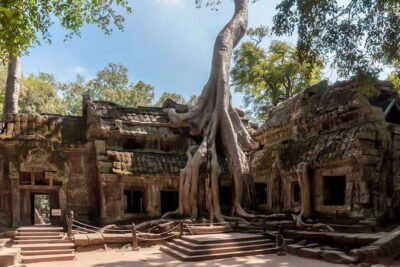
Angkor Wat Sunrise and Full-Day Sightseeing Tour
Read our review →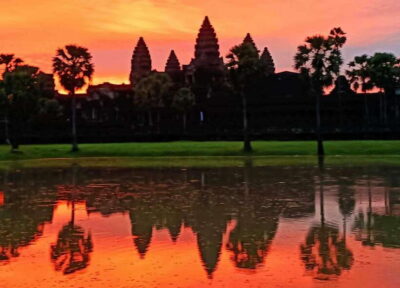
Siem Reap Tour: Angkor Wat Sunrise, Bayon, Ta Prohm, Banteay Srei
Read our review →
Angkor Wat Sunrise Explore The Most Iconic Temples
Read our review →Browse the lists this tour appears in