
Reviewed · TOURS
Siem Reap: Angkor Temples Off-Track Bicycle Tour
The quiet paths are the real prize. This eight-hour bicycle tour trades the busiest Angkor routes for jungle tracks, smaller temples, and a local guide who explains both Khmer culture and the Angkorian Empire. I like the small group, limited to seven people, and the fact that its profits support free education through KKO, the Khmer for Khmer Organisation.
I also like the thoughtful local spending: lunch comes from a local restaurant, while the tour supports farms and street vendors. The main consideration is simple: you need to ride a bicycle for much of the day, sometimes on off-road paths, and the temple schedule gives you a full day in the heat.
In This Review
- Key points at a glance
- Why a bicycle is a smart way to see Angkor
- Starting at Bayon Pastry School at 8:30
- Angkor Wat’s outer view before the smaller roads
- South Gate of Angkor Thom and Bayon
- Preah Palilay and the village of Angkor Thom
- Lunch at a local jungle restaurant
- Preah Khan, a larger temple with breathing room
- Ta Nei, the quietest temple stop
- Ta Keo before the ride back
- What the $65 price really includes
- Clothing, fitness, and the practical points
- Who should choose this bicycle tour?
- Should you book the off-track Angkor bicycle tour?
- FAQ
- How long does the bicycle tour last?
- How much does the tour cost?
- Where does the tour start and finish?
- What time should I arrive?
- Is the Angkor Pass included?
- Is lunch included?
- How many people can join the group?
- What languages are available?
- What should I bring and wear?
- Can the tour accommodate vegan food or a different schedule?
Key points at a glance
- Quiet jungle riding: Use smaller paths away from the busiest temple approaches, with stops at Preah Khan, Ta Nei, Preah Palilay, and Ta Keo.
- A compact group: The tour accepts no more than seven participants, giving the guide room to adjust the pace.
- A useful Angkor mix: See the South Gate of Angkor Thom, Bayon, Angkor Wat, and several less-visited temples in one day.
- A social purpose: Tour profits support free education and vocational training through KKO.
- Local lunch included: Take a midday break at a local restaurant in the jungle, with vegan food available if requested.
- Flexible planning: The operator can discuss a shorter or longer route, a different start time, or food needs before the tour.
Why a bicycle is a smart way to see Angkor

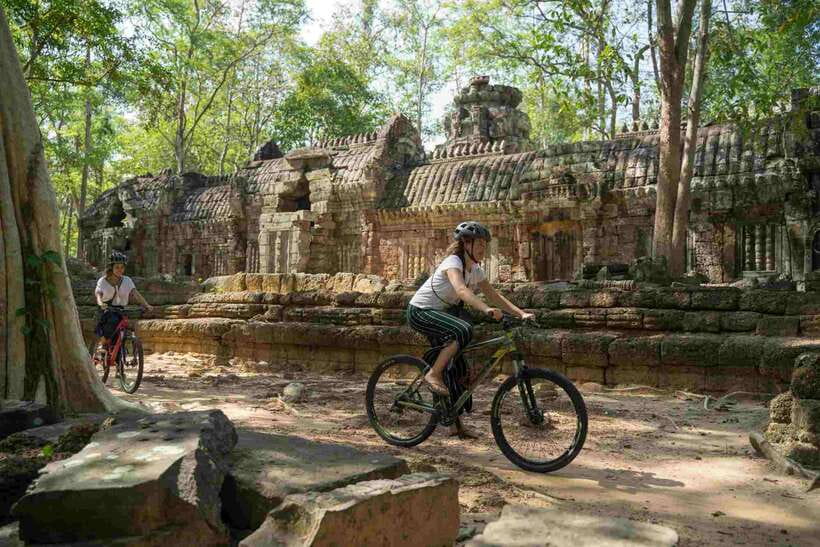
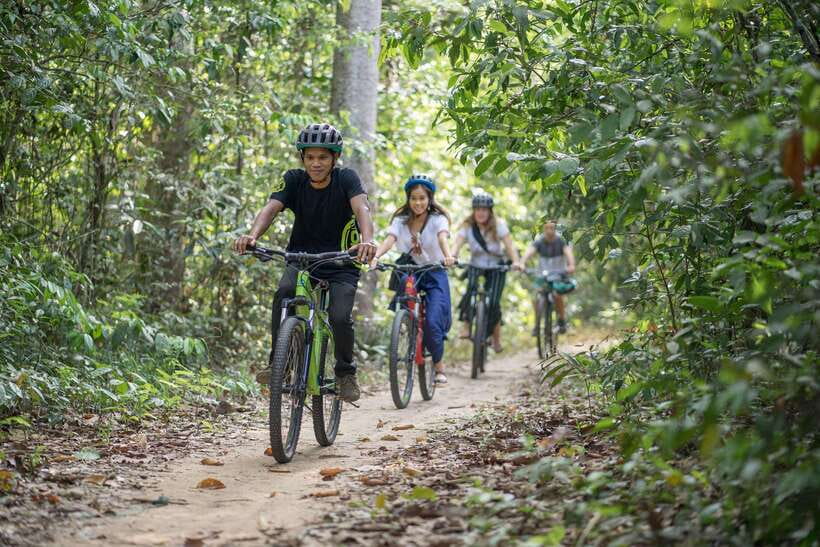
Angkor is enormous. Temple hopping by car or tuk-tuk gets you from one major site to another, but cycling gives you a better sense of the space between them. Here, the route uses jungle paths and smaller tracks, so the journey is part of the sightseeing rather than dead time between monuments.
That matters most around the quieter temples. You get shade, forest sounds, and a slower approach before the stonework appears. The paths also help the tour avoid some of the traffic and crowds found at the best-known sites, though you should not expect every stop to be empty.
The bikes are described as quality bicycles, and the operator carries a first-aid kit with an emergency safety plan. Your guide can adapt to the group, a point praised repeatedly in the feedback. One French participant described the guide as patient, attentive, and willing to match the ride to different abilities. That makes this a gentler option for many regular cyclists, but it is not suitable if you cannot ride a bike.
A few more trips worth weighing up
- Angkor Wat Sunrise or Sunset Tour with Guide from Siem Reap
★ 5.0 · 12,109 reviews - Siem Reap: Angkor Wat: Small-Group Sunrise or Sunset Tour
★ 5.0 · 9,444 reviews - From Siem Reap: Kampong Phluk Floating Village Tour by Boat
★ 4.9 · 6,979 reviews
Starting at Bayon Pastry School at 8:30
Your meeting point is Bayon Pastry School in Siem Reap, where you meet the guide at 8:30 am. The opening briefing covers the day ahead before you set off toward Angkor Park.
This is a useful meeting point for a tour with a social mission. If you have spare time, KKO’s school is worth adding to your Siem Reap plans, since the tour’s profits help fund free education and vocational training. One participant found a school visit added meaning to the day, turning the social purpose from an abstract promise into something easier to understand.
The exact pace can vary. The guide is expected to adjust to the group, and the operator invites you to ask about changing the length of the route or arranging a different start time. If early mornings are difficult for you, say so when booking rather than assuming the standard schedule will change automatically.
Angkor Wat’s outer view before the smaller roads
The route includes a stop connected with Angkor Wat, described as exploring the wall and taking a photo stop. This is not presented as a full, extended visit inside the central temple complex, so you should book this ride for the wider Angkor experience rather than as your only detailed Angkor Wat tour.
That limited stop can work well. Angkor Wat is often the place where visitors spend the most time, while the rest of the park receives less attention. This tour uses the famous temple as one piece of a larger day, then moves toward roads and paths that lead to other parts of the park.
Bring your camera, but keep it protected from dust and occasional rough sections of track. Sunscreen and insect repellent are also on the recommended packing list. You will have more fun if you treat the bicycle ride as an active outdoor day, not simply as a series of polished temple courtyards.
South Gate of Angkor Thom and Bayon
The ride continues through the jungle toward the South Gate of Angkor Thom. This is one of the day’s strongest visual approaches, with the gate and its sculpted figures providing an immediate sense of the scale and symbolism of the old Khmer capital.
From there, you visit Bayon Temple, the most famous major temple on this route after Angkor Wat. Bayon is known for its large stone faces, and it is also one of the more popular stops in Angkor Park. The tour cannot promise solitude here, but reaching Bayon by bicycle and then moving on to a smaller temple helps balance the busy and quiet parts of the day.
Plan for roughly an hour around Angkor Thom as a broad guide, though the exact time at each site can shift. The guide gives context about the temples and Khmer culture, which is important at Bayon because the carvings and faces can otherwise become a quick photo stop without much meaning.
If time allows, the guide may add Preah Palilay, a small temple within Angkor Thom. This is one of the route’s useful touches. It shows that the day is not limited to the best-known monuments, although the stop depends on timing and should not be treated as guaranteed.
A completely different kind of day out from Siem Reap:
- Sunset tour of Kampong Phluk stilts home village on the Tonle Sap
★ 5.0 · 4,865 reviews - Siem Reap: Angkor Wat 2-Day Tour with Sunrise and Sunset
★ 4.9 · 4,429 reviews - Siem Reap: Kampong Phluk Floating Village Tour with Boat
★ 4.9 · 3,843 reviews - Siem Reap: Full-Day Angkor Wat Guided Tour with Sunset
★ 4.9 · 3,803 reviews
Preah Palilay and the village of Angkor Thom
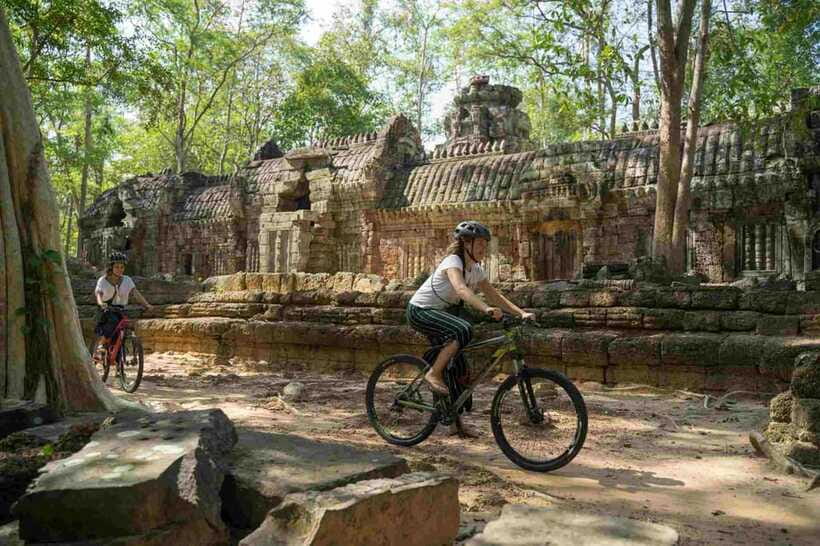
The experience also includes a visit to the village of Angkor Thom. That gives you a look beyond monumental stone buildings and royal roads, bringing local life into a day that could otherwise focus only on ancient architecture.
The supplied details do not specify how long you spend in the village or exactly what activities take place there. I would think of it as a brief local encounter along the route, not a separate village tour. The point is the contrast: temple walls tell one part of Cambodia’s story, while present-day village life shows how people use the same area now.
Preah Palilay is especially suitable for that quieter mood. If it appears in your schedule, expect a smaller-scale stop rather than another Bayon-sized monument. The guide’s explanations matter here because less famous sites do not always explain themselves at a glance.
Lunch at a local jungle restaurant

Lunch is included at a local restaurant in the jungle. That is practical after several hours on a bicycle, and it keeps some spending with local businesses rather than making the tour entirely dependent on large tourism operations.
You can request vegan food. The operator also says it can take care of other needs if you communicate them in advance. I would make any food request before the morning of the tour, especially if your diet is strict.
The setting is part of the appeal, but it also means you should expect a simple local meal rather than a formal restaurant service. The information provided does not specify the menu, so do not book expecting a named dish or a fixed selection. The value is the break, the local setting, and the fact that lunch is already included in the $65 price.
Preah Khan, a larger temple with breathing room
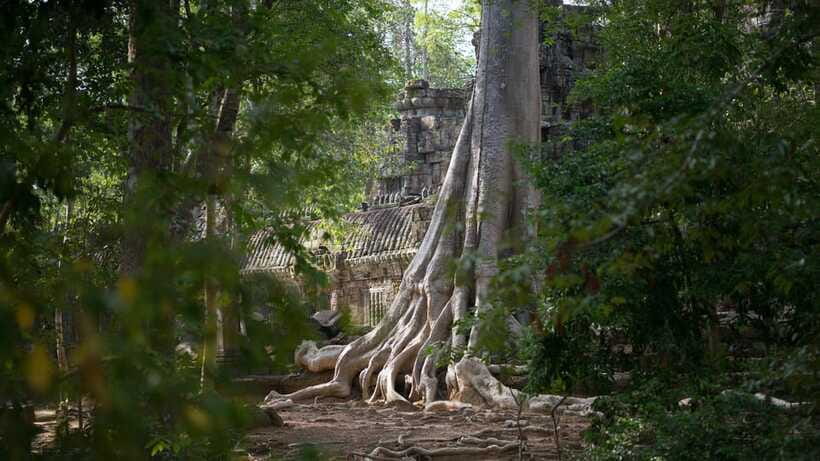
After lunch, the route heads through the jungle to Preah Khan. This temple is larger and more established than Ta Nei, and the route description notes that a few other people may be present. It is less crowded than Bayon, but not an isolated stop.
Preah Khan works well in the afternoon because it gives you a substantial temple after the lunch break. You can expect time for photographs, a guided visit, and more explanation of the site’s place in the Angkorian Empire.
The main drawback is energy. By this point, you have already cycled for hours and visited several temples. The guide’s ability to adjust the pace becomes important, especially if the heat is strong or the paths are soft. Quality bicycles help, but no bicycle makes an eight-hour outdoor day effortless.
Ta Nei, the quietest temple stop
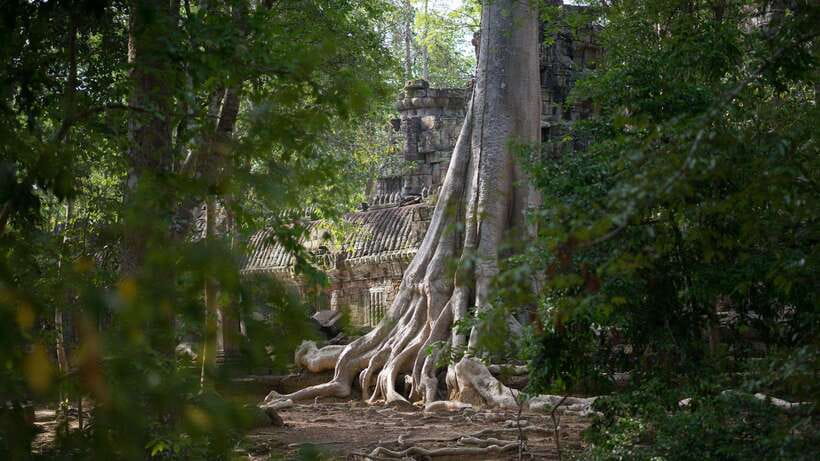
Ta Nei is often called the Ghost Temple because it is tucked away in the jungle and receives far fewer visitors. Of all the stops, this may best match the tour’s off-track promise.
Its appeal is not only the stonework. It is the approach through the trees, the quiet, and the feeling of reaching a place that sits away from the main flow of Angkor sightseeing. I would give this stop extra weight when deciding if the tour suits you. If you want the standard highlights with minimal physical effort, a vehicle-based temple circuit may be easier. If you like the journey and atmosphere around a monument, Ta Nei is a strong reason to choose this ride.
Because it is remote and quiet, the site may feel less polished or immediately easy to understand than Bayon. That is where the guide helps. English and Cambodian are offered, and the guide is expected to explain the temple and answer questions about Cambodian culture and history.
Ta Keo before the ride back
Ta Keo is the final temple stop before returning to town. Its inclusion gives the day another major architectural point after the smaller jungle sites.
The supplied details do not promise a climb or a fixed length of visit, so your experience here depends on the guide, the day’s timing, and the group’s energy. By the final stop, you may be ready for a shorter visit and the return ride. That is not a flaw in the route so much as a reminder that this is a full-day bicycle outing.
The tour then returns to Bayon Pastry School. The full duration is about eight hours, with the route covering Angkor Thom, Bayon, an optional smaller temple such as Preah Palilay, Preah Khan, Ta Nei, Ta Keo, and an Angkor Wat photo stop.
What the $65 price really includes
At $65 per person, this is not the cheapest way to see Angkor. You still need to buy your own Angkor Pass, and travel insurance is not included. The price makes more sense when you count the local guide, bicycle, lunch, small group, jungle route, and social contribution together.
The group limit of seven is a real benefit. A large cycling group can become slow and awkward on narrow paths, while a small group gives the guide more room to answer questions and respond to different riding speeds.
The non-profit model also affects the value. All profits go to KKO, which provides free education to children in Siem Reap and supports vocational training. The tour also directs business toward local restaurants, farms, and street vendors. You are paying for a service, but your money also supports a local education project rather than only a commercial operator.
That does not make the tour automatically right for everyone. If your priority is the lowest price, the longest possible Angkor Wat visit, or a private air-conditioned transfer, spend your money elsewhere. If you want active sightseeing and a clearer local benefit, the cost is reasonable.
Clothing, fitness, and the practical points
The clothing rules are important. Do not wear shorts, short skirts, or sleeveless shirts. Dress for temple visits with covered shoulders and knees, while choosing light clothing that works for cycling.
Use sunscreen and insect repellent, and bring a camera. The paths run through jungle areas, so these are not decorative suggestions. Water is not listed among the inclusions, so confirm your own drinking-water arrangements before setting out.
You should be comfortable riding a bicycle for a substantial part of the day. The operator says the guide can adapt to the group, and one French participant found the ride manageable because the guide adjusted to individual needs. Still, adaptation does not remove the heat, distance, or off-road surfaces.
The tour is offered in English and Cambodian. It includes a live guide, not a self-guided route. That is valuable at smaller temples where you may otherwise see attractive stones without understanding what you are looking at.
Free cancellation is available up to 24 hours before departure for a full refund, and you can reserve now and pay later. Those terms help if your Siem Reap plans are still shifting, but you should still check the current availability and start time when booking.
Who should choose this bicycle tour?
I would recommend it most strongly to you if you:
- Enjoy cycling and want the ride itself to be part of the day.
- Prefer smaller paths and quieter temples to a rapid major-site checklist.
- Want a small group with a guide who can respond to your pace.
- Care about supporting education and local businesses.
- Have enough time for an eight-hour outing.
- Are willing to follow temple clothing rules and prepare for sun and insects.
I would be more cautious if you dislike bicycles, tire easily in hot weather, or want a detailed, unhurried visit inside Angkor Wat. The route covers many places, so some individual stops may be shorter than they would be on a private temple tour.
Should you book the off-track Angkor bicycle tour?
Book it if you want Angkor to feel like a place you travel through, not just a row of famous monuments. The combination of South Gate, Bayon, Preah Khan, Ta Nei, Ta Keo, village scenery, jungle paths, and a local lunch gives you a broad day with both major and lesser-known sites.
The strongest reasons are the guide’s flexible approach, the seven-person limit, and the direct support for KKO’s free education work. The clearest warning is the physical commitment. You need to ride, dress appropriately, and accept that the day may leave you tired.
For an active visitor with one full day to spare, $65 is a fair price, especially with lunch and the social purpose included. If that sounds like your kind of Angkor day, this is a worthwhile choice. If not, choose a shorter temple visit and save your legs for Siem Reap’s night markets.
FAQ
How long does the bicycle tour last?
The tour lasts eight hours.
How much does the tour cost?
The price is $65 per person.
Where does the tour start and finish?
The tour starts and finishes at Bayon Pastry School in Siem Reap.
What time should I arrive?
The stated meeting time is 8:30 am.
Is the Angkor Pass included?
No. The Angkor Pass is not included in the tour price.
Is lunch included?
Yes. Lunch at a local restaurant in the jungle is included.
How many people can join the group?
The tour is limited to seven participants.
What languages are available?
The live guide is available in English and Cambodian.
What should I bring and wear?
Bring a camera, sunscreen, and insect repellent. Shorts, short skirts, and sleeveless shirts are not allowed.
Can the tour accommodate vegan food or a different schedule?
Yes. The operator says it can arrange vegan food and discuss a shorter or longer tour. It also says you can request a different start time, including if waking early is difficult. Make requests in advance.
Just added around Siem Reap
- Private Battambang Full-Day Guided Tour★ 4.5 · 3 reviews
- Kulen Mountain, Beng Mealea and Banteay Srei Full Day Tour★ 5.0 · 3 reviews
- Kompong Pluk Tour★ 5.0 · 3 reviews
- Private 3 Day Tour to Discover the ancient temples★ 5.0 · 3 reviews
- Kulen National Park Ticket -Waterfall & 1000 Lingas★ 5.0 · 3 reviews
- Cambodia: Absolute Traditional Dance Show with Buffet Dinner★ 5.0 · 3 reviews
- Border Transfer (Siem Reap to Laos/Laos to Siem Reap)★ 3.5 · 3 reviews
- Beng Melea, Rolous Group & Kompong Phluk Floating Village★ 5.0 · 3 reviews
Tours, compared.

Angkor Wat Sunrise or Sunset Tour with Guide from Siem Reap
Read our review →
Angkor Wat: Small-Group Sunrise or Sunset Tour
Read our review →
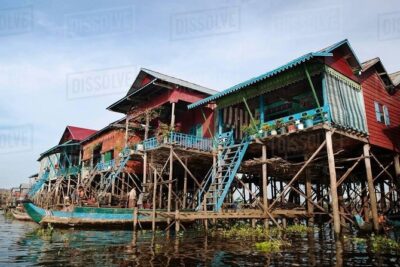
Sunset tour of Kampong Phluk stilts home village on the Tonle Sap
Read our review →
Angkor Wat 2-Day Tour with Sunrise and Sunset
Read our review →
Kampong Phluk Floating Village Tour with Boat
Read our review →
