
Reviewed · ANGKOR WAT TOURS
Siem Reap: Angkor Wat Tour Explore The Most Iconic Temples
Angkor rewards an early start. This private eight-hour tour gives you a clear route through Siem Reap’s best-known temples, beginning with sunrise at Angkor Wat and continuing to quieter Banteay Kdei, root-covered Ta Prohm, Ta Keo, Bayon, and Angkor Thom’s South Gate. I like the private transport, which lets you move at your own pace, and I like the small touches: chilled bottled water and cool towels matter when the Cambodian heat begins to bite. The main consideration is cost: the $24 price covers up to two people, but your Angkor temple pass and meals cost extra.
I also like the mix of famous sights and less visited corners. Ta Prohm and Bayon deliver the big visual moments, while Banteay Kdei offers slower corridors and fewer distractions. Drivers such as Ray, Chamrong, Lay, Soka, Danny, and Lai have earned praise for being punctual, helpful, and attentive. Still, you should confirm whether your booking includes a formal temple guide or mainly an English-speaking driver, since the description emphasizes transport and driver assistance.
In This Review
- Key points to know before booking
- Why this eight-hour route works
- Starting before sunrise at Angkor Wat
- Inside Angkor Wat, scale and detail
- Banteay Kdei brings a quieter pause
- Ta Prohm and the famous tree roots
- Ta Keo, the unfinished pyramid
- Bayon’s stone faces at Angkor Thom
- The South Gate and Angkor Thom’s causeway
- Transport, timing, and the human side of the tour
- Heat, clothing, and practical comfort
- Sunset at Phnom Bakheng
- Who will get the most from this tour?
- Should you book it?
- FAQ
- How long does the Angkor Wat tour last?
- How much does the tour cost?
- Is hotel pickup included?
- Is the tour private?
- Is sunrise included?
- Which temples are included?
- Do I need to buy an Angkor Temple Pass?
- What should I wear?
- Is the tour wheelchair accessible?
Key points to know before booking
- Sunrise begins at Angkor Wat: An early pickup gets you to the moat and western entrance before the main crowds gather.
- The route covers seven major stops: You visit Angkor Wat, Banteay Kdei, Ta Prohm, Ta Keo, Bayon, and the South Gate of Angkor Thom, with sunset at Phnom Bakheng noted as another possible point.
- Private transport is the strong suit: The $24 rate is for a group of up to two, with hotel pickup, drop-off, water, and cool towels included.
- Banteay Kdei adds a quieter temple: Its half-ruined Buddhist monastery setting gives the day a calmer pause between larger monuments.
- Ta Prohm and Bayon are the photo stars: Giant roots, jungle ruins, and serene stone faces provide the most memorable images.
- The temple pass is separate: Bring cash and budget for your Angkor admission before the tour begins.
Why this eight-hour route works
Angkor is not one temple. It is a vast archaeological park with monuments spread across roads, forest, moats, and old city walls. Seeing it by private vehicle saves you from arranging each transfer yourself, and it gives you a place to return to between temples.
The route is also sensibly varied. Angkor Wat gives you scale and detail. Banteay Kdei slows the pace. Ta Prohm supplies the jungle drama. Ta Keo changes the mood with its steep, unfinished stone pyramid. Bayon finishes the main temple circuit with its famous faces, and the South Gate provides a strong final photo stop before returning to Siem Reap.
At $24 per group of up to two, the transport cost is appealing. Split between two people, it works out to $12 each before the temple pass and food. For a solo visitor, it is less of a bargain, but the private setup still has value if you want a dedicated pickup and a driver waiting while you explore.
The price does not include the Angkor Temple Pass. That is the key extra expense, and you need a valid pass to enter the temples. Meals are also on your own, so bring cash for food and any stops you choose to make.
More Angkor Wat tours we have reviewed:
- Angkor Wat Sunrise or Sunset Tour with Guide from Siem Reap
★ 5.0 · 12,109 reviews - Siem Reap: Angkor Wat: Small-Group Sunrise or Sunset Tour
★ 5.0 · 9,444 reviews - Siem Reap: Angkor Wat 2-Day Tour with Sunrise and Sunset
★ 4.9 · 4,429 reviews
Starting before sunrise at Angkor Wat
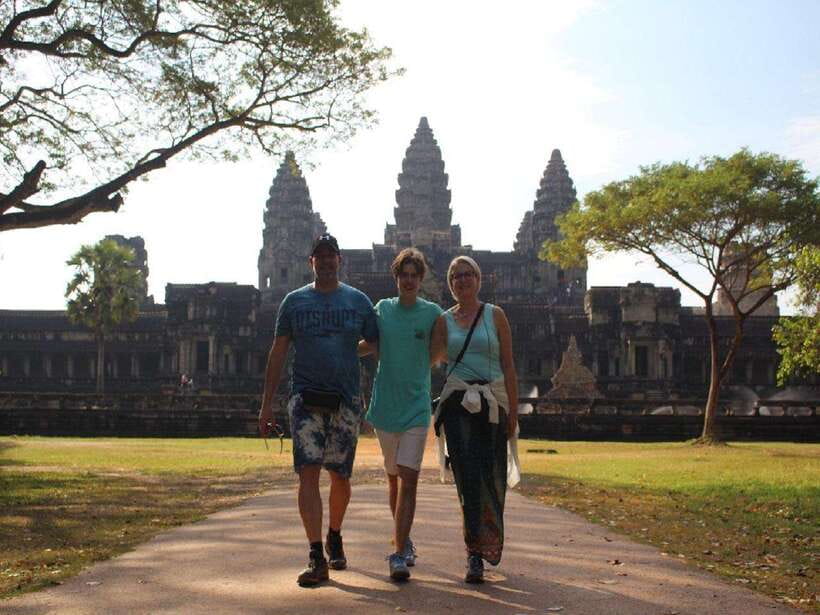
If you choose the sunrise option, pickup begins early from your Siem Reap hotel or accommodation. The driver takes you to buy your temple pass, then continues toward Angkor Wat through the western entrance, described as a quieter approach.
Sunrise is the right opening here. Angkor Wat’s five towers appear beyond the moat, and their reflection can make a calm morning scene. The best-known view is also the busiest, so arriving early gives you a better chance to find a comfortable place before the crowds thicken.
Do not treat sunrise as the whole Angkor Wat visit. The colors over the towers are brief, while the temple itself needs time. After the sky brightens, you continue inside for galleries, courtyards, carvings, and the central sanctuary.
Inside Angkor Wat, scale and detail
Angkor Wat was built as a Hindu temple dedicated to Vishnu and later became a Buddhist site. That change is visible in the monument’s religious layers, but you do not need to be an expert to appreciate the design.
The long galleries contain detailed bas-reliefs connected with Hindu mythology. Look closely rather than rushing from one photograph to the next. The carvings reward patience, especially when you compare the repeated figures, scenes, and patterns along the walls.
The central sanctuary gives the temple its height and power. You will walk, climb, and cross uneven stone, so comfortable shoes are essential. Covered shoulders and knees are required, not just suggested. A light, respectful outfit also makes the early heat easier to handle.
Angkor Wat can feel crowded even after sunrise. The benefit of private transport is that your driver remains outside with the vehicle while you spend the time you need inside. The limitation is that the supplied information does not promise a dedicated historian at every stop. Some drivers provide explanations and directions, while others focus mainly on transport.
Banteay Kdei brings a quieter pause
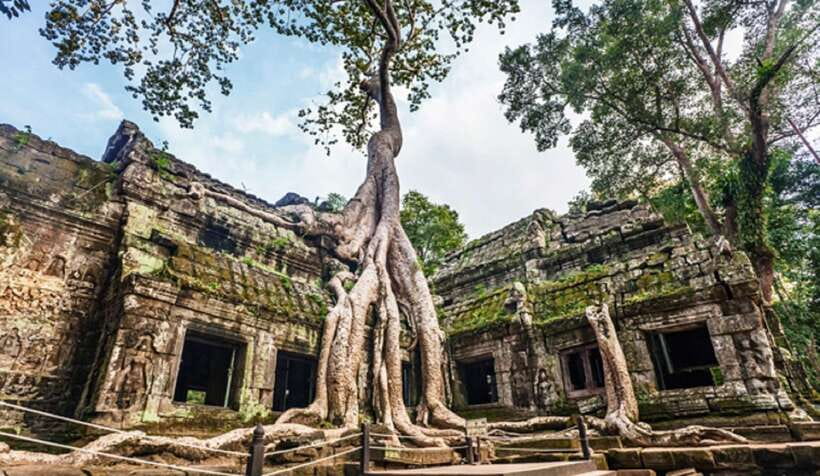
Banteay Kdei means Citadel of Chambers, and the name fits. Its late 12th-century Buddhist monastery layout gives you corridors, chambers, carvings, and partially ruined sections rather than one overpowering central view.
This is one of the most useful stops on the route because it breaks up the famous-temple sequence. After the scale of Angkor Wat, Banteay Kdei feels more intimate. The damaged stone and quiet passages create a peaceful, slightly mysterious mood.
You should not expect the same level of grandeur as Angkor Wat or Bayon. That is the point. If you like abandoned corners, worn carvings, and a slower walk, this temple may become one of your favorites. If you want only the most dramatic monuments, you may spend less time here.
A few more trips worth weighing up
- From Siem Reap: Kampong Phluk Floating Village Tour by Boat
★ 4.9 · 6,979 reviews - Sunset tour of Kampong Phluk stilts home village on the Tonle Sap
★ 5.0 · 4,865 reviews - Siem Reap: Kampong Phluk Floating Village Tour with Boat
★ 4.9 · 3,843 reviews - Siem Reap: Full-Day Angkor Wat Guided Tour with Sunset
★ 4.9 · 3,803 reviews
Ta Prohm and the famous tree roots
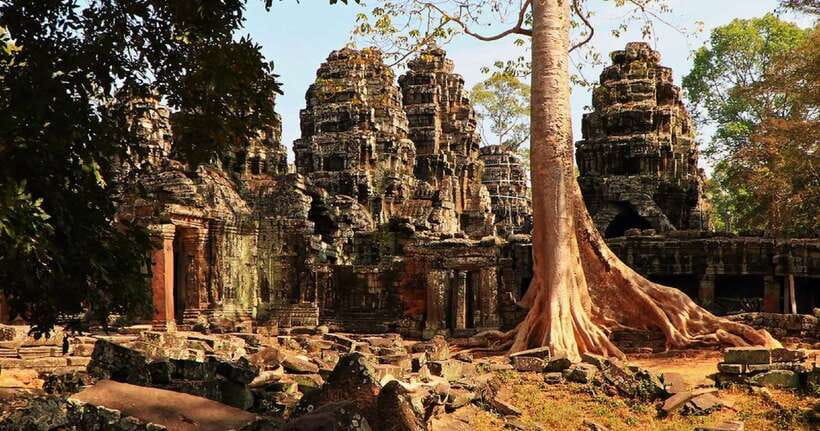
Ta Prohm is the temple most likely to match the picture you had in mind before arriving in Cambodia. Huge tree roots spread across walls and doorways, while stone galleries disappear into the surrounding greenery.
The temple was left largely unrestored, which gives it the jungle-temple look made famous by Tomb Raider. It is highly photogenic, but fame has a price. This is one of the busiest stops, and narrow passages can become slow when groups gather for photos.
Your driver waits outside while you walk through the ruins. That arrangement is especially useful here because you can take your time with the root-covered sections without worrying about finding another ride afterward. Rachel’s driver was also praised for practical warnings about monkeys, questionable guides, and tricky temple footing. Those reminders are worth taking seriously.
Keep your hands off the trees and stone. Watch where you step, especially around broken masonry and uneven paths. Ta Prohm is not a polished museum. Its charm comes from the meeting of living roots and old stone, but that also means care is needed.
Ta Keo, the unfinished pyramid
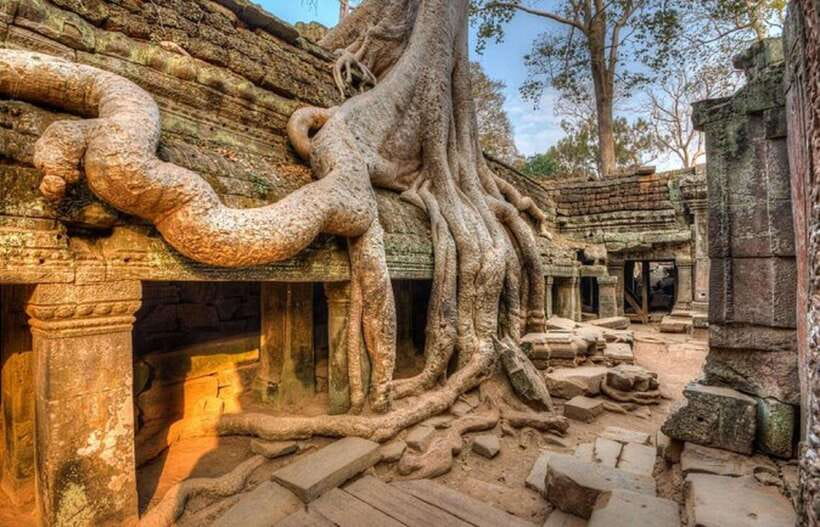
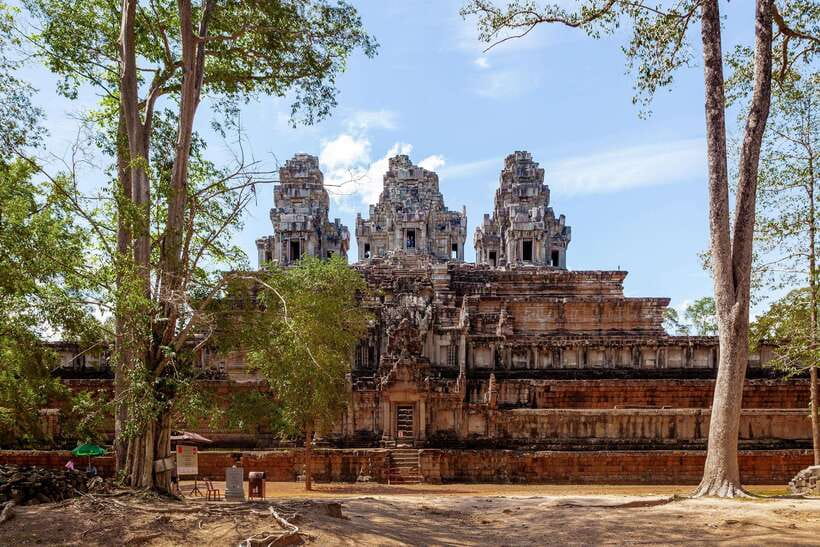
Ta Keo offers a different kind of temple experience. Built during the late 10th to early 11th century by King Jayavarman V and continued by later rulers, it was never fully completed.
The unfinished state changes what you notice. Instead of focusing only on delicate carvings, you see the temple’s strong structure, steep levels, and plain stone surfaces. It feels more like a massive architectural plan than a finished religious picture book.
This stop may appeal most to you if you like construction details and unusual historical puzzles. It can be physically demanding because of the temple’s height and uneven terrain. Take your time and do not treat the climb as a race.
Bayon’s stone faces at Angkor Thom
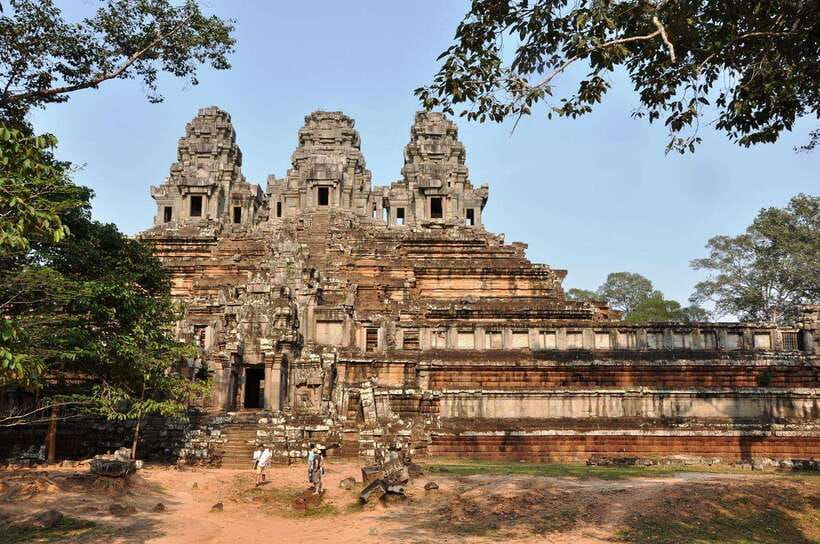
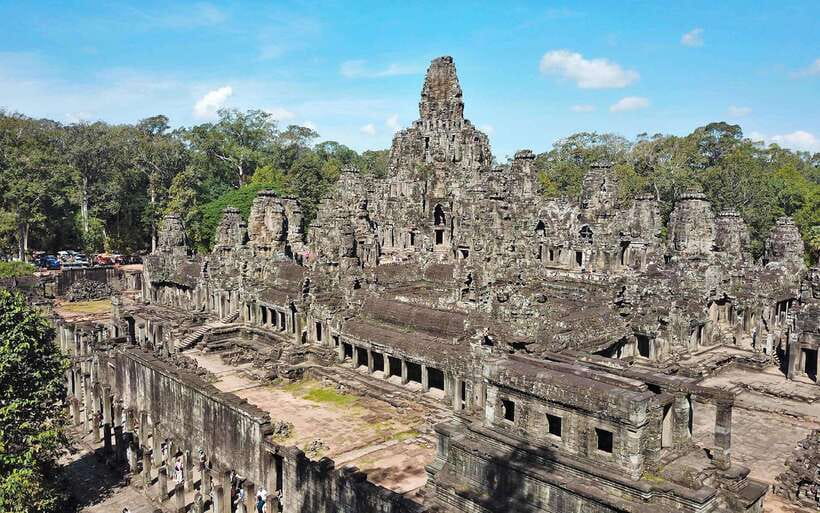
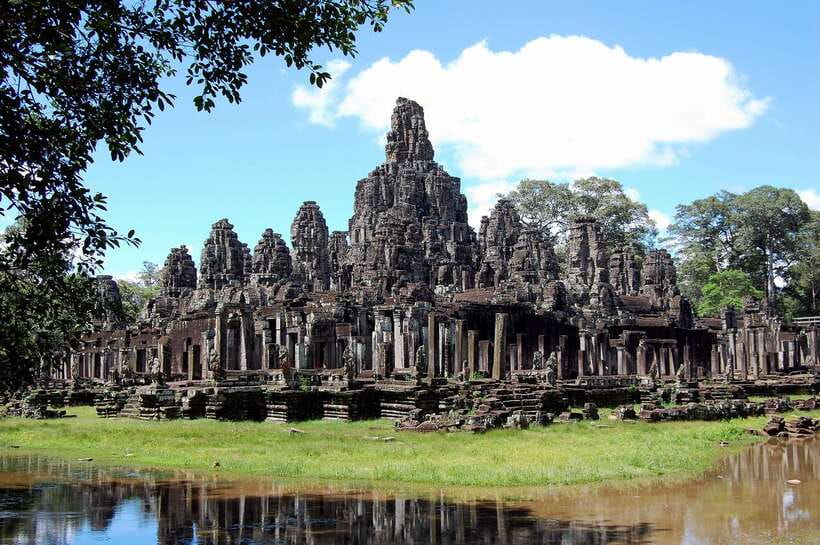
Bayon sits at the center of Angkor Thom and brings the route back to a grand, unforgettable scale. Its towers carry more than 200 serene stone faces, arranged across 54 towers according to the supplied description.
The faces are the main attraction, but the lower galleries deserve attention too. Carvings show scenes of daily life and historical battles, giving the temple a more human quality than a simple postcard view.
Bayon can be confusing to walk through. Towers, galleries, and narrow passages overlap, and it is easy to lose your sense of direction. A driver who gives clear meeting instructions is helpful here. Several highly rated drivers, including Chamrong, Lay, and Soka, were praised for waiting outside temples and helping with directions.
You may find the faces look different depending on the light and angle. Move slowly around the towers rather than stopping at the first obvious viewpoint. This is one place where a few extra minutes can improve the experience.
The South Gate and Angkor Thom’s causeway
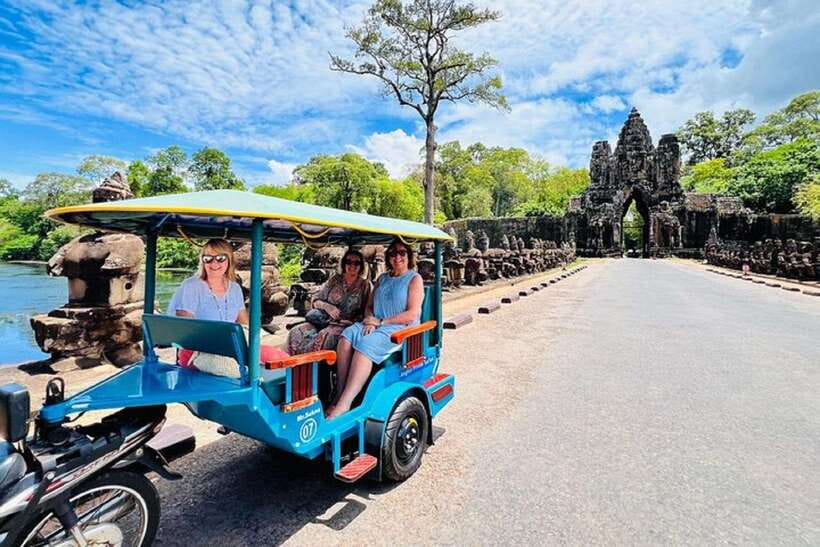
Tonle Om Gate, also called the South Gate of Angkor Thom, is a grand entrance flanked by a causeway lined with statues of gods and demons. The gate itself carries four large stone faces similar to those at Bayon.
This is a short stop, but it helps you understand the scale of Angkor Thom. The causeway, statues, moat, and gate work together as one dramatic approach. It is also a good place for photographs because you can frame the gate from outside rather than trying to capture it from a crowded interior.
The South Gate usually works best as a final stop before the ride back to your accommodation. You get a strong closing image without adding another long temple walk at the end of an already full day.
Transport, timing, and the human side of the tour
The tour lasts eight hours and includes private round-trip transport, hotel pickup and drop-off, unlimited bottled water, and a cool towel. The vehicle may be a tuk-tuk, as several bookings describe, and that can be a pleasant way to move between temples. The breeze helps on hot days, though a tuk-tuk offers less protection from sun and dust than a fully enclosed vehicle.
The driver is listed as English-speaking. The strongest service praise centers on reliability and care. Ray was described as finding the meeting point precisely and offering cold water and jasmine-scented towels. Chamrong was praised for helpful temple tips, local suggestions, and waiting reliably outside each site. Lay, Soka, Danny, and Lai also received warm comments for punctual pickups, assistance, and comfortable service.
That pattern tells you what this tour does best. It removes transport stress. You are not left searching for a tuk-tuk after each temple, and you have someone nearby if you need directions or a short break.
At the same time, you should set your expectations correctly. The experience may be ideal if you already enjoy reading about temples or want a flexible driver-led day. If you want detailed commentary on every carving, ask before booking whether a licensed guide is included. The description identifies the driver as the English-speaking service provider, while some bookings refer to the person as a guide.
Heat, clothing, and practical comfort
Bring sunglasses, sunscreen, and cash. The water and cool towel are welcome, but they do not replace sun protection. Even an early start becomes hot once you are walking across stone courtyards and open causeways.
Wear comfortable walking shoes. The temple terrain is uneven, and Ta Keo in particular can be demanding. Covered shoulders and knees are required at the sacred sites, so avoid planning an outfit that leaves you scrambling for a cover-up at the last minute.
The tour is not wheelchair accessible because of uneven temple terrain. It is also listed as unsuitable for babies under one year and people over 95 years. Pets, alcohol, and drugs are not allowed.
Pickup is described as approximately five minutes before departure, with a message sent one day before the tour. Keep your phone available and make sure the driver has the correct hotel or accommodation details.
Sunset at Phnom Bakheng
Phnom Bakheng is identified as a sunset point, while the main route uses Angkor Wat for sunrise. The supplied schedule does not clearly say that the standard eight-hour temple circuit includes both sunrise and sunset, so you should confirm this before booking if sunset is important to you.
That distinction matters. A sunrise start and a sunset finish can create a very long day, and temple access or timing may affect what is possible. Treat Phnom Bakheng as an optional point to clarify rather than assuming it is automatically part of the listed route.
Who will get the most from this tour?
I would choose this experience if you want the major Angkor temples in one organized day, prefer private transport, and value a friendly driver more than a formal lecture at every monument.
It suits couples especially well because the $24 rate covers up to two people. It also works for first-time visitors who want a sensible introduction without arranging temple transfers themselves. The route gives you the essential visual contrasts: grand Angkor Wat, quiet Banteay Kdei, jungle-covered Ta Prohm, unfinished Ta Keo, expressive Bayon, and the South Gate.
You may want another arrangement if you dislike early mornings, struggle with uneven walking, or need wheelchair access. You should also ask about the guide arrangement if temple history and detailed interpretation are central to your plans.
Cancellation is flexible, with a full refund available when you cancel at least 24 hours ahead. The reserve-now, pay-later option also helps if your Siem Reap schedule is still moving around.
Should you book it?
Book this tour if you want efficient private transport, a sunrise start, and the classic Angkor circuit at a low group price. The strongest evidence of quality is consistent care from drivers: punctual pickups, clear meeting points, waiting outside temples, cold water, and cool towels.
Before paying, confirm three things: the temple pass cost, the type of vehicle, and whether you will have a formal English-speaking guide or an English-speaking driver. If those details match your needs, this is a practical, well-priced way to see Angkor’s essential sights without spending the day negotiating rides.
FAQ
How long does the Angkor Wat tour last?
The tour is valid for eight hours.
How much does the tour cost?
The price is $24 per private group of up to two people. The Angkor Temple Pass and meals are not included.
Is hotel pickup included?
Yes. Pickup and drop-off at your hotel or accommodation are included.
Is the tour private?
Private group transport is available, and the price covers a group of up to two people.
Is sunrise included?
If you book the sunrise option, the tour begins with an early pickup and sunrise at Angkor Wat.
Which temples are included?
The route includes Angkor Wat, Banteay Kdei, Ta Prohm, Ta Keo, Bayon Temple, and Tonle Om Gate at the South Gate of Angkor Thom.
Do I need to buy an Angkor Temple Pass?
Yes. A valid Angkor Temple Pass is required, and you must purchase it separately because it is not included in the tour price.
What should I wear?
Wear clothing that covers your shoulders and knees, along with comfortable walking shoes.
Is the tour wheelchair accessible?
No. The tour is not wheelchair accessible because the temple terrain is uneven.
Just added around Siem Reap
- Private Battambang Full-Day Guided Tour★ 4.5 · 3 reviews
- Kulen Mountain, Beng Mealea and Banteay Srei Full Day Tour★ 5.0 · 3 reviews
- Kompong Pluk Tour★ 5.0 · 3 reviews
- Private 3 Day Tour to Discover the ancient temples★ 5.0 · 3 reviews
- Kulen National Park Ticket -Waterfall & 1000 Lingas★ 5.0 · 3 reviews
- Cambodia: Absolute Traditional Dance Show with Buffet Dinner★ 5.0 · 3 reviews
- Border Transfer (Siem Reap to Laos/Laos to Siem Reap)★ 3.5 · 3 reviews
- Beng Melea, Rolous Group & Kompong Phluk Floating Village★ 5.0 · 3 reviews
Angkor Wat Tours, compared.

Angkor Wat Sunrise or Sunset Tour with Guide from Siem Reap
Read our review →
Angkor Wat: Small-Group Sunrise or Sunset Tour
Read our review →
Angkor Wat 2-Day Tour with Sunrise and Sunset
Read our review →

Angkor Wat Sunrise tour with Small – Group and Guide tours
Read our review →
Angkor Wat Highlights and Sunrise Guided Tour from Siem Reap
Read our review →
Angkor Wat Sunset Small Group Tour with Lunch Included
Read our review →