
Reviewed · ANGKOR WAT TOURS
Siem Reap: Angkor Wat Tour with French-Speaking Guide
Ancient stones, cool towels, and excellent stories. This Angkor tour is appealing because you get a French-speaking guide and a carefully planned route through Angkor Thom, Ta Prohm, Bayon, and Angkor Wat. I also like the choice between a private outing and a small shared group, plus the steady supply of cold water in Cambodia’s fierce heat. The main drawback is simple: the $50 price does not include the temple pass or lunch, and the one-day schedule can feel full.
The two-day option gives you much more breathing room and adds some of Angkor’s finest smaller temples, including Banteay Srei. If you choose sunrise, you will start at 5:00 AM, so bring breakfast from your hotel. Guides such as Mey, Alex, Piset, Kamal, Philrom, and Kanal have been praised for clear French, humor, and strong knowledge of Cambodian history and culture.
In This Review
- Key points to know before booking
- What the $50 price really buys you
- Starting at the South Gate of Angkor Thom
- Bayon, Baphuon, and the royal heart of Angkor
- Ta Prohm and the roots that changed temple tourism
- Lunch near the temples, with one important warning
- Angkor Wat in the afternoon
- Why the two-day route is worth considering
- Banteay Srei and the finest carved details
- Sunrise, heat, clothing, and walking demands
- Guide quality is the heart of this tour
- Private or shared group?
- Should you book this Angkor tour?
- FAQ
- Is the Angkor entrance ticket included in the $50 price?
- What time does the regular tour begin?
- Can I choose a sunrise start?
- Is lunch included?
- What transport is used?
- What clothing is required at the temples?
Key points to know before booking
- French-speaking guidance: Expect historical explanations in French, with guides such as Piset, Mey, Alex, Kamal, Philrom, and Kanal named for their warm manner and clear storytelling.
- One or two days: The one-day route covers the main temples, while the two-day plan adds the Grand Circuit and Banteay Srei at a calmer pace.
- Cold water and towels: Bottled water and chilled towels are provided during the day, a small comfort that matters greatly in 35-degree heat.
- Tuk-tuk or air-conditioned vehicle: One or two people generally ride by tuk-tuk, while larger groups use an air-conditioned van or bus.
- Temple pass costs extra: Add $37 for a one-day pass or $62 for a two to three-day pass to the $50 tour price.
- Sunrise means an early start: The sunrise version begins at 5:00 AM and finishes around noon, not late afternoon.
What the $50 price really buys you
The tour costs $50 per person, before the Angkor Archaeological Park pass. Add $37 for a one-day ticket, bringing the basic total to $87 per person, before lunch. For the two-day visit, the $62 pass brings the combined tour and ticket cost to $112 per person, again excluding meals.
That is not the cheapest way to see Angkor. You can hire local transport separately and explore without a guide. But this price pays for hotel pickup, transport, a French-speaking guide, temple visits, cold drinking water, and chilled towels. If French is your preferred language, the extra cost may be worthwhile because it is less common to find a French-speaking guide than an English-speaking one.
The value is strongest for first-time visitors. Angkor is huge, the temple names blur together quickly, and the symbolic details are easy to miss without help. A good guide explains why a gateway matters, what the carved faces represent, and how the temples fitted into Khmer royal and religious life.
The choice of transport affects the feel of the day. One or two people normally use a tuk-tuk, which gives you open-air views and a classic Siem Reap ride. You can choose a car instead at checkout. Groups of three or more use an air-conditioned van or bus, which is a better choice if you dislike heat, dust, or long periods in the sun.
For a family, the deal improves. Children under 12 join free on the private tour, though you must show a passport to prove their age. Children under 12 do not need an entrance ticket.
More Angkor Wat tours we have reviewed:
- Angkor Wat Sunrise or Sunset Tour with Guide from Siem Reap
★ 5.0 · 12,109 reviews - Siem Reap: Angkor Wat: Small-Group Sunrise or Sunset Tour
★ 5.0 · 9,444 reviews - Siem Reap: Angkor Wat 2-Day Tour with Sunrise and Sunset
★ 4.9 · 4,429 reviews
Starting at the South Gate of Angkor Thom
Pickup is scheduled between 8:30 and 9:00 AM from your hotel lobby. The guide then takes you to the ticket booth, unless you have bought the pass online in advance. The ticket is not included, so plan for this extra expense before you set out.
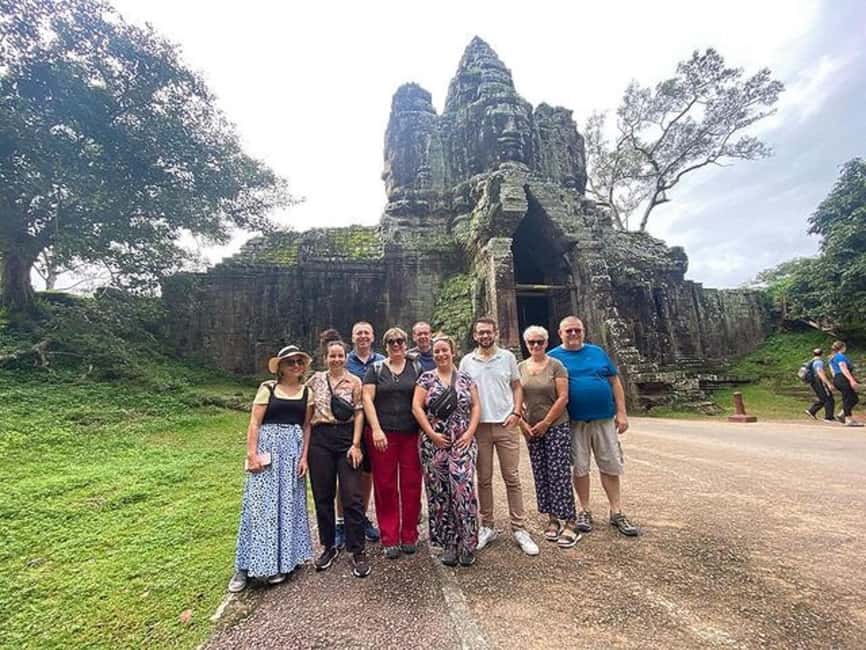
The route begins at the South Gate of Angkor Thom, one of the most dramatic entrances in the park. Giant stone faces watch over the approach, while rows of statues line the causeway. This is a fine opening stop because it gives you an immediate sense of the scale and ambition of the Khmer Empire.
You get about two and a half hours around Angkor Thom, including the Terrace of the Elephants, Baphuon, and Bayon. That is a substantial block of time, but you will still be walking over uneven stone and exposed ground. Comfortable shoes are not optional here.
The Victory Gate is included as a 15-minute photo stop. It is useful for a quick picture and helps show how the old royal city had several formal entrances. Do not expect a long lecture at every stop. The day works best when the guide keeps the explanations focused and moves you along before the heat takes over.
Bayon, Baphuon, and the royal heart of Angkor
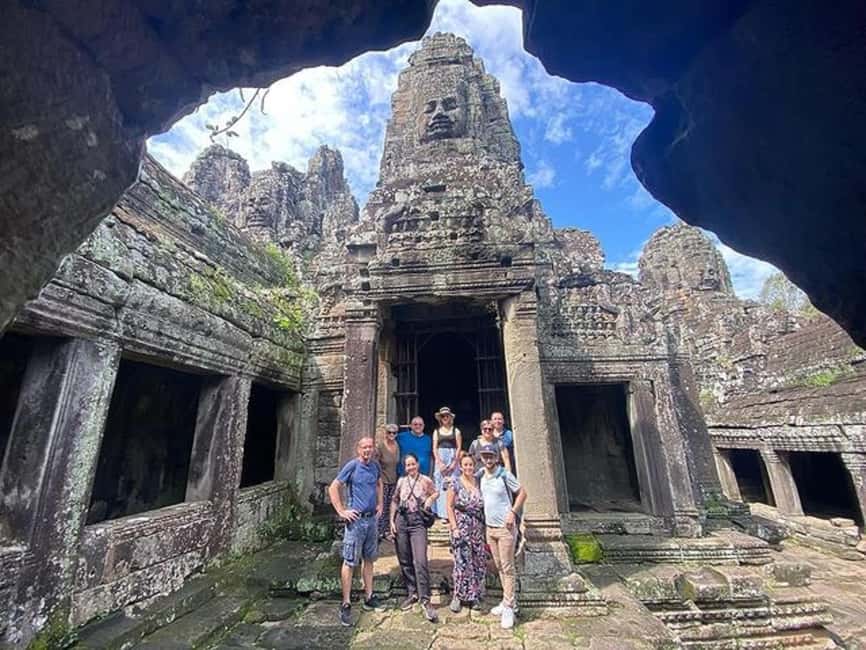
Bayon is often the emotional high point of Angkor Thom. Its towers carry calm stone faces that appear from different angles as you walk around the temple. The effect is more personal than grand. Instead of one huge central view, you find faces revealing themselves between towers and passageways.
A French-speaking guide adds real value here because Bayon can otherwise become a forest of gray stone. You will learn how the temple relates to the reign of Jayavarman VII and why its imagery differs from that of Angkor Wat. The listed visit lasts about 45 minutes, enough for an introduction and photographs, though not every corner.
Baphuon receives another 45 minutes. Its tall pyramid form gives you a different architectural experience from Bayon, with steep levels and strong lines. Depending on your comfort with steps and uneven surfaces, you may find this stop more tiring than the time suggests.
The Terrace of the Elephants takes about 15 minutes. This is a short but worthwhile stop, especially if you enjoy carved details and royal ceremony. The terrace once formed part of the city’s formal center, and your guide can help you picture how it functioned rather than leaving you to admire a long stone wall without context.
Ta Prohm and the roots that changed temple tourism
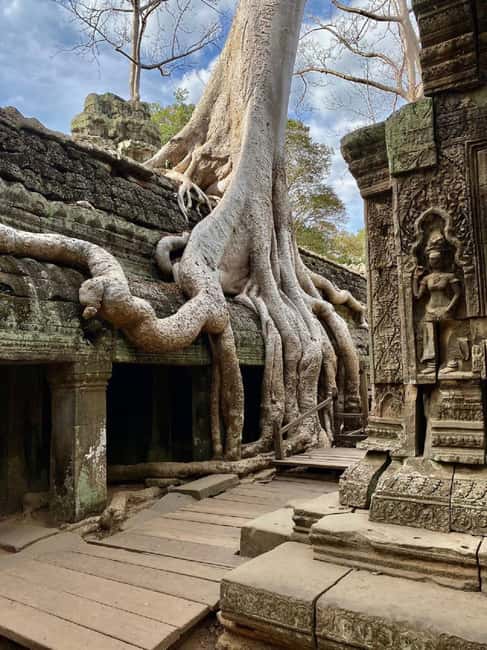
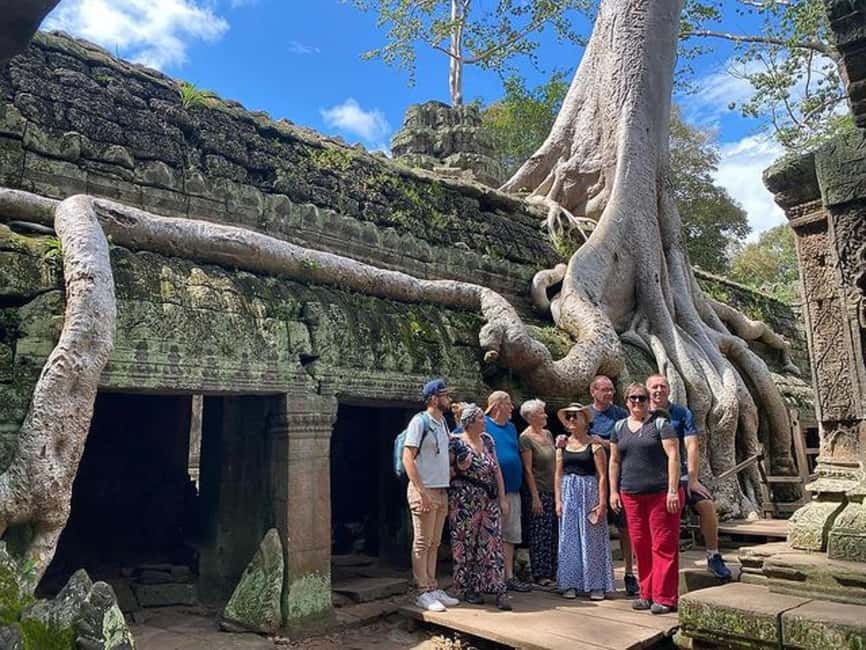
Ta Prohm is the most theatrical stop of the day. Large tree roots push across walls and doorways, making the temple look as if the forest is slowly reclaiming it. The combination of stone, roots, narrow corridors, and open sky creates the kind of scene that stays in your memory.
You get about an hour here. That is enough to see the main features without wandering too far from the group. Ta Prohm can be busy, and the guide’s skill matters when it comes to finding good photo positions without wasting time.
The temple is famous for its movie connection, but it deserves more than a quick film-location picture. Look at the carved lintels, collapsed galleries, and the way roots have become part of the visual identity of the site. You will need sturdy shoes, sun protection, and insect repellent. The shade helps, but the walk remains uneven.
The guide also helps you notice the difference between Ta Prohm and the more formal Angkor Wat. Ta Prohm feels raw and unstable. Angkor Wat feels ordered and ceremonial. Seeing both in one day gives you a useful contrast.
A few more trips worth weighing up
- From Siem Reap: Kampong Phluk Floating Village Tour by Boat
★ 4.9 · 6,979 reviews - Sunset tour of Kampong Phluk stilts home village on the Tonle Sap
★ 5.0 · 4,865 reviews - Siem Reap: Kampong Phluk Floating Village Tour with Boat
★ 4.9 · 3,843 reviews - Siem Reap: Full-Day Angkor Wat Guided Tour with Sunset
★ 4.9 · 3,803 reviews
Lunch near the temples, with one important warning
Lunch is not included. The schedule allows about an hour at a nearby local restaurant, where you can order a Cambodian meal.
This is convenient because leaving the archaeological park would cost time. Still, budget carefully. One particularly useful piece of advice is to avoid assuming that the nearest restaurant will offer the best value. A meal close to a major monument may be more expensive, and the quality may not always match the price.
Ask your guide about the lunch stop and prices before ordering. If you are particular about food or trying to keep costs down, you may prefer to bring something from your hotel if that is permitted by your accommodation. For the sunrise option, bringing breakfast from the hotel is specifically recommended.
The midday break also has a practical purpose. You will have spent the morning walking in strong sun, so use the hour to eat, drink, and cool down rather than rushing through another temple.
Angkor Wat in the afternoon
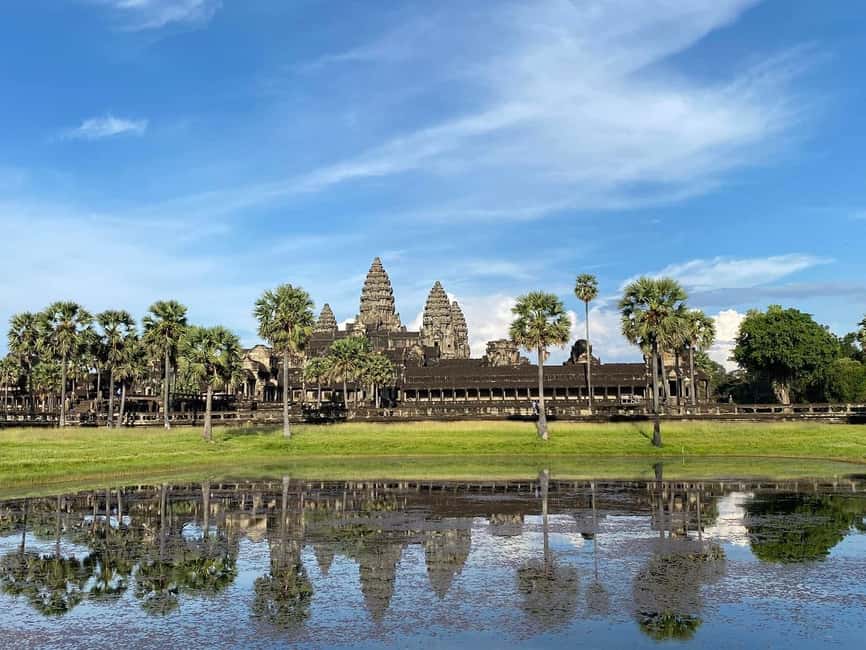
Angkor Wat gets about two hours on the one-day route. That is enough to see the main galleries, central structure, carvings, and long approach, but you should not expect to inspect every detail.
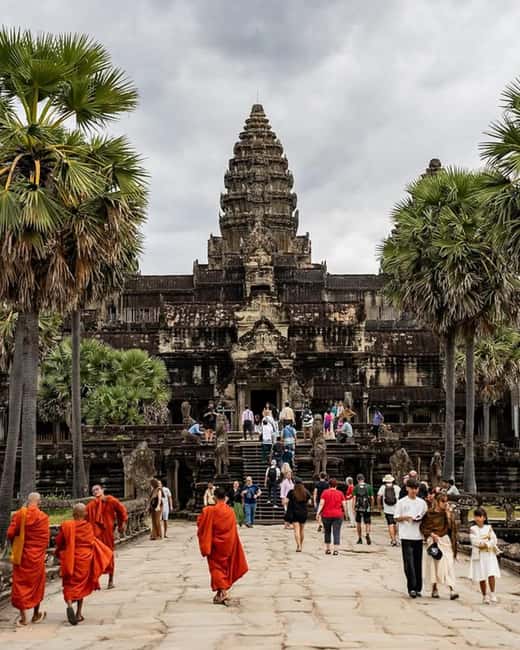
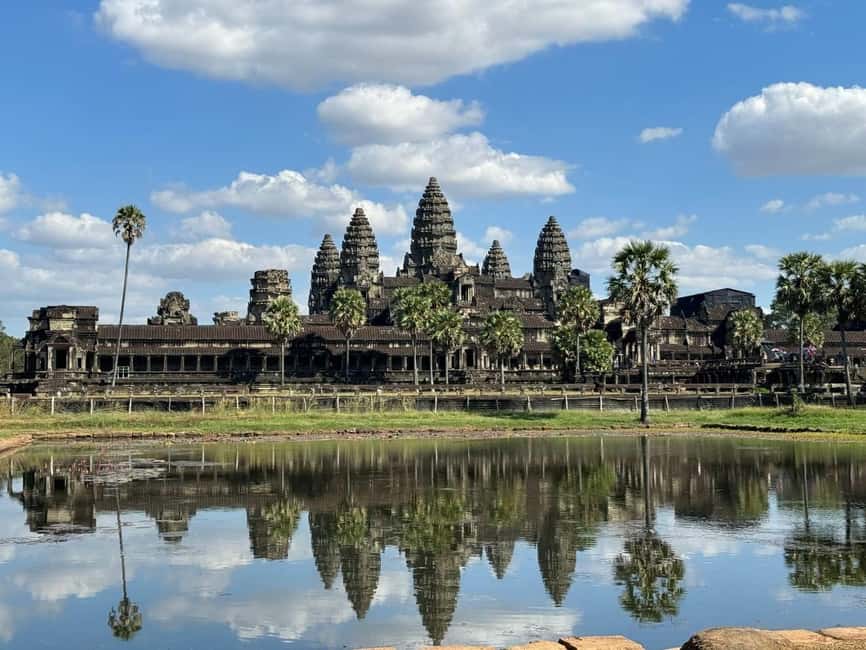
This is the world’s largest religious monument, and its scale is difficult to grasp from a single photograph. The long causeway, balanced towers, galleries, and surrounding water were designed as a unified religious image. Your guide can explain the temple’s symbolism, artwork, and place in Khmer history in a way that makes the layout easier to read.
The afternoon timing is practical. You have already seen several smaller and more enclosed temples, so Angkor Wat provides a grand finish. The tradeoff is heat. By this point, your feet may be tired and the stone surfaces may be hot, so take water and use the provided cold towels.
Proper clothing matters here. Your pants or skirt must cover the knees, and your shirt must cover the shoulders. Short skirts, shorts, tank tops, and sleeveless shirts are not allowed. A scarf can help cover knees and shoulders at some temples, but Angkor Wat requires clothing that meets the rules from the start.
The one-day tour normally finishes around 5:00 PM and returns you to your hotel. If you select the sunrise version, pickup moves to 5:00 AM and the tour ends around noon. That version gives you a different mood at the temples, but it is not a full-day route. You should choose it for the early light, not because it includes more sightseeing.
Why the two-day route is worth considering
If you have two days in Siem Reap, I prefer the extended option for most people. The first day covers the Small Circuit and the major sights. The second day adds the Grand Circuit and Banteay Srei, with the finish around 4:00 PM.
The second day begins at Preah Khan, a broad monastic complex with corridors, carvings, and a quiet sense of decay. It is less immediately famous than Angkor Wat, yet many people find it more comfortable for slow exploration because its spaces feel less formal and monumental.
Neak Pean is a smaller temple surrounded by pools. It offers a change of pace after the larger complexes. The water and compact design make it a good stop for photographs, though the visit is more about setting and structure than a long walk through a huge monument.
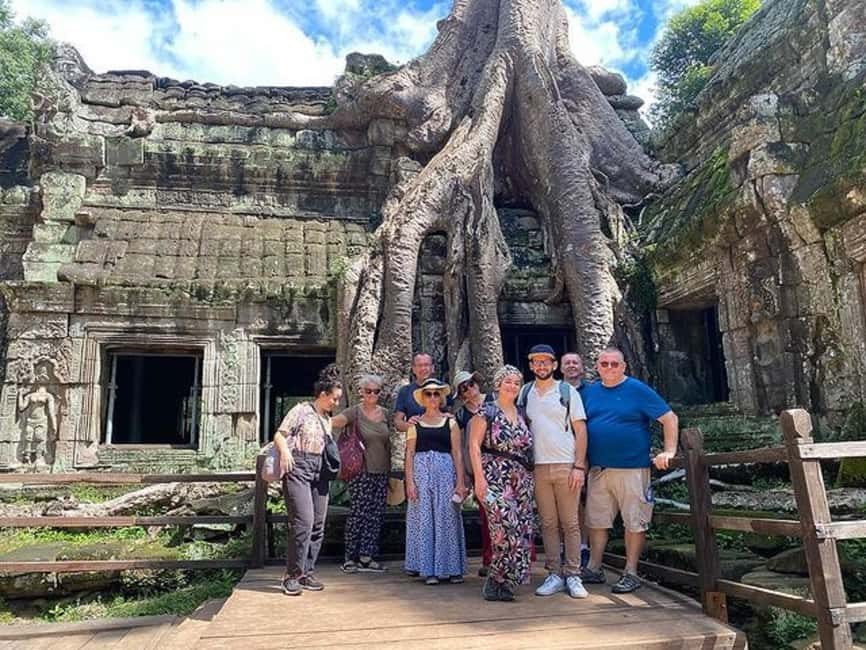
Ta Som is known for its tree-covered gate. It echoes the atmosphere of Ta Prohm on a smaller scale. If you want a photograph showing nature and stone in the same frame, this is one of the best stops on the extended route.
East Mebon once sat on an island in an ancient reservoir. Today, its position makes more sense when your guide explains the water system and the role of reservoirs in Angkor’s planning. Without that context, you might see only another temple mound. With it, you begin to understand how much engineering supported the royal city.
Pre Rup is a mountain-style temple with broad views across the Cambodian countryside. Its stairs can be demanding, particularly late in the day, but the strong silhouette and open setting make it a satisfying final stop before Banteay Srei.
Banteay Srei and the finest carved details
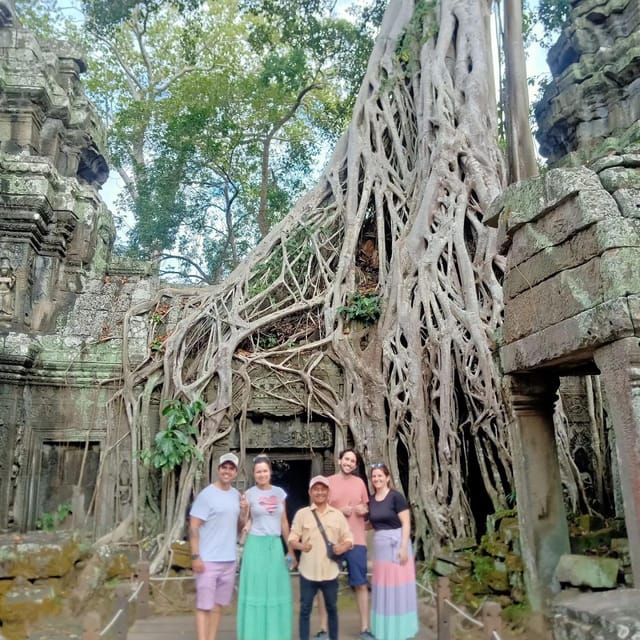
Banteay Srei, often called the Citadel of Women, is built from pink sandstone and is admired for highly detailed carvings. It is smaller than Angkor Wat, but its decoration is remarkably precise.
This is one reason the two-day option gives better value than trying to squeeze everything into one long day. Banteay Srei is outside the main concentration of temples, so it needs extra driving time. The reward is a temple with a distinct color, scale, and style.
You will likely spend less time here than at Angkor Thom, but the visit feels focused. Pay attention to the carved doorways and figures. This is where a French-speaking guide can help you understand details you might otherwise pass without noticing.
The second-day lunch is also not included. After Banteay Srei, the tour returns you to your hotel around 4:00 PM. That earlier finish can be welcome after two days of stone steps and hot paths.
Sunrise, heat, clothing, and walking demands
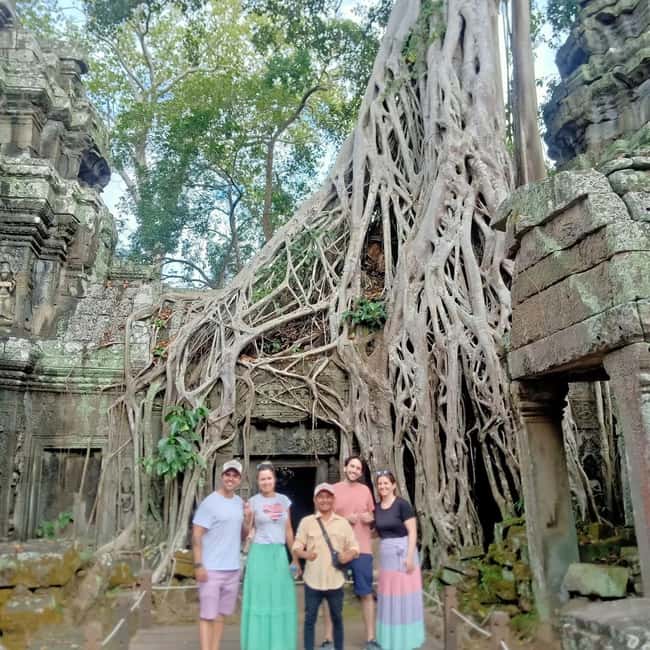
Sunrise pickup is at 5:00 AM. It changes the rhythm of the tour completely. You need to wake early, bring hotel breakfast, and accept that the tour ends around noon. Check the exact sunrise option when booking, since the details specify that it can be selected for the extended tour’s second day as well.
Cambodia can be very hot. One French-language group described 35-degree heat, and that is exactly the sort of condition in which cold towels become more than a nice extra. Water and towels are available in the vehicle during the day, but you should still bring sunscreen, sunglasses, a sun hat, and insect repellent.
Wear comfortable clothes that meet the temple rules. Bring shoes suitable for uneven paths and steps. Alcohol and drugs are not allowed, and the tour is not suitable for wheelchair users or people over 95 years old.
The transport plan also affects comfort. Tuk-tuks feel open and local, but an air-conditioned car can be chosen by smaller private groups. Larger groups use an air-conditioned van or bus. If you are sensitive to heat, the private car option may be worth the added cost if available for your booking.
Guide quality is the heart of this tour
The strongest feature here is the French-language guiding. Piset has been praised for speaking excellent French and for sharing Cambodian history and culture with warmth. Mey has been described as attentive and kind, while Alex is noted for supplying many historical references.
Kamal is described as friendly and funny, and Philrom helped make Cambodian history accessible and interesting. Kanal is also praised for humor and a strong grasp of the site. Spellings can vary, and the guide assigned to you may be different, but these names give you a sense of the service style to expect.
The best guides do more than recite dates. They connect architecture, religion, kingship, sculpture, and daily life. They also help with timing, moving you from one temple to the next without long delays. That coordination matters because Angkor is too large to treat as one simple walking tour.
The 4.9 rating from 245 ratings reflects a very strong overall record. Still, no guide can remove every drawback. The heat is real, lunch is extra, the ticket is extra, and a packed one-day schedule demands reasonable fitness.
Private or shared group?
The private tour is the better choice if you want to control the pace, have children, or prefer more time for photographs. It is also the only option that includes free admission for children under 12. A private vehicle may cost more in total, but the added flexibility can make the day easier.
The shared option makes sense for solo visitors or couples who want to keep the price down. Groups of one or two normally use a tuk-tuk, while three to six people use an air-conditioned van. A shared schedule may leave less room for lingering, but the route is already designed to cover the key temples efficiently.
I would choose the private two-day tour for families and for anyone with a serious interest in Angkor’s art. I would choose the shared one-day tour for a shorter Siem Reap stay, especially if French guidance is important and you want the main sights handled in one organized day.
Should you book this Angkor tour?
Book it if you want French explanations, hotel pickup, reliable transport, and a well-planned route through the major temples. The cold water and fresh towels are especially valuable during hot weather, and the guides appear to bring humor and personal warmth to the historical detail.
Choose the two-day version if your schedule allows. It adds Preah Khan, Neak Pean, Ta Som, East Mebon, Pre Rup, and Banteay Srei without forcing every temple into one exhausting day.
Skip it if you want complete control over meals, timing, and temple order, or if you are trying to visit Angkor on the absolute lowest budget. Also remember to add the temple pass and lunch when working out the real cost.
For most French-speaking first-time visitors to Siem Reap, I would book the two-day private option. For a shorter stay, the one-day route still gives you the essential Angkor experience, provided you arrive prepared for heat, walking, and an early start if you choose sunrise.
FAQ
Is the Angkor entrance ticket included in the $50 price?
No. The Angkor Archaeological Park pass must be purchased separately. It costs $37 for one day and $62 for two to three days.
What time does the regular tour begin?
Hotel pickup is scheduled between 8:30 and 9:00 AM. You should provide your hotel name or address and a contact number when booking.
Can I choose a sunrise start?
Yes. If you select the sunrise option, pickup is at 5:00 AM. The tour finishes around noon, and bringing breakfast from your hotel is recommended.
Is lunch included?
No. Lunch is not included on either the one-day or two-day option. You stop at a nearby local restaurant for about one hour.
What transport is used?
One or two people generally travel by tuk-tuk, with a car available as an option at checkout. Groups of three or more use an air-conditioned van or bus. The two-day private option uses a tuk-tuk on Day 1 and a car on Day 2 for one or two participants.
What clothing is required at the temples?
You need clothing that covers your knees and shoulders. At Angkor Wat, pants or skirts must cover the knees and shirts must cover the shoulders. Shorts, short skirts, tank tops, and sleeveless shirts are not permitted.
Just added around Siem Reap
- Private Battambang Full-Day Guided Tour★ 4.5 · 3 reviews
- Kulen Mountain, Beng Mealea and Banteay Srei Full Day Tour★ 5.0 · 3 reviews
- Kompong Pluk Tour★ 5.0 · 3 reviews
- Private 3 Day Tour to Discover the ancient temples★ 5.0 · 3 reviews
- Cambodia: Absolute Traditional Dance Show with Buffet Dinner★ 5.0 · 3 reviews
- Kulen National Park Ticket -Waterfall & 1000 Lingas★ 5.0 · 3 reviews
- Border Transfer (Siem Reap to Laos/Laos to Siem Reap)★ 3.5 · 3 reviews
- Best Taxi Siem Reap to Battambang – English Speaking Driver★ 4.5 · 3 reviews
Angkor Wat Tours, compared.

Angkor Wat Sunrise or Sunset Tour with Guide from Siem Reap
Read our review →
Angkor Wat: Small-Group Sunrise or Sunset Tour
Read our review →
Angkor Wat 2-Day Tour with Sunrise and Sunset
Read our review →

Angkor Wat Sunrise tour with Small – Group and Guide tours
Read our review →
Angkor Wat Highlights and Sunrise Guided Tour from Siem Reap
Read our review →
Angkor Wat Sunset Small Group Tour with Lunch Included
Read our review →