
Reviewed · ANGKOR WAT TOURS
Siem Reap: Angkor Wat with German or English Guided Tour
Angkor rewards a good plan. This eight-hour outing gives you a clear route through Angkor Wat, Angkor Thom, Bayon, and Ta Prohm, with hotel pickup, a private air-conditioned vehicle, and a live English or German guide. I like the way the day focuses on the major temples without trying to cram in every distant ruin, and I like the small touches, such as cold water and, according to several bookings, chilled towels from the driver. The main drawback is that the advertised $49 price does not include the $37 temple pass or lunch.
The strongest part of the experience is the human guidance. Guides including Sak, Sam, Bun, Sopheap Rath, Pi, and Sokpee have been praised for clear explanations, good English, helpful photo stops, and careful pacing. You should still expect a long, hot day with plenty of walking, and the tour is not suitable for wheelchair users.
In This Review
- Key points at a glance
- Why this Angkor tour makes sense for a first visit
- Hotel pickup and the ride to Angkor
- Angkor Wat: two hours with Cambodia’s great monument
- Angkor Thom and the southern gate
- Bayon: stone faces and close-up detail
- Ta Prohm: the jungle temple hour
- Srah Srang gives the day some breathing room
- What the guide and driver add to the day
- The real price: $86 before lunch
- Who should book this day?
- Should you book this Angkor Wat tour?
- FAQ
- How long does the tour last?
- Which languages are available?
- Is hotel pickup included?
- Which temples are included?
- Is the temple entrance fee included?
- Are meals included?
- What should I bring?
- Is the tour suitable for wheelchair users?
Key points at a glance
- Four essential temple stops: Angkor Wat, Ta Prohm, Angkor Thom, and Bayon form a sensible introduction to the small circuit.
- A guide who adds meaning: The best value comes from explanations of Khmer architecture, religion, carvings, and temple design.
- Comfort between walks: Hotel pickup, an air-conditioned vehicle, bottled water, and a driver are included.
- A full eight-hour outing: The route allows substantial time at the main monuments, with a break at Srah Srang.
- Budget carefully: The $49 tour price is separate from the $37 temple entrance pass and meals.
- Bring the right clothing: Comfortable shoes, a hat, sunglasses, insect repellent, a camera, and cash are sensible choices. Shorts are not allowed.
Why this Angkor tour makes sense for a first visit
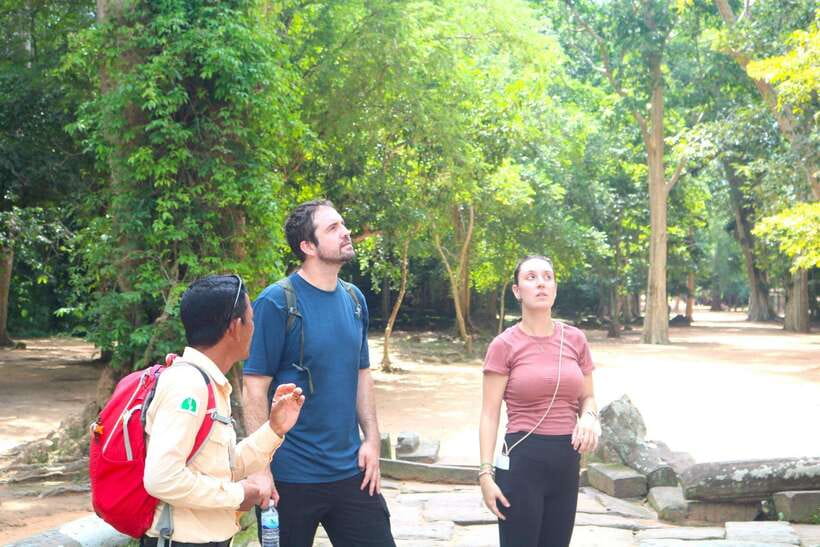
Angkor is too large and important to treat as a quick photo stop. The temple zone covers a wide area, and the grand monuments can blur together if you do not have a guide to explain what you are seeing. This route gives you the classic first-day sequence, moving from the ceremonial scale of Angkor Wat to the fortified city of Angkor Thom and then to the jungle-covered Ta Prohm.
I like this approach because it balances famous sights with different kinds of experience. Angkor Wat gives you monumental architecture and detailed carvings. Angkor Thom adds gates, city walls, and Bayon’s stone faces. Ta Prohm feels more enclosed and atmospheric, while Srah Srang gives you a quieter pause between major walks.
The tour lasts eight hours, including transport, sightseeing, and a break. That is enough time to see the core temples without turning the day into a race, although the schedule is still active. You will walk on uneven surfaces, climb steps at some temple areas, and spend time outdoors in Cambodian heat.
More Angkor Wat tours we have reviewed:
- Angkor Wat Sunrise or Sunset Tour with Guide from Siem Reap
★ 5.0 · 12,109 reviews - Siem Reap: Angkor Wat: Small-Group Sunrise or Sunset Tour
★ 5.0 · 9,444 reviews - Siem Reap: Angkor Wat 2-Day Tour with Sunrise and Sunset
★ 4.9 · 4,429 reviews
Hotel pickup and the ride to Angkor
Pickup is included from your hotel in Siem Reap. The listed route begins at 57 2 Thnou Street, and the drive to Angkor Wat is about 20 minutes in the provided schedule. Your transport is a private air-conditioned vehicle, not an open tuk-tuk, which matters once the sun is high.
Several bookings praised the drivers as careful, punctual, and attentive. Names mentioned include Kosal, Mr Mao, Me Sung, Chi, Mr Bund, and Bun. Drivers were also praised for supplying cold water and cool wet towels, useful comforts after walking around exposed stone courtyards.
The vehicle gives you a place to cool down between temples, but do not mistake the air conditioning for a relaxed day indoors. The main sights require walking, and the best views and carvings are often reached on foot. Wear shoes you can comfortably use for several hours rather than sandals with thin soles.
Angkor Wat: two hours with Cambodia’s great monument
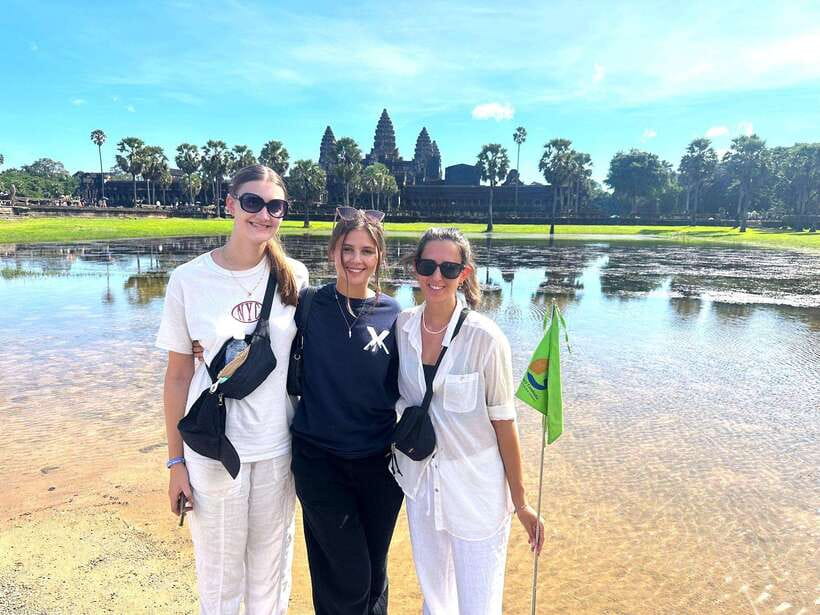
The first major stop is Angkor Wat, with about two hours for a guided visit. This is the largest and most famous temple on the route, built in the 12th century as a Hindu temple dedicated to Vishnu before later use as a Buddhist site.
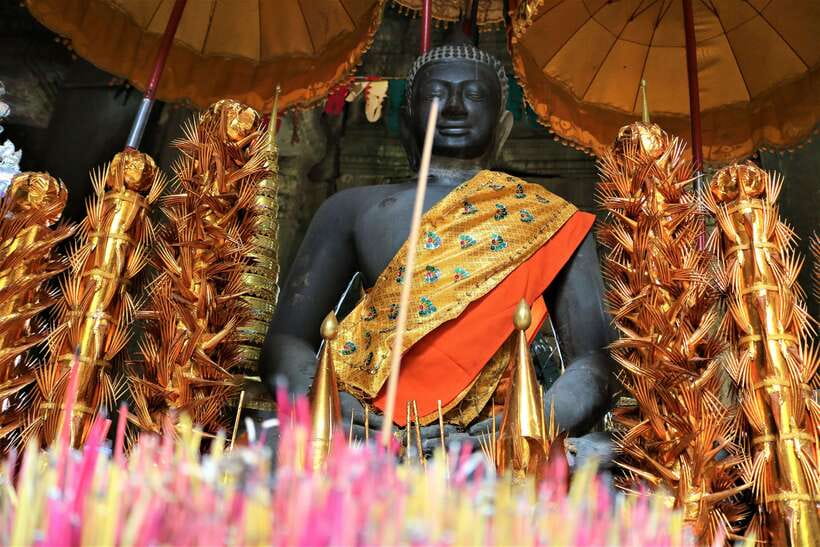
The guide’s role is important here. The temple is not just a huge stone silhouette. Its galleries carry long bas-reliefs showing scenes from mythology, warfare, and royal power. Without context, you may notice only repeated figures and elaborate patterns. With a good explanation, the carvings become a way to understand how religion and kingship shaped Khmer art.
Look closely at the building’s design as you walk. Angkor Wat is arranged with strong symmetry, galleries, towers, courtyards, and rising levels that represent a sacred mountain. A guide can point out how the architecture supports that religious idea instead of leaving you to admire the size alone.
Two hours sounds generous, but Angkor Wat can absorb it easily. You may spend part of the time examining carvings, part crossing large courtyards, and part finding good angles for photographs. The temple can feel demanding in the heat, so use the vehicle’s water supply and keep your pace steady.
The tour description emphasizes the intricate bas-reliefs and classical Khmer architecture. That focus suits the stop well. If you already know the standard facts about Angkor Wat from books or videos, a strong guide can still add value by showing you details you might otherwise walk past.
Angkor Thom and the southern gate
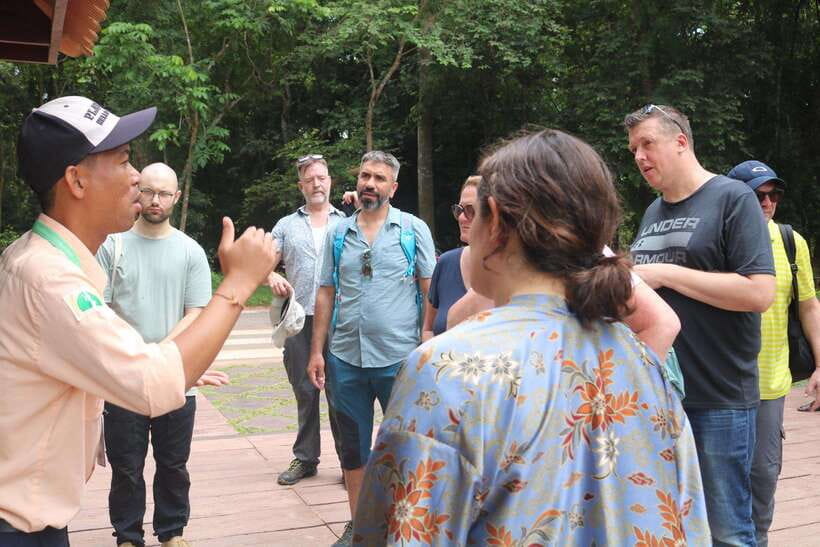
After Angkor Wat, the route continues to Angkor Thom, the fortified city that once formed a major center of the Khmer Empire. The scheduled guided visit to the city itself is about 30 minutes, followed by a longer visit to Bayon.
The southern gate is one of the memorable approach points. You will see rows of 54 stone figures representing gods and demons, arranged on opposite sides of the causeway. They hold the body of a giant serpent, linking the entrance to the Hindu story of the churning of the ocean of milk.
This is a good place to let the guide do more than name the figures. The gate presents the city as a protected sacred and royal space, not simply as an old entrance. The repeated figures also give the approach a strong visual rhythm, and the causeway makes an easy place for photographs.
The half-hour city visit is brief, so do not expect a detailed walk around every wall or gate. It works best as an introduction before Bayon. If you want more time for the city’s other terraces or smaller monuments, you should ask the guide about the day’s flexibility, though the core stops need to remain the priority.
A few more trips worth weighing up
- From Siem Reap: Kampong Phluk Floating Village Tour by Boat
★ 4.9 · 6,979 reviews - Sunset tour of Kampong Phluk stilts home village on the Tonle Sap
★ 5.0 · 4,865 reviews - Siem Reap: Kampong Phluk Floating Village Tour with Boat
★ 4.9 · 3,843 reviews - Siem Reap: Full-Day Angkor Wat Guided Tour with Sunset
★ 4.9 · 3,803 reviews
Bayon: stone faces and close-up detail
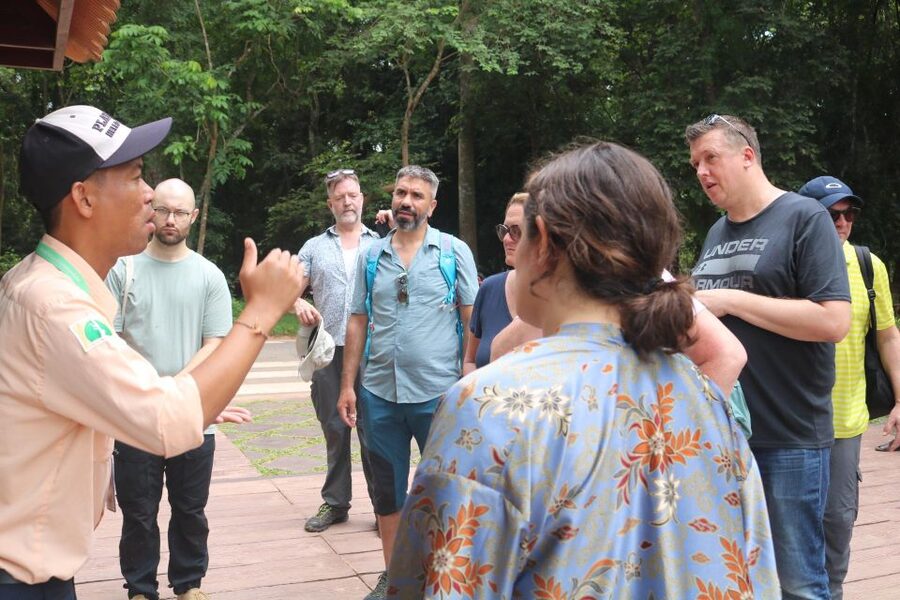
Bayon receives about an hour of guided sightseeing. Located inside Angkor Thom, it is known for its towers carved with large stone faces. The temple’s compact, maze-like arrangement feels very different from Angkor Wat’s broad symmetry.
This is one of the places where a guide earns the fee. Bayon can seem confusing at first because corridors, towers, galleries, and faces overlap at close range. A guide can help you read the plan of the temple and direct your attention to carvings that show daily life, battles, processions, and religious scenes.
The scale is also deceptive. From a distance, the faces make Bayon look calm and repetitive. Inside, the narrow passages and dense carvings create a more intimate experience. You will likely be looking up, around corners, and into shaded galleries rather than simply walking across one large open court.
The tour also includes the Terrace of the Leper King and the Terrace of the Elephants as part of the Angkor Thom visit. These royal terraces help explain the city’s ceremonial character. The Elephant Terrace is especially easy to appreciate for its long decorated facade, while the Leper King Terrace is noted for its carved figures and enclosed lower passage.
Because the listed time for Bayon is one hour, the guide needs to keep the visit moving. That can be a benefit in the heat, but anyone who wants extended time for close photography may find the schedule a little tight.
Ta Prohm: the jungle temple hour
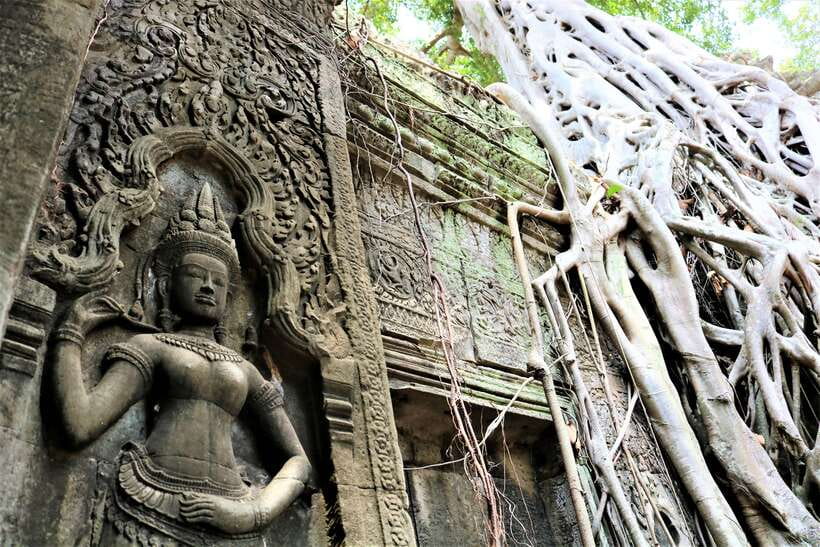
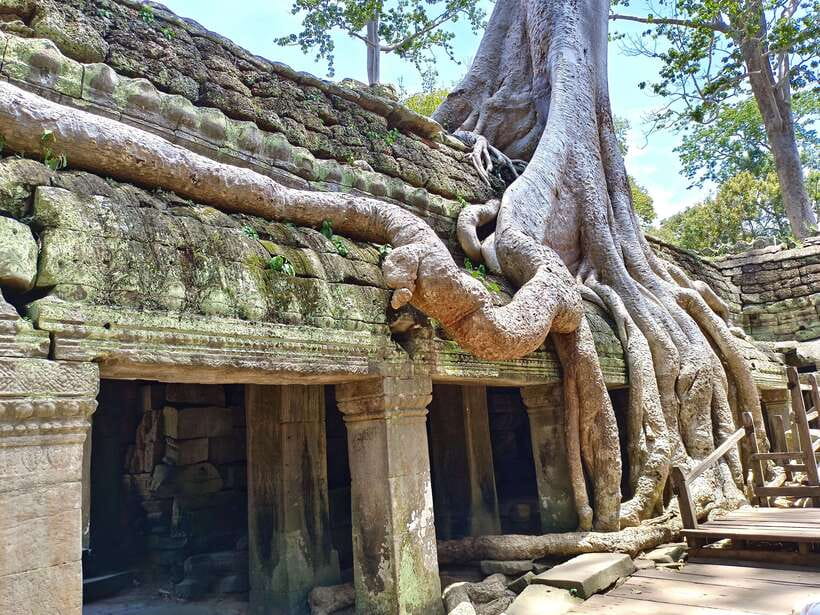
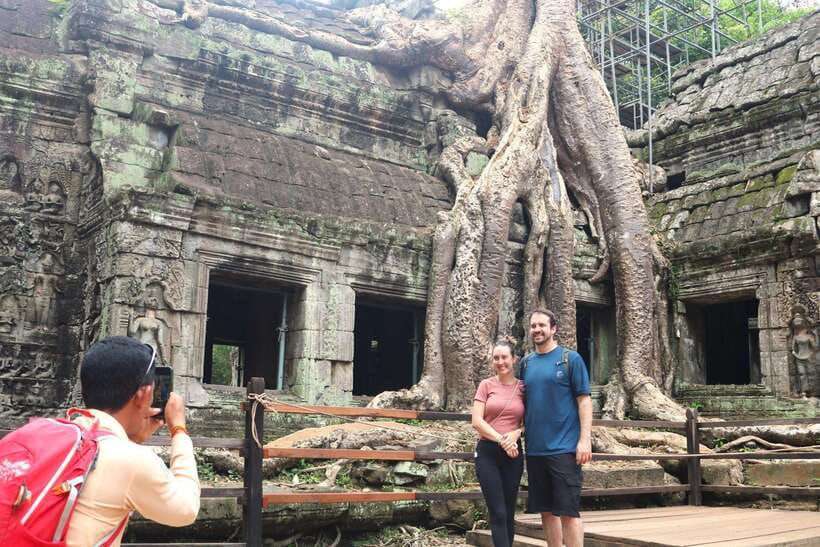
After lunch, the route heads to Ta Prohm for about an hour. This is the temple most associated with trees growing over stone walls and roots pushing through galleries. Its narrow passages and broken sections create a very different mood from the ordered scale of Angkor Wat.
Ta Prohm is also a maze. It is easy to lose your sense of direction among doorways, courtyards, collapsed blocks, and corridors. A guide can keep the visit focused, explain what remains of the temple, and help you reach worthwhile photo positions without wasting your limited time.
The jungle setting is part of the appeal, but it also means uneven ground, shade interrupted by hot open sections, and a need for sensible footwear. Insect repellent belongs in your day bag. The tour information advises against large bags and luggage, so carry only what you need for water, a camera, cash, and sun protection.
An hour is enough for a useful introduction to Ta Prohm, especially if you want the famous tree-and-stone views. It is not enough to examine every corner. I would treat this as a focused visit rather than a slow archaeological study.
Srah Srang gives the day some breathing room
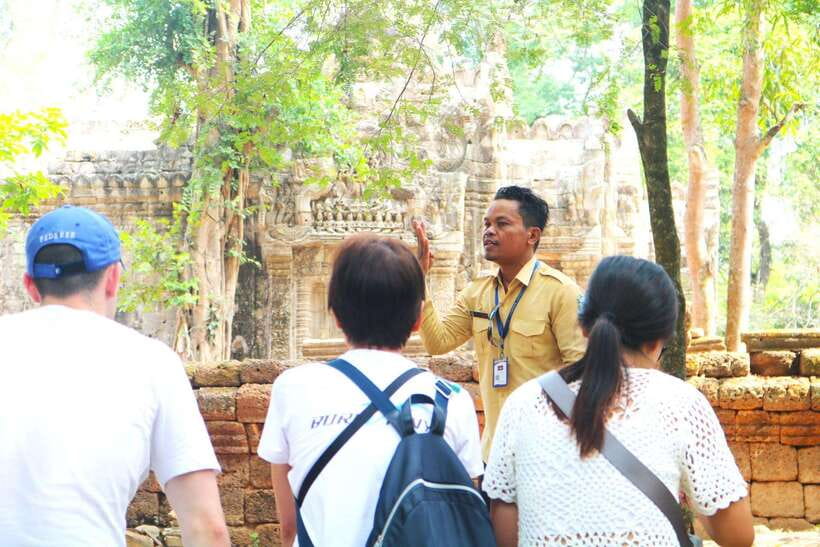
The itinerary allows one hour at Srah Srang for a break and free time. This reservoir, associated with the Angkor period, gives you a chance to sit, take photographs, drink water, and recover from the temple walks.
That pause matters. A full day of stone courtyards and steps can wear you down, and a scheduled break makes the main monuments easier to enjoy. The stop is not presented as a major guided temple visit, so expectations should stay modest. Think of it as a useful reset between the more demanding sightseeing sections.
Lunch is not included. The schedule places the meal around the later part of the day, and one booking praised the lunch stop while another found the restaurant disappointing. This is the least consistent part of the experience, so I would not choose the tour mainly for its food arrangements. Bring cash and be prepared for lunch to be a practical pause rather than a highlight.
What the guide and driver add to the day
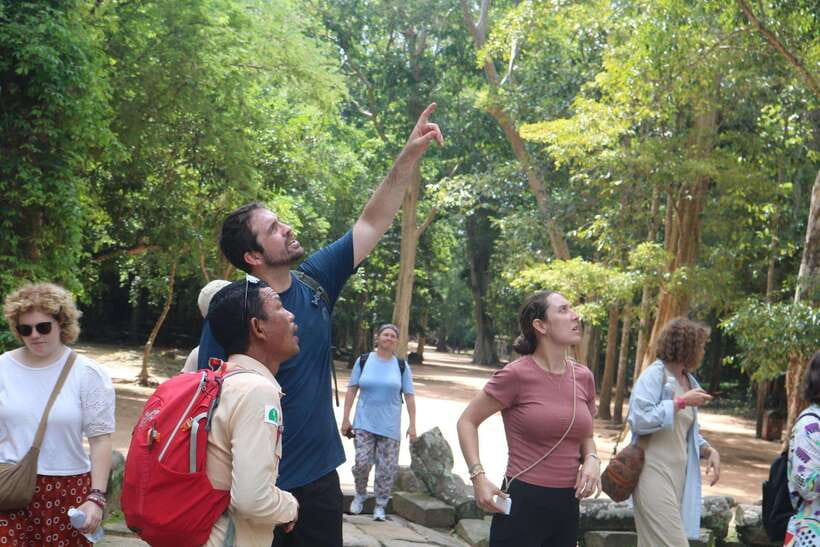
The guide is the key reason to choose this tour instead of arranging basic transport alone. The most warmly praised guides were friendly, patient, clear in English, and able to answer questions about both the temples and Cambodia. Sam was praised for offering detailed explanations without becoming dull, while Sak was noted for strong site knowledge and thoughtful service.
Mr Sokpee was remembered for taking care of people during a very hot day. Mr Bun was praised for history explanations and for showing exact spots for photographs. Nuon Chansarak was described as especially good at explaining architecture, religion, and mythology, as well as finding less crowded paths.
Guide quality can naturally vary by departure, since the booking may assign different people. The listed languages are English and German, so select the language you can follow most comfortably. If you care about photography, tell your guide early. Several bookings valued help with angles, photo locations, and taking pictures.
The drivers also receive unusually strong praise. The transport score is reported at 94 percent perfect, and the practical details explain why: punctual pickup, clean vehicles, careful driving, cold drinks, and wet towels. Those touches do not change the temples, but they make a hot eight-hour day much easier.
The real price: $86 before lunch
The tour costs $49 per person, but you must add the $37 entrance fee for the temple complex. That brings the known cost to $86 per person before meals.
The temple pass covers all the temples on this route, so you are not paying a separate fee at Angkor Wat, Bayon, Ta Prohm, or the other main stops. The tour includes hotel pickup and drop-off, transport, the guide, and bottled water.
For a first visit, that is fair value if you want interpretation and door-to-door transport. You are paying for more than a ride. You get a planned route, an English or German guide, an air-conditioned vehicle, and help making sense of monuments that can be confusing on your own.
The value is weaker if you only want quick photographs or already have transport and a detailed guidebook. In that case, the entrance pass is still necessary, but the extra $49 may feel less useful. For most first-time visitors, the guide is the part that justifies the added cost.
Who should book this day?
This tour suits you if you want the major Angkor temples in one organized day and prefer not to arrange separate transport. It is also a good match if you care about historical explanations, architectural details, and practical help with photographs.
The route works for most people who can walk for several hours in warm conditions. Comfortable shoes, sunglasses, a hat, insect repellent, a camera, and cash are specifically recommended. Shorts are not allowed, so choose clothing that meets temple rules and keeps you comfortable.
It is not suitable for wheelchair users. It is also a poor fit if you need a slow, highly accessible schedule or dislike full sightseeing days. The itinerary is not punishing, but it is active, and the major temples are spread across a large area.
Free cancellation is available up to 24 hours before the activity, and you can reserve now and pay later. Starting times depend on availability, so check the pickup details carefully before booking.
Should you book this Angkor Wat tour?
Book it if you want a well-supported first look at Angkor’s essential temples, especially if you value a guide who can explain carvings, religion, and city design. The combination of Angkor Wat, Angkor Thom, Bayon, Ta Prohm, and Srah Srang gives you a strong one-day introduction.
I would book with the full cost in mind: $49 for the tour, $37 for admission, plus lunch. Expect the guide assignment to vary, but the repeated praise for people such as Sak, Sam, Bun, and Sopheap Rath is encouraging. Tell the guide what interests you, carry little, dress for the heat, and save energy for Ta Prohm.
For a first day in Siem Reap, this is a practical choice with real educational value. For a second or third day, you may prefer a slower route or less famous temples, but this small circuit is the right starting point for understanding Angkor.
FAQ
How long does the tour last?
The activity lasts eight hours, including transport, temple visits, and the break at Srah Srang.
Which languages are available?
You can choose a live guide in English or German.
Is hotel pickup included?
Yes. Pickup and drop-off from your hotel in Siem Reap are included. The listed route begins at 57 2 Thnou Street.
Which temples are included?
The route includes Angkor Wat, Angkor Thom, Bayon Temple, Ta Prohm Temple, the Terrace of the Leper King, the Terrace of the Elephants, and Srah Srang.
Is the temple entrance fee included?
No. The entrance fee is $37 per person and covers all the temples visited on the route.
Are meals included?
No. Meals are not included, so you should bring cash for lunch.
What should I bring?
Bring comfortable shoes, sunglasses, a hat, a camera, insect repellent, and cash. Bottled water is included.
Is the tour suitable for wheelchair users?
No. The activity is not suitable for wheelchair users. Most other visitors can take part, provided they are comfortable walking around the temple complex.
Just added around Siem Reap
- Private Battambang Full-Day Guided Tour★ 4.5 · 3 reviews
- Kulen Mountain, Beng Mealea and Banteay Srei Full Day Tour★ 5.0 · 3 reviews
- Kompong Pluk Tour★ 5.0 · 3 reviews
- Private 3 Day Tour to Discover the ancient temples★ 5.0 · 3 reviews
- Kulen National Park Ticket -Waterfall & 1000 Lingas★ 5.0 · 3 reviews
- Cambodia: Absolute Traditional Dance Show with Buffet Dinner★ 5.0 · 3 reviews
- Border Transfer (Siem Reap to Laos/Laos to Siem Reap)★ 3.5 · 3 reviews
- Best Taxi Siem Reap to Battambang – English Speaking Driver★ 4.5 · 3 reviews
Angkor Wat Tours, compared.

Angkor Wat Sunrise or Sunset Tour with Guide from Siem Reap
Read our review →
Angkor Wat: Small-Group Sunrise or Sunset Tour
Read our review →
Angkor Wat 2-Day Tour with Sunrise and Sunset
Read our review →

Angkor Wat Sunrise tour with Small – Group and Guide tours
Read our review →
Angkor Wat Highlights and Sunrise Guided Tour from Siem Reap
Read our review →
Angkor Wat Sunset Small Group Tour with Lunch Included
Read our review →