
Reviewed · ANGKOR WAT TOURS
Angkor Wat 3-Day Temple Tours
Sunrise is only the beginning. This three-day private tuk-tuk tour gives you a practical way to cover Angkor Wat, the main temples around Angkor Thom, the older Roluos group, and the floating village of Kampong Phluk. I like the hotel pickup each day and the free water and cold towels, two small comforts that matter in Cambodia’s heat. I also like the flexible private format, which lets you travel with your own group instead of following a large bus timetable.
The main drawback is the amount packed into the schedule. Day three includes several distant temples, Banteay Srei, and Kbal Spean, so the pace may feel tiring. Temple tickets, boat fees, lunch, and an English-speaking guide are not included, so the $144 price is for transport and related service rather than a full guided package.
In This Review
- Key points to know before booking
- What the $144 price really covers
- Day one: Angkor Wat before the heat
- Day two: Roluos temples and Kampong Phluk
- Day three: the grand circuit and farther temples
- A private tuk-tuk makes the route easier
- Guide or driver: know the difference
- How tiring are three days?
- Who should book this tour?
- Should you book the Angkor Wat 3-Day Temple Tour?
- FAQ
- Where does the Angkor Wat 3-Day Temple Tour begin?
- Is the tour private?
- What transport is included?
- Are Angkor temple tickets included?
- Is the Kampong Phluk boat fee included?
- Is an English-speaking guide included?
- Are meals included?
- What are the main stops on day one?
- Can I cancel for a full refund?
Key points to know before booking
- Sunrise at Angkor Wat: Start early for photographs of the temple reflected in the ponds before the day becomes hot and crowded.
- Private tuk-tuk transport: Your driver collects you from your hotel lobby each day, giving your group a simple way to move between temple sites.
- Kampong Phluk village: See homes raised on roughly 6-meter stilts, along with village facilities, waterways, and the floating forest area.
- Three very full days: The plan covers the small circuit, Roluos, the grand circuit, Banteay Srei, and Kbal Spean.
- Comfort in the heat: Cold drinking water and chilled towels are included, a welcome touch during long temple visits.
- Guide not included: You can hire an English-speaking guide separately, but the listed price does not provide one.
What the $144 price really covers
At $144, this tour offers good value if your main need is reliable transportation over three days. Angkor Archaeological Park covers a wide area, and arranging separate tuk-tuks for every temple can take time and require repeated bargaining. Here, you have one private vehicle and a planned route.
That price does not include the admission ticket for the temples. It also excludes the boat entrance fee at Kampong Phluk, lunch near the temples, personal expenses, and an English-speaking tour guide. You should add those costs to your budget before deciding that this is an all-inclusive tour.
The private format is useful for couples, families, or friends who want to move at their own pace. You will not be sharing the tuk-tuk with strangers. It also gives you room to request small changes, although the full schedule leaves less freedom than a simple one-day outing.
The included water and cold towels deserve more credit than they might seem to. Angkor visits involve repeated walks, stairways, open courtyards, and long periods in the sun. A cold towel at the right moment can feel like a minor miracle.
More Angkor Wat tours we have reviewed:
- Angkor Wat Sunrise or Sunset Tour with Guide from Siem Reap
★ 5.0 · 12,109 reviews - Siem Reap: Angkor Wat: Small-Group Sunrise or Sunset Tour
★ 5.0 · 9,444 reviews - Siem Reap: Angkor Wat 2-Day Tour with Sunrise and Sunset
★ 4.9 · 4,429 reviews
Day one: Angkor Wat before the heat
The first morning begins with Angkor Wat at sunrise. The early start is worth it for the light, cooler air, and classic views across the reflecting pools. If you want photographs, arrive prepared to wait quietly and be patient. Sunrise is one of the busiest moments at the complex, even though the rest of the morning can spread visitors across many sites.
Angkor Wat is the centerpiece of the trip. It is the largest religious building in the world, and its scale becomes clearer as you move from the outer causeway toward the galleries and central towers. Give yourself time to notice the carved walls rather than treating the temple as a quick photo stop.
After Angkor Wat, the route continues through the small circuit. At the South Gate of Angkor Thom, you pass between rows of monumental figures before reaching the walled city. The Bayon is the star here, with its many serene stone faces looking down from the towers.
The Bayon can be confusing at first because its towers crowd together. I suggest taking a few minutes to look from the outer galleries before moving inward. That helps you understand how the temple is arranged instead of seeing only a maze of stone.
Baphuon follows, along with the Terrace of the Elephants and the Terrace of the Leper King. These sites help show how Angkor Thom worked as a royal center, not just as a collection of isolated temples. The terraces are especially useful for understanding ceremonial space and the scale of the former city.
Ta Prohm brings a different mood. Trees and roots press against the old stonework, and the temple has a more enclosed, atmospheric feel than Angkor Wat. Its fame means you may find busy areas around the best-known views, but the site remains one of the most memorable stops on the route.
The day ends with Banteay Kdei and Sras Srang. Banteay Kdei is a large monastic complex with a quieter feel than Ta Prohm, while Sras Srang is a broad reservoir and a pleasant place to pause. After a morning of major monuments, this final stretch gives you a little breathing room.
The strength of day one is variety. You see the grandest temple, a royal city, face towers, carved terraces, jungle-covered ruins, and a large reservoir. The tradeoff is that it is a long sightseeing day, especially after the sunrise start.
Day two: Roluos temples and Kampong Phluk
Day two begins with a drive of about 13 kilometers from Siem Reap’s Pub Street toward the Roluos group. These temples mark an earlier phase of Khmer construction and are linked with Hariharalaya, an early capital of the Khmer Empire.
The Roluos group includes Bakong, Lolei, Preah Ko, and smaller remains. The sites are important because they show the beginnings of the classical Khmer period. Their brick towers and sandstone details look different from the later Angkor monuments, so this day adds useful context to what you saw on day one.
Bakong is the largest and most imposing of the main Roluos temples. Preah Ko is known for its early towers and carved sandstone elements, while Lolei gives you another look at the older brick-building tradition. These temples do not have the same instant fame as Angkor Wat, but that is part of their appeal.
The route then heads toward Kampong Phluk, about 37 kilometers from Angkor Wat. This is not another temple stop. It is a chance to see how a community lives with the changing water levels of Tonle Sap Lake.
Homes in the village are built on stilts of about 6 meters to help protect them from flooding during the rainy season. The village includes clinics, pagodas, schools, restaurants, and churches. The exact appearance of the area changes with the season. From December to April, during the dry season, motorbikes can travel through the village.
A boat trip is not included in the tour price, so check the entrance arrangements before setting out. The boat fee is separate, but the water portion can add an important human and environmental contrast to the temple days. You may also see the floating forest and local wildlife.
Kampong Phluk is valuable because it keeps the trip from becoming three straight days of stone walls. You get a view of present-day Cambodian life, local transport, flood adaptation, and the relationship between homes and the lake.
Still, set your expectations correctly. This is a visit to a living community, not a staged cultural show. Be respectful with photography, particularly around homes, schools, and people going about daily work. Lunch near the temples is also not included, so plan for that separately.
Day three: the grand circuit and farther temples
The third day covers the grand circuit and then reaches farther sites. The itinerary lists Preah Khan, Neak Pean, Ta Som, East Mebon, Pre Rup, Banteay Samre, Banteay Srei, and Kbal Spean.
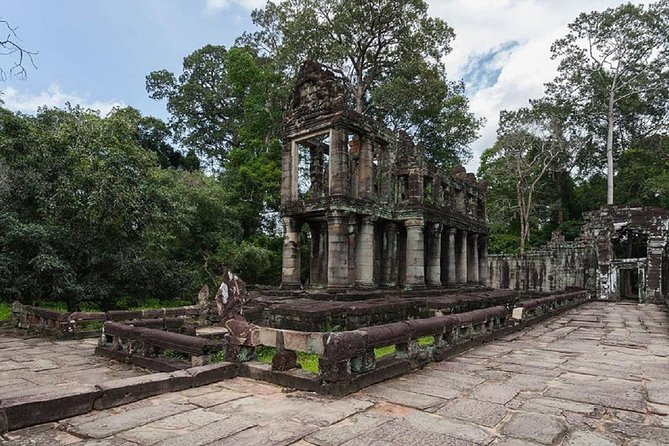
Preah Khan, meaning Holy Sword, is one of the most rewarding stops on this day. Its corridors, courtyards, carved details, and partly overgrown sections make it feel more layered than a simple central tower temple. The scale can be hard to grasp at first, so allow time to move through the complex without rushing.
Neak Pean is unusual because the central sanctuary sits within a water-centered design. Its setting differs sharply from the broad courtyards of Angkor Wat and the dense stone towers of Bayon.
Ta Som is smaller and more intimate. It is often remembered for its doorway and tree growth, but the pleasure is in seeing how a modest temple can offer a quieter visit after the larger complexes.
East Mebon and Pre Rup are brick-and-stone temple mountains with strong upper-level views. Their stairs can be demanding, and you should follow the temple dress code. Shoulders and knees need to be covered at temple sites, so pack light clothing that still meets the rules.
Banteay Samre brings another architectural variation. It is often appreciated for its strong enclosure walls and detailed carvings. Since the day includes many sites, your driver’s timing matters. A good route keeps you from wasting energy on unnecessary backtracking.
Banteay Srei is farther from the central Angkor area and is famous for its fine pink sandstone carvings. It is smaller than Angkor Wat, but the detail is unusually delicate. The distance makes it a worthwhile addition for people who want more than the standard central circuit, though it also adds to the day’s travel time.
Kbal Spean is listed as the final stop on day three. It is associated with carved features along a riverbed, but the available tour details do not specify the walking conditions or exact visit length. Ask the provider about the current plan before booking if this stop is especially important to you.
Day three is ambitious. You gain a wide view of Angkor architecture and reach sites that many short itineraries skip. The price for that coverage is fatigue, particularly after two earlier days of temple walking.
A few more trips worth weighing up
- From Siem Reap: Angkor Wat and Floating Village 3-Day Trip
★ 5.0 · 100 reviews - 3-Day Angkor Wat with All Interesting Major Temples, Banteay Srei & Beng Mealea
★ 5.0 · 70 reviews - 3-Day Angkor Wat & All Interesting Major Temples & Kulen Mount Waterfall
★ 5.0 · 63 reviews - 3 Days Siem Reap Explorer – Small Group
★ 5.0 · 50 reviews
A private tuk-tuk makes the route easier
The private tuk-tuk is the practical core of this experience. You are collected from your hotel lobby each day, with a listed start time of 8:00 a.m. The sunrise visit on day one naturally requires an earlier departure, so confirm the exact pickup time in advance.
A tuk-tuk is open to the air, which gives you a better sense of the countryside than a sealed vehicle. It also means you will feel the heat, dust, and road conditions more directly. The free water and cold towels help, but you should still dress for sun and bring whatever personal items you need for long days outside.
Communication appears to be handled quickly through WhatsApp. Vutha is the main contact named in the tour information, and past arrangements have also involved drivers called Ly and Vuthaa. When Vutha was already booked, a colleague covered the driving, so confirm the name of your actual driver before the first morning.
The strongest pattern in the service is punctuality and flexibility. Drivers have been praised for arriving on time, helping with daily arrangements, and adjusting routes to avoid the largest tourist flows. Do not assume every driver provides temple commentary, though. An English-speaking guide is specifically excluded.
Guide or driver: know the difference
This tour can work well without a formal guide if you enjoy looking around independently and doing your reading before arrival. Your driver handles the transport, route, and daily movement between sites.
If you want detailed explanations of Khmer art, religious symbolism, royal history, or the construction of each monument, budget for an English-speaking guide. The package does not include one, and the driver’s role should not be confused with guided interpretation.
That distinction affects the value. At $144, you are paying for a private three-day transport arrangement with water and towels. Add a guide if learning the meaning behind the carvings is central to your visit.
How tiring are three days?
The schedule is physically demanding because it combines early mornings, repeated temple walks, outdoor heat, and long tuk-tuk rides. Most travelers can participate, according to the tour information, but that does not mean the pace will feel easy for everyone.
I would choose this tour if you want broad coverage and do not mind full days. You will see far more than on a one-day visit, including Roluos, Kampong Phluk, Banteay Srei, and the farther temples.
I would hesitate if you prefer slow mornings or long breaks. The private format gives you some control, but the list of sites is extensive. You can ask about shortening a day, yet doing so may mean leaving out one or more temples.
Wear clothing that follows temple dress rules and use the cold towels as intended. Carry water even though some is supplied, and plan lunch separately because meals near the temples are not included.
Who should book this tour?
This tour suits first-time visitors who want a strong overview without arranging every ride themselves. It is also a good match for small private groups that value direct hotel pickup and a driver dedicated to their party.
It works best for people who want both famous temples and less central places. Day one delivers the essential Angkor sights, while days two and three add early Khmer temples, a lake community, and distant monuments.
You may prefer a shorter or more relaxed option if your main goal is a quiet visit to Angkor Wat. You may also want a different arrangement if a full-time English-speaking guide, meals, boat fees, and temple tickets need to be bundled into one price.
The cancellation policy is friendly: you can receive a full refund if you cancel at least 24 hours before the experience begins. Changes or cancellations made inside that window are not accepted for a refund.
Should you book the Angkor Wat 3-Day Temple Tour?
I would book it for coverage, private transport, and practical service, provided you understand what is not included. The itinerary reaches far beyond Angkor Wat, and the drivers associated with the service have a strong record for punctual pickups, helpful arrangements, and avoiding heavy tourist flows.
Before paying, confirm the sunrise pickup time, the driver’s name, the temple ticket arrangements, the separate Kampong Phluk boat fee, and whether you want to add an English-speaking guide. If you are comfortable with three demanding days and a tuk-tuk rather than a full tour bus, the $144 transport package is a sensible way to see a great deal of Siem Reap.
FAQ
Where does the Angkor Wat 3-Day Temple Tour begin?
Pickup is offered from your hotel lobby in Siem Reap. The listed general start time is 8:00 a.m., but the sunrise visit on day one requires an earlier departure, so confirm the exact time.
Is the tour private?
Yes. This is a private tour or activity, and only your group participates.
What transport is included?
Tuk-tuk transport is included for the three days. The driver collects you from your hotel each day.
Are Angkor temple tickets included?
No. Temple admission tickets are not included in the $144 price.
Is the Kampong Phluk boat fee included?
No. The boat entrance fee is listed separately and must be paid in addition to the tour price.
Is an English-speaking guide included?
No. An English-speaking tour guide is not included. The package provides tuk-tuk transport, water, and cold towels.
Are meals included?
No. Lunch near the temples is not included, so you should budget for meals separately.
What are the main stops on day one?
Day one includes Angkor Wat at sunrise, the South Gate of Angkor Thom, Bayon, Baphuon, the Terrace of the Elephants, the Terrace of the Leper King, Ta Prohm, Banteay Kdei, and Sras Srang.
Can I cancel for a full refund?
Yes, if you cancel at least 24 hours before the experience start time. Cancellations or changes made less than 24 hours in advance are not accepted for a refund.
Just added around Siem Reap
- Private Battambang Full-Day Guided Tour★ 4.5 · 3 reviews
- Kulen Mountain, Beng Mealea and Banteay Srei Full Day Tour★ 5.0 · 3 reviews
- Kompong Pluk Tour★ 5.0 · 3 reviews
- Private 3 Day Tour to Discover the ancient temples★ 5.0 · 3 reviews
- Cambodia: Absolute Traditional Dance Show with Buffet Dinner★ 5.0 · 3 reviews
- Kulen National Park Ticket -Waterfall & 1000 Lingas★ 5.0 · 3 reviews
- Border Transfer (Siem Reap to Laos/Laos to Siem Reap)★ 3.5 · 3 reviews
- Best Taxi Siem Reap to Battambang – English Speaking Driver★ 4.5 · 3 reviews
Angkor Wat Tours, compared.

Angkor Wat Sunrise or Sunset Tour with Guide from Siem Reap
Read our review →
Angkor Wat: Small-Group Sunrise or Sunset Tour
Read our review →
Angkor Wat 2-Day Tour with Sunrise and Sunset
Read our review →

Angkor Wat Sunrise tour with Small – Group and Guide tours
Read our review →
Angkor Wat Highlights and Sunrise Guided Tour from Siem Reap
Read our review →
Angkor Wat Sunset Small Group Tour with Lunch Included
Read our review →
Full-Day Angkor Wat Sunrise Private Tour with Guide from Siem Reap
Read our review →Browse the lists this tour appears in