
Reviewed · ANGKOR WAT TOURS
2-Day Angkor Wat and Banteay Srei with Countryside Exploration
Sunrise makes Angkor unforgettable. This two-day private tour pairs the famous morning view with local breakfast and a useful range of temples, from Ta Prohm to Banteay Srei. I also like the cool water, towels, air-conditioned transport, and guides such as Mony, Sareik, Sinan, and Sam, who have been praised for clear explanations and friendly service. The main drawback is the first day’s punishing schedule, starting around 4:30 or 5:00 in the morning and possibly lasting until early afternoon.
The second day is easier, with an 8:00 am pickup and a thoughtful mix of major and smaller sites. You get Preah Khan, Neak Pean, Ta Som, Eastern Mebon, Banteay Srei, and the Cambodian Landmine Museum without trying to cram every temple in the park into one blur.
The $160 price is fair for a private two-day service with transport, guide, breakfast, and lunch, but remember to add the $62 two-day Angkor pass and the $5 museum fee. Bring covered clothing, expect plenty of walking and steps, and tell the operator ahead of time if you need vegetarian meals.
In This Review
- Key points to know before booking
- Why two days works better than one
- Day one begins before dawn at Angkor Wat
- Breakfast at Srah Srang keeps the morning grounded
- Pre Rup shows a different side of Angkor
- Ta Prohm delivers the famous tree-covered ruins
- Angkor Thom and Bayon provide the day’s great finale
- Day two explores the outer temple circuit
- Lunch and the road to Banteay Srei
- The Landmine Museum adds difficult modern context
- Guides, vehicles, and the small comforts
- What the $160 price really covers
- Who should book this temple tour?
- Final verdict: a strong two-day Angkor introduction
- FAQ
- Is the Angkor pass included in the $160 price?
- What time is pickup on the first day?
- What meals are included?
- Can vegetarian meals be provided?
- Is the Landmine Museum ticket included?
- Is this a private tour?
Key points to know before booking
- The sunrise pickup is very early: Hotel collection is scheduled between 4:30 am and 5:00 am on day one, so prepare clothing, tickets, and water the night before.
- The $160 tour price excludes the Angkor pass: The required two-day pass costs $62 per person and must be arranged before the tour begins.
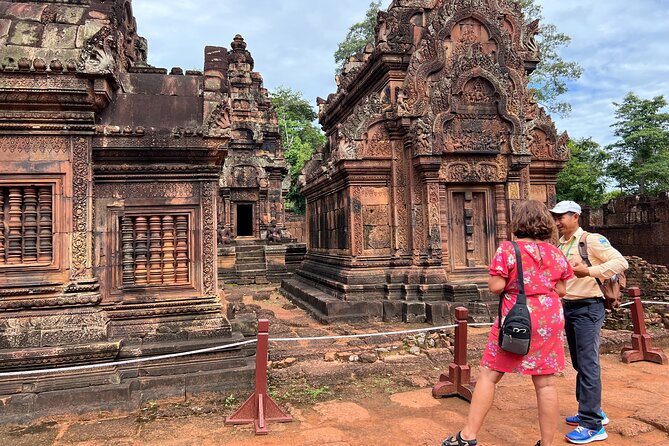
- Banteay Srei is the artistic highlight: Its small sandstone buildings feature exceptionally fine carvings and deserve the planned two-hour visit.
- You eat locally, not just at tourist stops: Day one includes breakfast at a family restaurant near Srah Srang, while day two includes lunch ordered from a menu.
- The guides add real value: Past guide assignments have included Mony, Sareik, Sinan, Sam, Makara, and Jan, with praise for temple knowledge, patience, humor, and photography.
- This is private, but not leisurely: Only your group participates, yet day one covers a lot of ground and can feel long.
Why two days works better than one
Angkor Archaeological Park is not one temple. It is a huge collection of sites spread across a wide area, with different periods, religious ideas, building materials, and moods. A rushed one-day visit can leave you remembering only heat, steps, and a pile of similar-looking stones.
This tour gives you two distinct days. The first focuses on the famous sights and the classic Angkor experience: sunrise, Angkor Wat, Ta Prohm, Angkor Thom, and Bayon. The second moves through quieter temple sites and heads farther into the countryside for Banteay Srei and the Landmine Museum.
I like that division. You see the icons first, then spend the following day noticing smaller details. The second morning begins at 8:00 am rather than before dawn, which gives you a chance to recover from the sunrise start.
The private format is also useful. Your own group participates, so you are not tied to strangers’ pace or forced into a large coach. That matters at temples, where one person may want ten minutes for a carved doorway while another wants to move on. The supplied information also notes group discounts, though the exact discount is not stated.
More Countryside Tours in Siem Reap
- Siem Reap Countryside Bike Tour / E-Bike or Tuk Tuk
★ 5.0 · 935 reviews - Siem Reap Countryside Quad Biking Tour
★ 5.0 · 322 reviews - Siem Reap: Guided Countryside Bike Tour
★ 4.9 · 294 reviews
Day one begins before dawn at Angkor Wat
Hotel pickup takes place between 4:30 am and 5:00 am. You should wait in the lobby 15 minutes early, since the schedule is built around reaching Angkor Wat before sunrise.
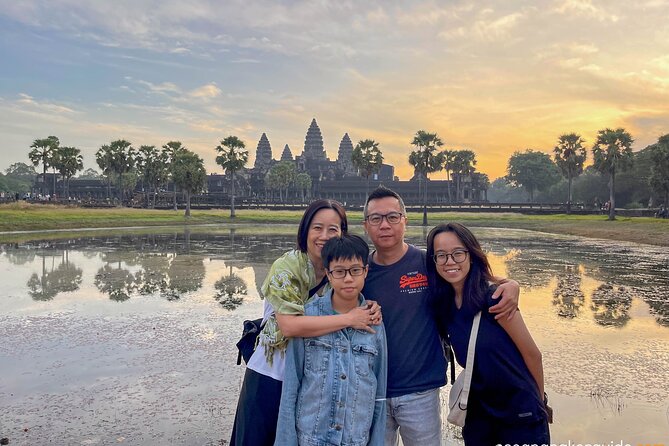
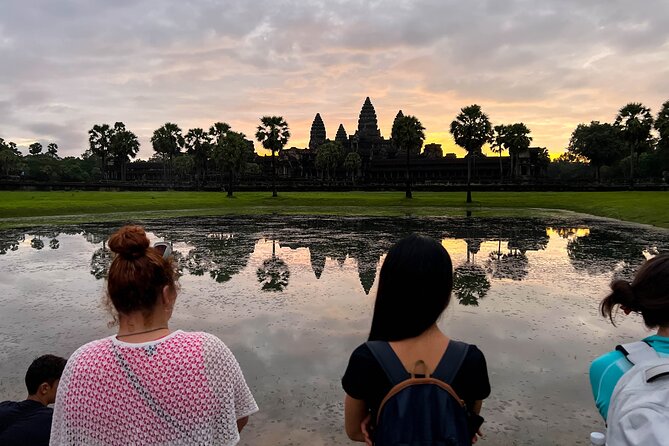
The opening visit lasts about two hours, but the famous sunrise itself is only part of the experience. Darkness gives way to the outline of the towers, then the first light begins to reveal the pools and the long stone causeway. You will be among many people aiming for the same view, but the scale of Angkor Wat still makes this a worthwhile start.
Your Angkor pass is not included. The required two-day pass costs $62 per person, and the operator asks you to have it before the tour begins. This is an important planning detail because a delay at the ticket stage could spoil the sunrise.
Angkor Wat is the best place for your guide to explain the broader story of the park. You can expect interpretation about the temple’s religious purpose, its architecture, and the meaning of its carvings. The strongest guide feedback centers on this kind of explanation. Sinan was praised for a serious, respectful approach, while Sareik was noted for patient explanations and stories connected to his life as a monk and his family’s experience during Cambodia’s war years.
Breakfast at Srah Srang keeps the morning grounded
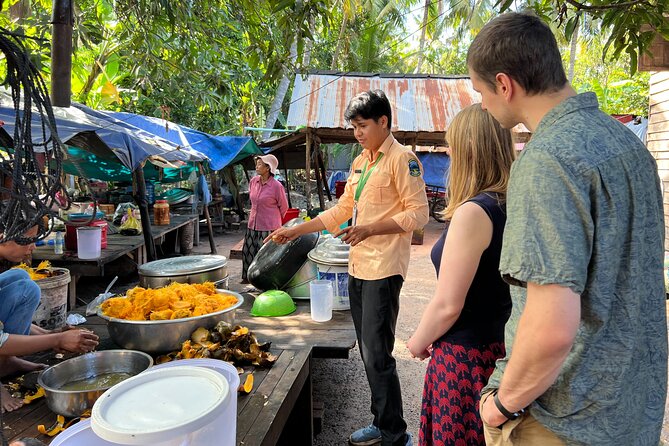
After Angkor Wat, the tour moves to Srah Srang for about an hour. The experience includes breakfast with local food at a family restaurant, and the meal is intended to support a local household.
This is one of the tour’s best touches. After a pre-dawn start, you need food, shade, and a chance to sit down. Eating locally also gives the morning a more human rhythm. Instead of staying inside the temple zone all day, you get a small connection with daily life in Siem Reap.
Vegetarian breakfast is available if you request it in advance. Food and soft drinks beyond the stated meals are not included, so you should ask what is covered and budget for anything extra.
The schedule also refers to a village breakfast and local market experience before continuing to Pre Rup. The exact flow may depend on the day, but the point is clear: this is not only a monument-to-monument circuit.
Pre Rup shows a different side of Angkor
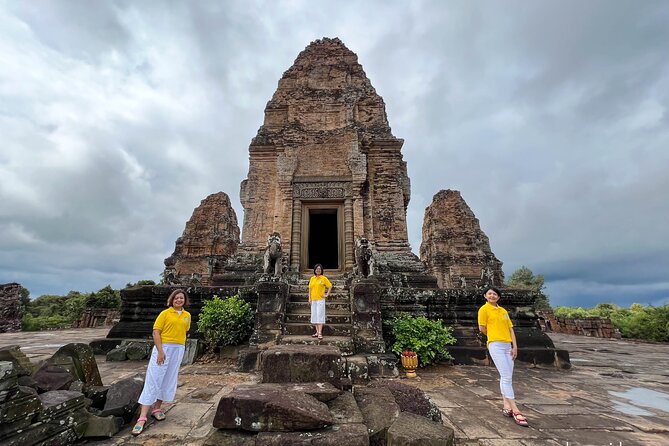
Pre Rup receives about 40 minutes. Built mainly of brick, this Hindu temple has a more severe, warm-colored appearance than the vast sandstone monuments later in the route.
The tall terraces and stacked brick towers reward a slow look at the construction. I would use this stop to compare materials and design rather than simply taking another temple photograph. Your guide can help you understand how Pre Rup fits into the wider development of Angkor architecture.
Forty minutes is enough for an introduction, but it is not a long visit. If you like detailed architectural study, you may wish this stop were longer. The benefit is that the tour keeps moving and saves more time for Ta Prohm and Bayon.
More Banteay Srei trips:
- Full-Day Banteay Srei & 4 Temples – Grand Tours Join-in Tour
★ 5.0 · 1,155 reviews - Siem Reap Tour: Angkor Wat Sunrise, Bayon, Ta Prohm, Banteay Srei
★ 5.0 · 931 reviews - 2-Day Angkor Wat With Small, Big Circuit and Banteay Srei Tour
★ 5.0 · 545 reviews - From Siem Reap: Banteay Srei Temple & Grand 5 Temple Tour
★ 4.8 · 262 reviews
Ta Prohm delivers the famous tree-covered ruins
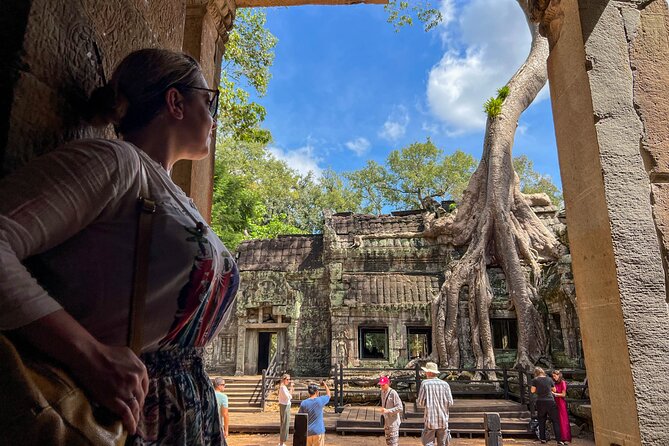
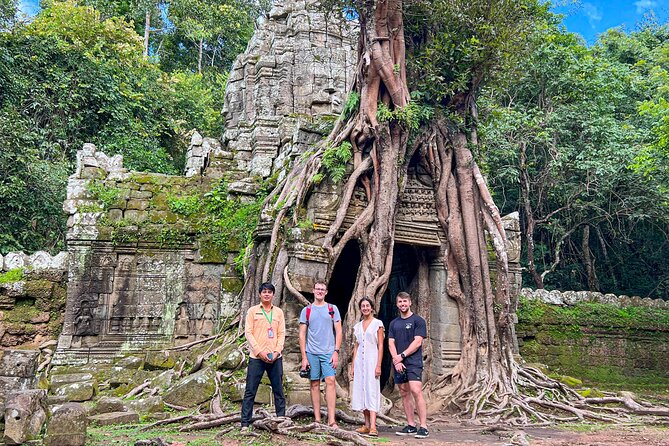
Ta Prohm is given about an hour. It is the temple most associated with giant roots and jungle growth, and parts of it have been left in their original condition.
The attraction is not just the trees. Ta Prohm shows how nature and stone interact when a major monument is no longer maintained as an active religious center. Roots press against walls, doorways frame broken galleries, and narrow passages create a more intimate experience than Angkor Wat’s broad central approach.
You will want sturdy footwear and modest clothing. The temple route includes uneven surfaces, and the Cambodian dress code requires covered knees and shoulders. Shorts are not acceptable simply because the weather is hot, so pack a light shirt or scarf if needed.
The one-hour visit is well judged for most people. Ta Prohm can become tiring if you linger in every corridor, especially after the early start.
Angkor Thom and Bayon provide the day’s great finale
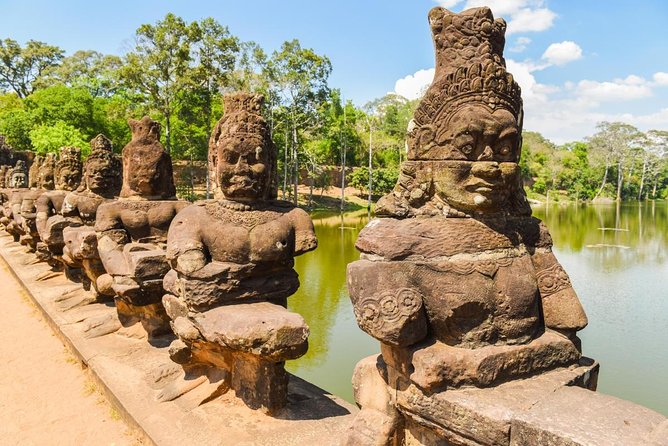
The stop at Angkor Thom’s South Gate lasts about 15 minutes. The gate is decorated with statues of gods and demons, making it a quick but striking introduction to the fortified royal city.
The route description also refers to the Victory Gate, but the scheduled stop is the South Gate. Ask your guide to clarify the exact gate on the day if this distinction matters to you.
Next comes Bayon, with about an hour to explore. Its towers carry more than 200 carved faces, creating the famous calm, smiling expressions associated with the temple. Bayon is less immediately orderly than Angkor Wat, with galleries and towers packed close together. A guide is especially helpful here because the carvings can feel confusing without a sense of the plan.
The first day then returns you to your Siem Reap hotel. This is where the tour’s main weakness becomes obvious. A 4:30 am start, several temples, breakfast, walking, heat, and a return around early afternoon can make the day feel very long even though it ends before evening. One practical solution is to keep your evening free and treat day one as a full physical effort.
Day two explores the outer temple circuit
Pickup is at 8:00 am after breakfast, a much kinder start. The morning covers four temples before lunch, so the pace remains active but lacks the pressure of a sunrise departure.
Preah Khan comes first, with about an hour. This major Buddhist temple gives you another chance to see long galleries, courtyards, carved entrances, and stonework altered by time. It is a useful contrast with Ta Prohm because both have a partly overgrown feel, yet each has its own layout and atmosphere.
Neak Pean follows for about 30 minutes. The temple sits on an artificial island in the Jayatataka Baray reservoir, which was associated with Preah Khan. The setting is different from the main temple compounds, and the short stop works well as a change of pace.
Ta Som receives another 30 minutes. Built at the end of the 12th century for King Jayavarman VII, it is smaller than the major temples but still rewarding for its details and quieter scale. This is the sort of stop that benefits from a guide who can point out what you might otherwise walk past.
Eastern Mebon also lasts about 30 minutes. This 10th-century temple once stood on an artificial island in the East Baray reservoir, which is now dry. Its history helps explain how water management shaped the Angkorian capital, not just agriculture and transport but also temple placement and royal display.
The shorter visits are a strength for anyone who wants variety. They are less suitable if you prefer to sit, sketch, or photograph one site at length.
Lunch and the road to Banteay Srei
Day two includes lunch at a local restaurant, with an individual dish ordered from a menu. This gives you more choice than a fixed group meal, though the cost of food is not separately included beyond the stated tour arrangement. Vegetarian dishes can be arranged if requested in advance.
After lunch, the trip heads toward Banteay Srei. The drive takes you beyond the main city center and adds a countryside element to the temple program. The information provided does not give a precise driving time, so you should expect the afternoon to depend on road conditions and the day’s pace.
Banteay Srei is given two hours, and that is appropriate. This smaller sandstone temple is famous for exceptionally fine reliefs, with careful carving on doorways, lintels, and walls. Its scale makes the detail easier to appreciate than at larger complexes where huge courtyards can dominate your attention.
I would not judge Banteay Srei by size. Its appeal is craft. Look closely at the figures, floral patterns, and layered stone decoration. Your guide can make the visit more useful by explaining what you are seeing rather than leaving you to scan the walls quickly.
The temple is one of the strongest reasons to choose this two-day route. It adds an artistic high point that feels different from the monumental power of Angkor Wat or the tree-covered drama of Ta Prohm.
The Landmine Museum adds difficult modern context
On the return to Siem Reap, the tour stops at the Cambodian Landmine Museum for about 20 minutes. The museum presents different types of mines used during Cambodia’s civil war.
This is a brief visit, but it changes the frame of the trip. The temples belong to Cambodia’s ancient past, while landmines point to the country’s much more recent suffering and recovery. Putting both parts of Cambodian history on the same itinerary helps you see that Siem Reap is not only an archaeological destination.
Admission costs $5 per person and is not included. Twenty minutes is enough for a short introduction, but you should not expect an extensive museum visit at this stop length. The tour then transfers you back to your hotel.
Guides, vehicles, and the small comforts
The strongest praise goes to the guiding. Names associated with the service include Sam, Sinan, Makara, Mony, Sareik, and Jan. Their reported strengths differ slightly, which is useful to know: Sam brought humor and energy, Sinan offered a more serious style, Sareik was patient and informative, and Mony was also praised for photography.
You cannot choose a specific guide from the information provided, so treat those names as examples rather than a promise. The important point is that the operator places a professional English-speaking guide with your group, and the guide is a central part of the value.
Transportation is by air-conditioned minivan or minibus. Cold water and fresh cool towels are provided during the tour. These may sound like minor extras, but in Cambodia’s heat they matter, especially on day one when the walking begins before sunrise and continues through several temple compounds.
The tour is described as private, with only your group participating. That gives you more control than a large group departure, though the packed first day still follows a fairly fixed route.
What the $160 price really covers
At $160 per person, the tour includes hotel pickup and return, air-conditioned transport, an English-speaking guide, breakfast on day one, lunch on day two, water, and towels. The private format adds value if you are traveling with family or friends and want the day to move at your own group’s pace.
The required extra costs are significant:
- Two-day Angkor pass: $62 per person
- Landmine Museum: $5 per person
- Extra food and soft drinks not listed as included
That puts the known cost at $227 per person before additional drinks or other food. The tour is still reasonable if you want a guide and private transport for two substantial days, but it is not a $160 all-in experience.
I would compare it with the cost of arranging a driver, guide, and meals separately. The advantage here is convenience and a prepared route. You do not need to negotiate transport between distant temples or work out which smaller sites fit together.
Who should book this temple tour?
I would recommend it to you if you have two days in Siem Reap and want a broad introduction to Angkor without planning every transfer yourself. It suits people who value explanations, local meals, a private vehicle, and a route that includes both major monuments and smaller sites.
It is also a good choice if Banteay Srei is high on your list. The two-hour visit gives that temple the attention it deserves instead of treating it as a quick photo stop.
I would hesitate if you dislike early starts, heat, uneven ground, or a full sightseeing schedule. The first morning is demanding, and the number of stops means you will not have unlimited time at each temple.
Book with a few practical preparations. Get the Angkor pass before day one, wait in the lobby early, wear clothing covering your knees and shoulders, request vegetarian food in advance if needed, and keep the first evening quiet. Free cancellation is available up to 24 hours before the start time, subject to the stated minimum-group condition.
Final verdict: a strong two-day Angkor introduction
I like this tour because it does more than deliver the famous Angkor Wat photograph. You get sunrise, local breakfast, Ta Prohm’s roots, Bayon’s faces, the quieter outer temples, finely carved Banteay Srei, and a short but meaningful look at Cambodia’s modern past.
Its weak point is the long first day, not poor planning. If you accept the early alarm and added admission costs, the route offers very good value and a useful balance of major sights, smaller temples, countryside, food, and interpretation.
For a first visit to Siem Reap, I would book it if you have two full days and want the history explained along the way. If you have only one day, choose a shorter Angkor plan, because this itinerary’s strength is the extra time it gives you beyond the main temple circuit.
FAQ
Is the Angkor pass included in the $160 price?
No. The required two-day Angkor pass costs $62 per person and must be arranged before the tour starts.
What time is pickup on the first day?
Hotel pickup is scheduled between 4:30 am and 5:00 am. You should wait in the hotel lobby 15 minutes before the scheduled pickup time.
What meals are included?
Breakfast with local food is included on day one. Lunch is included on day two, with an individual dish ordered from a menu.
Can vegetarian meals be provided?
Yes. You must tell the operator in advance so vegetarian breakfast and lunch options can be arranged.
Is the Landmine Museum ticket included?
No. The museum ticket costs $5 per person and is paid separately.
Is this a private tour?
Yes. Only your own group participates in the activity, with transportation provided by air-conditioned minivan or minibus.
More 2-Day Experiences
- Angkor 2-Day Sunset & Sunrise Small-Group Tour
★ 5.0 · 2,567 reviews - 2 Days Exclusive Temple Highlights with Sunset and Sunrise Tour
★ 5.0 · 1,157 reviews - Siem Reap: Angkor Sunrise 1- or 2-Day Guided Temples Tour
★ 4.9 · 1,132 reviews - 2 Days Guided Historical Tour in Angkor
★ 5.0 · 855 reviews
More Angkor Wat Tours
- Angkor Wat Sunrise or Sunset Tour with Guide from Siem Reap
★ 5.0 · 12,109 reviews - Siem Reap: Angkor Wat: Small-Group Sunrise or Sunset Tour
★ 5.0 · 9,444 reviews - Siem Reap: Angkor Wat 2-Day Tour with Sunrise and Sunset
★ 4.9 · 4,429 reviews - Siem Reap: Full-Day Angkor Wat Guided Tour with Sunset
★ 4.9 · 3,803 reviews
Just added around Siem Reap
- Private Battambang Full-Day Guided Tour★ 4.5 · 3 reviews
- Kulen Mountain, Beng Mealea and Banteay Srei Full Day Tour★ 5.0 · 3 reviews
- Kompong Pluk Tour★ 5.0 · 3 reviews
- Private 3 Day Tour to Discover the ancient temples★ 5.0 · 3 reviews
- Kulen National Park Ticket -Waterfall & 1000 Lingas★ 5.0 · 3 reviews
- Cambodia: Absolute Traditional Dance Show with Buffet Dinner★ 5.0 · 3 reviews
- Border Transfer (Siem Reap to Laos/Laos to Siem Reap)★ 3.5 · 3 reviews
- Best Taxi Siem Reap to Battambang – English Speaking Driver★ 4.5 · 3 reviews
Angkor Wat Tours, compared.

Angkor Wat Sunrise or Sunset Tour with Guide from Siem Reap
Read our review →
Angkor Wat: Small-Group Sunrise or Sunset Tour
Read our review →
Angkor Wat 2-Day Tour with Sunrise and Sunset
Read our review →

Angkor Wat Sunrise tour with Small – Group and Guide tours
Read our review →
Angkor Wat Highlights and Sunrise Guided Tour from Siem Reap
Read our review →
Angkor Wat Sunset Small Group Tour with Lunch Included
Read our review →
Full-Day Angkor Wat Sunrise Private Tour with Guide from Siem Reap
Read our review →Browse the lists this tour appears in