
Reviewed · SUNSET TOURS
2 Days Exclusive Temple Highlights with Sunset and Sunrise Tour
Sunrise makes Angkor Wat unforgettable. This two-day Siem Reap tour pairs the major Angkor temples with quieter ruins, an English-speaking guide, and an air-conditioned vehicle, making it a strong first look at Cambodia’s ancient capital. I like the well-planned temple mix, which includes famous sites and less-visited corners, and I like the steady supply of bottled water and cool towels. The main catch is the extra $62 temple pass, while meals are also on your own.
The schedule is full, but it does not simply race from one photo stop to the next. Guides such as Pal Saruon, Chhay, Sokpee, Sak, and Vantha have been praised for clear explanations, good timing, and taking photos when asked. You should still expect long walks, early mornings, hot weather, and two energetic days.
In This Review
- Key points to know before you book
- Why this two-day plan works for first-time visitors
- Day 1: Pre Rup and the finely carved Banteay Srei
- Day 1: Neak Pean and Preah Khan among water and roots
- Sunset choices: rice fields or Bakheng Mountain
- Day 2: Angkor Wat before dawn
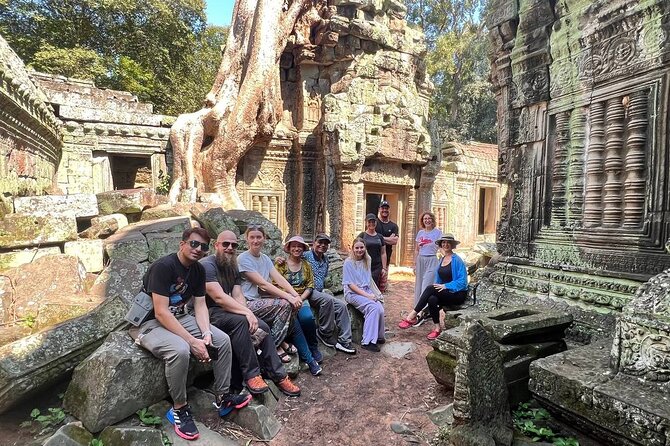
- Ta Prohm and Ta Nei: two very different ruins
- Angkor Thom, Bayon, and the city gates
- Guides, drivers, and the comfort details that matter
- What the $49 price really includes
- Who will enjoy this tour most
- Should you book the two-day Angkor tour?
- FAQ
- How much does the tour cost?
- Is hotel pickup included?
- Does the tour visit Angkor Wat at sunrise?
- Which temples are included?
- Is the tour private or shared?
- Are meals included?
- What should I wear to the temples?
Key points to know before you book
- Angkor Wat at sunrise on Day 2: The tour saves the biggest moment for the second morning, with a pre-dawn departure and entry from the eastern side.
- A broad temple selection: You visit Pre Rup, Banteay Srei, Neak Pean, Preah Khan, Ta Prohm, Ta Nei, and Angkor Thom.
- Cool transport matters: The air-conditioned vehicle, water, and cold towels are useful comforts after walking among the stone ruins.
- The $49 price is not the full cost: Add the required $62 pass for two or three days, plus your own meals and drinks.
- A choice of sunset settings: Private arrangements include sunset among rice fields at Baitang, while small-group arrangements include sunset at Bakheng Mountain.
- A busy but carefully timed plan: You see a lot in two days, yet the guide usually allows time to explore on your own.
Why this two-day plan works for first-time visitors
Angkor is not one temple. It is a huge archaeological area spread around Siem Reap, with monuments from different periods and religious traditions. Going independently can mean spending too much time finding each site, missing a major temple, or arriving at the wrong time for sunrise.
This plan gives you a useful structure. Day 1 focuses on several temples outside the most familiar central circuit, then finishes with sunset. Day 2 brings you to Angkor Wat, Ta Prohm, Ta Nei, and Angkor Thom.
I like the order. You do not burn out on Angkor Wat during the first morning and then spend the rest of the visit comparing every ruin with it. Instead, you build up to Angkor Wat on Day 2, when the temple is still fresh in your mind and the pre-dawn setting gives the visit extra drama.
The tour is listed at $49 per person, which is a low starting price for two days of transport and guiding. But the required temple pass costs another $62 per person for a two or three-day visit. That puts the basic admission and tour cost at $111 before food and drinks.
That is still a reasonable deal if you want transportation, a guide, and a tightly arranged route. It is less attractive if you already have a vehicle, prefer to explore alone, or want a slow visit with only two or three temples per day.
The exact vehicle arrangement depends on the option you choose. Small-group departures are available, and private upgrades are offered for people who want more control over the pace. The included information also describes a private air-conditioned vehicle and participation limited to your own group, so check the selected option carefully before paying.
More sunset tours:
- Angkor Wat Sunrise or Sunset Tour with Guide from Siem Reap
★ 5.0 · 12,109 reviews - Siem Reap: Angkor Wat: Small-Group Sunrise or Sunset Tour
★ 5.0 · 9,444 reviews - Sunset tour of Kampong Phluk stilts home village on the Tonle Sap
★ 5.0 · 4,865 reviews
Day 1: Pre Rup and the finely carved Banteay Srei
Pre Rup is a strong opening stop. Built as a state temple by King Rajendravarman and dedicated in 961 or early 962, it is a temple mountain made from brick, laterite, and sandstone.
The design gives you a useful introduction to Khmer temple planning. You climb toward the central upper levels and see how the monument was intended to rise above its surroundings. The one-hour visit is long enough for a guide to explain the structure without making the first stop feel heavy.
Pre Rup is also a reminder that Angkor is more than one famous facade. Its worn surfaces and warm brick tones offer a different look from the gray sandstone temples later in the day.
Next comes Banteay Srei, with about two hours to explore. This smaller temple is famous for its detailed sandstone carvings, which remain unusually fine and well preserved. The scale is more intimate than Angkor Wat, but the decoration demands close attention.
This is where a good guide helps. A casual walk can turn Banteay Srei into a quick sequence of pretty walls. With explanations, you can better understand the figures, stories, and craftsmanship carved into the pinkish stone.
Banteay Srei is located farther from the central Angkor temples, so the drive takes time. That distance is part of the tradeoff. You spend more time in the vehicle, but you gain one of the most distinctive monuments in the area. If you care about sculpture and small details, this is one of the day’s best stops.
Day 1: Neak Pean and Preah Khan among water and roots
Neak Pean changes the mood. The temple sits on an artificial island and is reached across a causeway. The setting is open and watery, a contrast to the stone towers and enclosed galleries at other sites.
The planned visit lasts about an hour. You are not getting a long temple exploration here, but the stop gives the day some variety. Your guide can explain the Buddhist purpose of the site and the role of water in its design.
Preah Khan follows, with roughly two hours. This large ruin is atmospheric without relying on a single iconic view. Tree roots, broken stone, long corridors, and crumbling structures create a sense of a former complex slowly being reclaimed by the forest.
Preah Khan rewards a slower pace. Let your guide explain what you are looking at, then take time to notice the details yourself. The long layout can feel confusing, so the guide’s help is especially useful here.
The drawback is simple: by this point, you may already have walked through several temples. Comfortable shoes are not a minor suggestion. Uneven stone, steps, heat, and repeated walking can make the second afternoon tiring.
Sunset choices: rice fields or Bakheng Mountain
The final stop on Day 1 depends on the tour format. With the private option, you relax for about two hours at Baitang in the Siem Reap rice fields. This is a calmer, more local-feeling end to a day of ruins, with a cold drink and a light local snack available.
I like this option for people who do not need another crowded viewpoint. Sitting in the countryside lets you shift gears and see a quieter side of Siem Reap. Food and drinks are not included in the tour price, so budget separately.
Small-group arrangements include sunset at Bakheng Mountain instead. This is a classic Angkor sunset location, and the view gives you a broad sense of the temple region. It may suit you better if a high viewpoint and a traditional temple experience matter more than a relaxed countryside stop.
Because sunset conditions and site access can affect the experience, do not treat the final stop as the main reason to book. The temple visits and Day 2 sunrise are the stronger anchors. Still, the choice between rice fields and Bakheng can shape the feel of the evening, so confirm which option applies to you.
A few more trips worth weighing up
- Siem Reap: Angkor Wat 2-Day Tour with Sunrise and Sunset
★ 4.9 · 4,429 reviews - Siem Reap: Full-Day Angkor Wat Guided Tour with Sunset
★ 4.9 · 3,803 reviews - Angkor Wat Sunset Small Group Tour with Lunch Included
★ 5.0 · 3,059 reviews - Angkor 2-Day Sunset & Sunrise Small-Group Tour
★ 5.0 · 2,567 reviews
Day 2: Angkor Wat before dawn
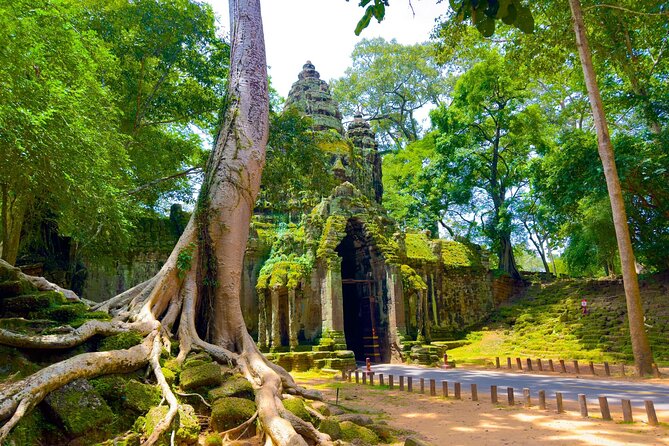
Day 2 begins before sunrise. Bring a torch, as the plan calls for entering Angkor Wat in darkness from the quieter eastern side before moving through its galleries.
This is one of the cleverest parts of the schedule. Many people arrive only for the familiar reflection-pool view, then leave once the sky brightens. Entering from the eastern side gives you a different approach and lets you experience the temple before daylight fills the courtyards.
You should prepare for a very early start and limited visibility at first. Wear shoes that are easy to walk in, keep your belongings secure, and bring a small torch rather than relying only on a phone light.
The Angkor Wat visit lasts about three hours. That gives your guide time to cover the temple’s layout, religious purpose, carvings, and major galleries while leaving some space for your own photographs and quiet looking.
Sunrise is not guaranteed to produce dramatic color. Clouds can soften the view, and crowds can gather around popular photo points. Even so, the timing gives the temple a sense of occasion that a midday visit often lacks.
Several people have praised guides for finding useful photo positions and taking pictures for the group. That is a welcome service, especially when you are traveling with children or want a full-group photo. You should still allow time to look without a camera in your hand.
Ta Prohm and Ta Nei: two very different ruins
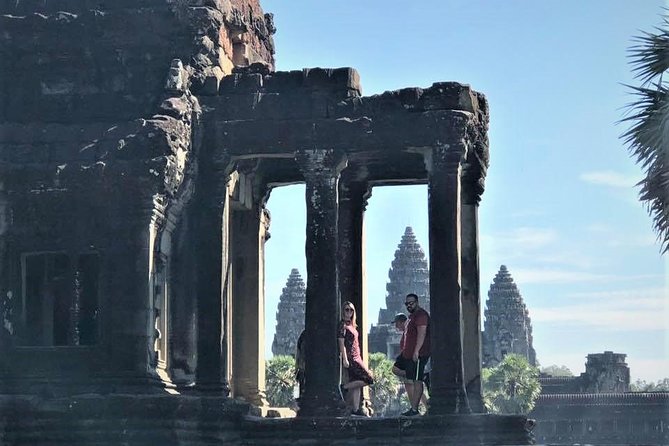
After Angkor Wat, the route moves to Ta Prohm for about two hours. This is the temple many people associate with jungle roots and the film Tomb Raider. Its appeal is immediate: trees press against walls, roots cross galleries, and the ruin feels caught between preservation and nature.
Ta Prohm can be busy, and its most famous sections attract plenty of attention. Your guide can help you understand the site beyond the recognizable tree-root photographs. The temple was once home to 2,740 monks, a detail that helps you picture it as a working religious community rather than a silent ruin.
The two-hour stop is generous, but the walking can be demanding after sunrise. If you are tired, tell your guide. The route includes enough major sights that you do not need to inspect every corridor.
Ta Nei provides a quieter contrast. This late 12th-century stone temple is located within Angkor and receives less attention than Ta Prohm. The visit lasts about an hour, giving you a chance to see a smaller ruin without the same pressure to find the famous angle.
Ta Nei is valuable because it slows the rhythm. You have already seen a major temple wrapped in roots, and now you get a more subdued site where the structure itself matters. Do not expect the same scale or polish as Angkor Wat. Its appeal is the more restrained atmosphere.
Angkor Thom, Bayon, and the city gates
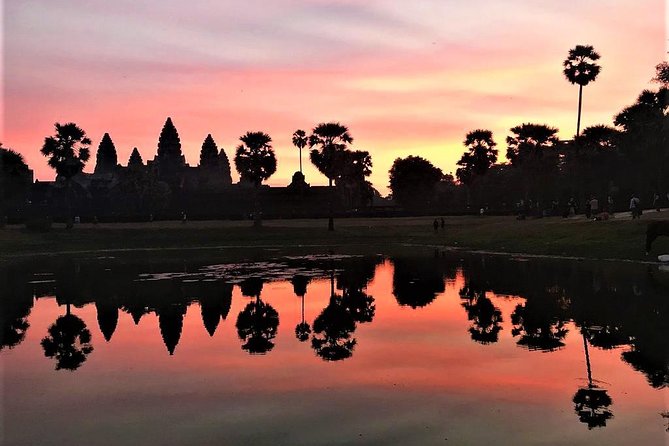
The afternoon continues to Angkor Thom, the former capital of the Khmer Empire. The site is not just one temple but a vast walled city area, and the scale helps you understand the power that once centered here.
The itinerary includes about 90 minutes at Angkor Thom, along with passes by the Terrace of the Elephants and the Terrace of the Leper King. These terraces are important parts of the city, even though the schedule does not give them separate long visits.
Bayon is the main temple focus. Its stone faces are among the most recognizable images in Cambodia, but the site can be hard to read without context. The towers, galleries, and shifting views make more sense when your guide explains how the temple fits into the former capital.
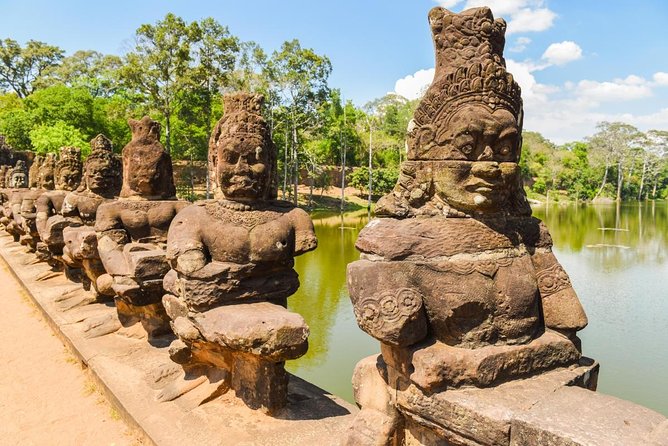
The route also includes about 30 minutes at the South Gate. The gate provides a strong visual introduction to Angkor Thom, with its monumental entrance and approach across the moat.
The time here is practical rather than leisurely. You get the major elements, but you will not explore every corner of the old capital. That is a fair compromise for a two-day introduction, especially since the plan has already included several outlying temples.
Guides, drivers, and the comfort details that matter
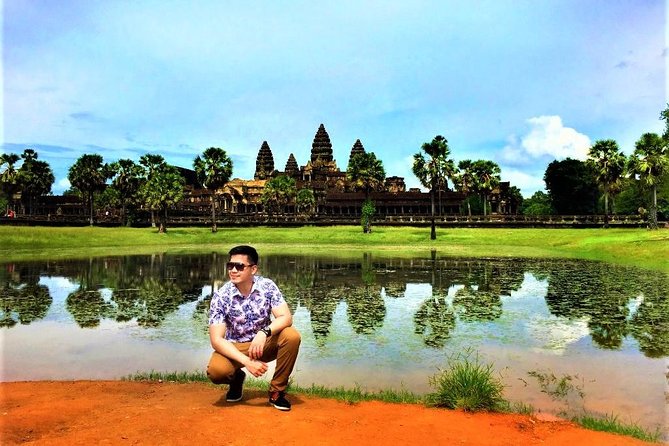
The strongest pattern in this experience is the quality of the guide service. Names repeatedly praised include Pal Saruon, Chhay, Sokpee, Sok, Sak, Vantha, and Vongsetha. The useful qualities are not just facts about dates and kings. Good guides explain Cambodian customs, daily life, religious meaning, and the purpose of each building.
Pal Saruon has been praised for patience, time management, and helping with photographs. Chhay is noted for explaining both temple history and Cambodian life. Sokpee is described as friendly and clear, while Vantha is praised for helping with sunrise and sunset views.
Your experience will depend on the guide assigned to your departure, so you should not book solely around one name. Still, the consistent pattern is encouraging: the guides appear to balance instruction with time for personal exploration.
The driver matters, too. Names such as Seyha, Vichet, Mao, Ro, Keal, and Bun Ly appear in strong feedback for careful driving, punctual pickups, and attentive service. You are in the vehicle repeatedly over two days, so a calm driver and a clean, air-conditioned van make a real difference.
Bottled water is supplied throughout the tour, and cool towels are offered during the temple stops. In Siem Reap’s heat, these are practical comforts, not fancy extras. They help you recover between walks and reduce the need to carry large amounts of water yourself.
What the $49 price really includes
At $49 per person, the tour offers good value if you want a guide and transport without arranging each temple transfer yourself. The price includes an English-speaking guide, an air-conditioned vehicle, hotel pickup and drop-off when that option is selected, bottled water, and cool towels.
The required temple pass is separate and costs $62 per person for two or three days. This is the biggest extra expense, and you should include it in your mental price from the beginning.
Meals and drinks are also separate. The tour may stop at breakfast or lunch places, but you choose and pay for what you order. One practical warning: dining stops can cost more than similar places in town, with average food at higher prices. If you want to control your budget, ask about the stop and carry a little extra food.
Group discounts may be available, and mobile tickets are supported. Confirmation is provided when you book. Free cancellation is available up to 24 hours before the start time, but changes or cancellations inside that window are not accepted.
Who will enjoy this tour most
I would choose this experience for a first visit to Siem Reap when I wanted to see the major temples without spending days planning routes. It suits couples, families with an adult present, and small groups that value a guide’s explanations and help with timing.
It also works for people with a limited schedule. One person managed to finish the second day in time for a 3:30 p.m. bus to Phnom Penh, though you should confirm your own transport plans rather than assume the same timing.
You should think twice if you dislike early mornings, long walks, organized schedules, or temple crowds. The plan is full and energetic. It gives you breadth, not unlimited time at each ruin.
Wear comfortable walking shoes and respectful clothing. Shoulders and knees must be covered for both men and women, and a scarf over the shoulders is not accepted as a substitute. Entry can be refused if you do not follow the dress rules.
Should you book the two-day Angkor tour?
Book it if you want a well-paced introduction that covers Angkor Wat, Ta Prohm, Angkor Thom, Banteay Srei, and several less familiar temples. The sunrise timing, wide temple selection, helpful guides, careful drivers, air-conditioning, water, and cold towels make the $49 starting price worthwhile once you add the required $62 pass.
Choose a private option if you want more control over the pace and prefer the rice-field sunset at Baitang. Choose the small-group version if you like meeting other people and want sunset at Bakheng Mountain.
I would not book it expecting a slow, solitary examination of every monument. You will see a lot, walk a lot, and follow a firm schedule. But for two days in Siem Reap, this is a sensible way to get the big sights, a few quieter ruins, and the unforgettable chance to watch dawn arrive at Angkor Wat.
FAQ
How much does the tour cost?
The tour price is $49 per person. A separate $62 temple pass for two or three days is payable on the day of the activity, and food and drinks are not included.
Is hotel pickup included?
Hotel pickup and drop-off are included when that option is selected.
Does the tour visit Angkor Wat at sunrise?
Yes. Day 2 begins before dawn, with sunrise at Angkor Wat. You should bring a torch for the early entry.
Which temples are included?
The route includes Pre Rup, Banteay Srei, Neak Pean, Preah Khan, Angkor Wat, Ta Prohm, Ta Nei, and Angkor Thom. It also passes the Terrace of the Elephants, the Terrace of the Leper King, and Angkor Thom South Gate.
Is the tour private or shared?
The experience offers small-group and private options. The private option lets your group travel at its own pace, while the small-group option may include sunset at Bakheng Mountain. Check the option you select when booking.
Are meals included?
No. Food and drinks are not included, although stops may be made at restaurants or cafes. Bottled water and cool towels are provided.
What should I wear to the temples?
Your shoulders and knees must be covered. This rule applies to both men and women, and a scarf used to cover the shoulders is not accepted. Comfortable walking shoes are recommended.
More 2-Day Experiences
- Siem Reap: Angkor Sunrise 1- or 2-Day Guided Temples Tour
★ 4.9 · 1,132 reviews - 2 Days Guided Historical Tour in Angkor
★ 5.0 · 855 reviews - 2-Day Angkor Wat With Small, Big Circuit and Banteay Srei Tour
★ 5.0 · 545 reviews - Siem Reap: 2-Day Temple Highlights Sunrise and Sunset Option
★ 4.9 · 445 reviews
More Morning
- Angkor Wat Sunrise tour with Small – Group and Guide tours
★ 5.0 · 3,655 reviews - Angkor Wat Highlights and Sunrise Guided Tour from Siem Reap
★ 5.0 · 3,213 reviews - Full-Day Angkor Wat Sunrise Private Tour with Guide from Siem Reap
★ 5.0 · 2,920 reviews - Angkor Wat Sunrise & 3 Main Temples with Breakfast – Small Group
★ 5.0 · 2,857 reviews
Just added around Siem Reap
- Private Battambang Full-Day Guided Tour★ 4.5 · 3 reviews
- Kulen Mountain, Beng Mealea and Banteay Srei Full Day Tour★ 5.0 · 3 reviews
- Kompong Pluk Tour★ 5.0 · 3 reviews
- Private 3 Day Tour to Discover the ancient temples★ 5.0 · 3 reviews
- Kulen National Park Ticket -Waterfall & 1000 Lingas★ 5.0 · 3 reviews
- Cambodia: Absolute Traditional Dance Show with Buffet Dinner★ 5.0 · 3 reviews
- Border Transfer (Siem Reap to Laos/Laos to Siem Reap)★ 3.5 · 3 reviews
- Best Taxi Siem Reap to Battambang – English Speaking Driver★ 4.5 · 3 reviews
Sunset Tours, compared.

Angkor Wat Sunrise or Sunset Tour with Guide from Siem Reap
Read our review →
Angkor Wat: Small-Group Sunrise or Sunset Tour
Read our review →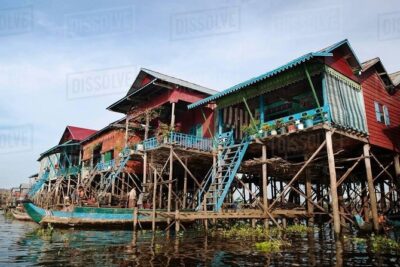
Sunset tour of Kampong Phluk stilts home village on the Tonle Sap
Read our review →
Angkor Wat 2-Day Tour with Sunrise and Sunset
Read our review →

Angkor Wat Sunset Small Group Tour with Lunch Included
Read our review →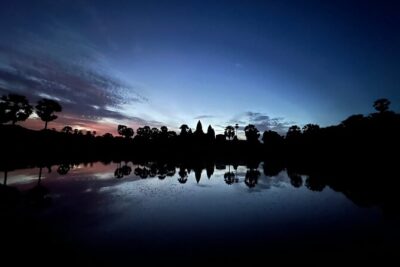
Angkor 2-Day Sunset & Sunrise Small-Group Tour
Read our review →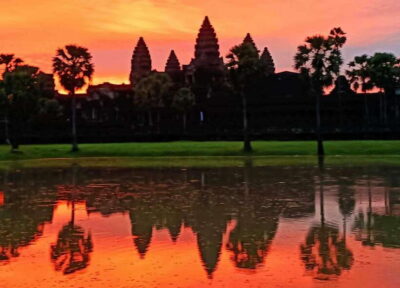
Browse the lists this tour appears in