
Reviewed · ANGKOR WAT TOURS
2-Day Best of Angkor Wat and Tonle Sap Lake Tour
Two days, two very different Cambodian worlds. This private Siem Reap tour pairs the grand temples of Angkor with the floating community of Kampong Phluk, giving you both ancient Khmer culture and modern lake life. I like the private air-conditioned vehicle and the chance to shape the pace with your own guide. I also like the clear focus: Angkor’s key monuments on day one, then Tonlé Sap on day two.
The main drawback is cost clarity. The advertised $99 price does not include the required $37 Angkor Pass, food, drinks, or insurance, so your real basic cost begins at $136 per person before meals and any other extras. Still, the private format and two full sightseeing days can make the price fair for families or small groups.
In This Review
- Key points to know before booking
- Why this two-day plan works in Siem Reap
- Angkor Wat begins the 8 a.m. temple day
- Angkor Thom brings royal scale and city walls
- Bayon’s stone faces reward a slower look
- The Elephant Terrace shows royal ceremony
- Ta Prohm closes the temple route
- Kampong Phluk changes the pace on day two
- What the private format adds
- Is $99 per person a fair price?
- Who should book this experience?
- FAQ
- Is the Angkor Pass included in the tour price?
- Does the tour include hotel pickup and drop-off?
- Is this a private tour?
- What clothing can I wear at the temples?
- How long is the Tonlé Sap boat ride?
- Can I cancel for a full refund?
- Should you book the two-day Angkor and Tonlé Sap tour?
Key points to know before booking
- The $99 price excludes the $37 Angkor Pass, which you must buy separately.
- Day one covers five major Angkor stops, including Angkor Wat, Bayon, the Elephant Terrace, and Ta Prohm.
- Day two reaches Kampong Phluk by local boat, with about 45 minutes of road travel and a listed 1.5-hour boat ride.
- Your guide and driver are reserved for your group, not mixed with strangers.
- Guide Sophy earned special praise for being attentive and well informed during a family visit.
- Temple clothing rules are strict, with trousers or knee-length skirts and dresses permitted.
Why this two-day plan works in Siem Reap
Angkor can feel confusing on a first visit. The temple park covers a huge area, and its buildings come from several periods and religious traditions. You can certainly hire transport and wander on your own, but a good guide helps connect the carvings, rulers, religious changes, and building styles.
This tour gives you a useful first look rather than trying to cover every temple in the park. Day one is devoted to the major sights most people hope to see. That makes sense if you have limited time, especially since Angkor Wat, Bayon, and Ta Prohm each offer a different experience.
Day two changes the subject completely. Instead of more stone temples, you travel into the countryside and onto Tonlé Sap Lake. Kampong Phluk offers a look at a water-based community and the routes people use to reach the lake. I like this contrast. You are not spending two straight days moving from one temple gate to another.
The tour is private, but that does not mean it is self-directed from start to finish. Pickup is set for 8 a.m. on both days, and the stops follow a planned route. You gain privacy, air conditioning, and a guide focused on your group, but you should still expect a structured sightseeing day.
More Angkor Wat tours we have reviewed:
- Angkor Wat Sunrise or Sunset Tour with Guide from Siem Reap
★ 5.0 · 12,109 reviews - Siem Reap: Angkor Wat: Small-Group Sunrise or Sunset Tour
★ 5.0 · 9,444 reviews - Siem Reap: Angkor Wat 2-Day Tour with Sunrise and Sunset
★ 4.9 · 4,429 reviews
Angkor Wat begins the 8 a.m. temple day
The first morning starts with hotel pickup in Siem Reap in an air-conditioned vehicle. You then go to the Angkor Wat Ticket Office to purchase the required Angkor Pass. The pass costs $37 per person and is not included in the tour price.
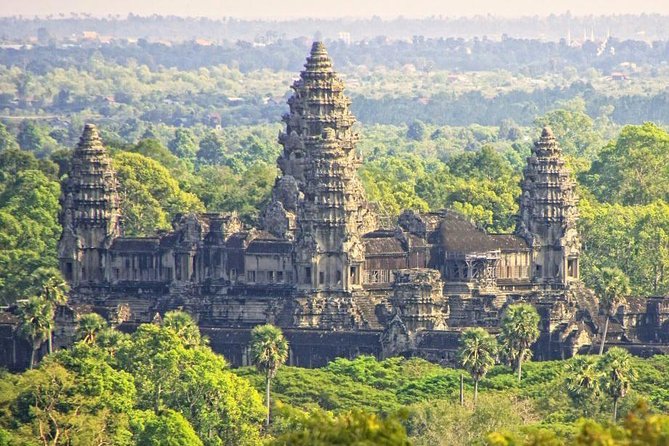
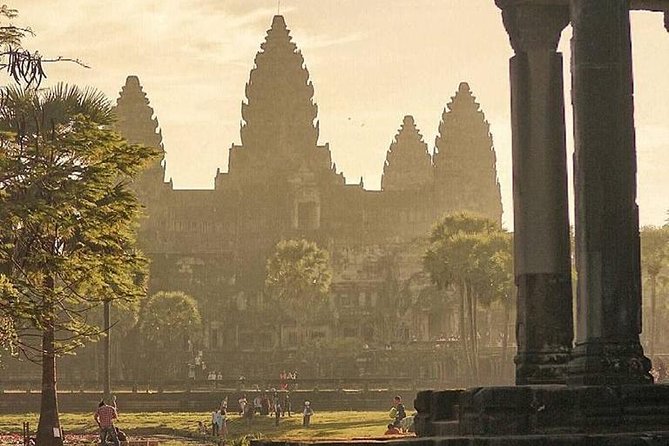
Angkor Wat receives about three hours in the schedule, making it the longest stop of the first day. That is sensible. The temple is not a quick photo stop. You need time to cross its outer areas, study the galleries, and take in the scale of the main structure.
Your guide should help you understand what you are seeing rather than simply point out doorways and towers. The temple was built as a major Khmer religious monument, and its carvings and layout reward slow attention. Ask questions as you go. Since this is a private tour, you have a better chance to pause when something catches your eye.
There are practical matters to remember here. You will be walking and standing for long periods, so the moderate fitness requirement is worth taking seriously. Wear sensible shoes, bring water, and dress for temple rules. Trousers or a knee-length skirt or dress are permitted, while shorter clothing is not.
The main limitation is that the three-hour schedule has to balance Angkor Wat with four more stops. If you want a very slow study of every gallery, this itinerary may feel brisk. If you want a well-organized first visit, the timing gives you enough room to see the main areas without allowing the morning to disappear at one monument.
Angkor Thom brings royal scale and city walls
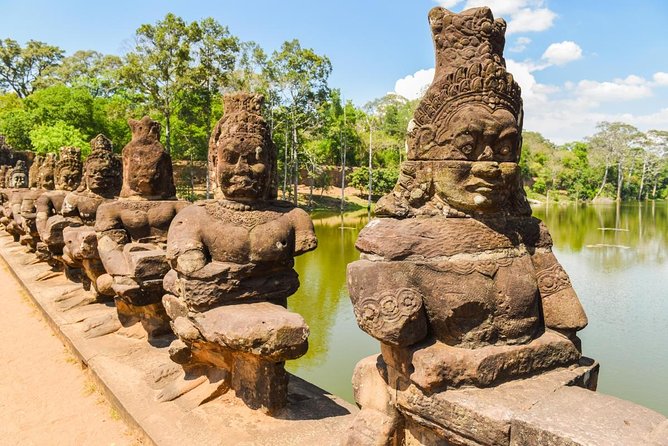
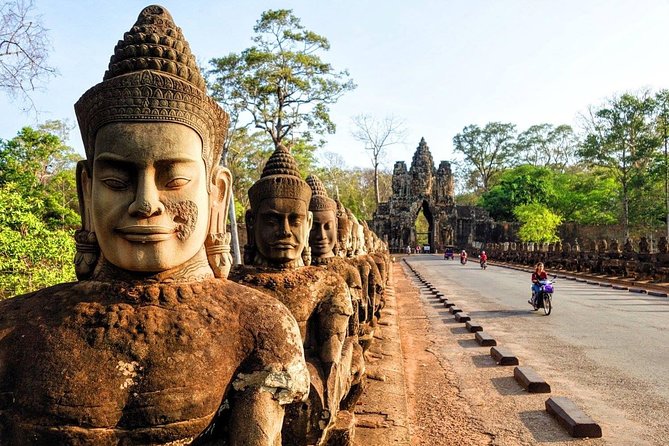
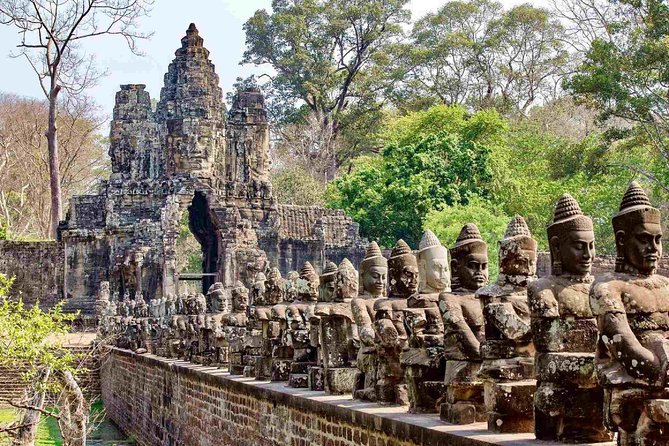
After Angkor Wat, the route continues to Angkor Thom South Gate for about 30 minutes. Angkor Thom was a major walled city, and its defensive walls were roughly 6 meters wide, 8 meters high, and 13 kilometers long.
Those numbers help you understand the scale better than a quick photograph does. This was not just a single temple surrounded by jungle. It was a large royal center with space for the king, officials, priests, soldiers, and members of the royal household.
The South Gate is a useful introduction to that larger setting. Your guide can place the gate and walls in the context of the wider complex, which makes the next stops easier to understand. I would treat this half hour as a scene-setting visit rather than a full exploration of Angkor Thom’s many monuments.
The itinerary marks admission as not included at the individual stops because access depends on the Angkor Pass you buy at the beginning. Keep that pass with you during the day.
Bayon’s stone faces reward a slower look
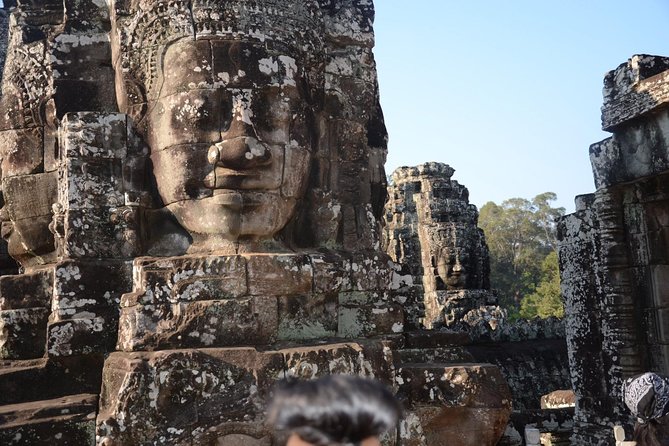
The Bayon Temple receives about 45 minutes. Built in the late 12th or early 13th century under the Mahayana Buddhist king Jayavarman VII, Bayon served as the state temple at the center of Angkor Thom.
Its most memorable feature is the collection of enormous carved faces. They appear from different angles as you move through the temple, and the close quarters make Bayon feel very different from the broad, ordered approach to Angkor Wat.
Forty-five minutes is enough for a focused introduction, especially with a guide explaining the temple’s role and decoration. It is not enough for every carving and passageway. You will need to accept that this is a highlight visit, not an archaeological study session.
I like the order here. Angkor Thom’s South Gate gives you the city setting, then Bayon shows you the religious and royal heart of that city. Without that context, Bayon can look like a maze of stone faces. With it, the temple becomes easier to read.
More Tonle Sap floating village trips:
- From Siem Reap: Kampong Phluk Floating Village Tour by Boat
★ 4.9 · 6,979 reviews - Sunset tour of Kampong Phluk stilts home village on the Tonle Sap
★ 5.0 · 4,865 reviews - Siem Reap: Kampong Phluk Floating Village Tour with Boat
★ 4.9 · 3,843 reviews - Siem Reap Floating Village Kampong Phluk Sunset with Boat
★ 5.0 · 1,962 reviews
The Elephant Terrace shows royal ceremony
The next section lasts about an hour and includes the Terrace of the Elephants and the Terrace of the Leper King. These terraces were connected with royal ceremony and display.
The Terrace of the Elephants functioned as a platform from which the king could welcome back a victorious army. That detail gives the long carved platform a clear purpose. You are not just looking at a wall covered in decoration. You are seeing part of the stage on which the royal court presented power.
The Terrace of the Leper King is known for its detailed carvings. The combined one-hour visit should allow your guide to explain both terraces and give you time to inspect the reliefs.
This stop may appeal to you if you enjoy how architecture fits into political life. It is less about entering a single grand building and more about reading the public spaces of the old city. The tradeoff is that the terraces may not produce the same immediate impact as Angkor Wat or Ta Prohm. Their value grows when your guide supplies the setting and meaning.
Ta Prohm closes the temple route
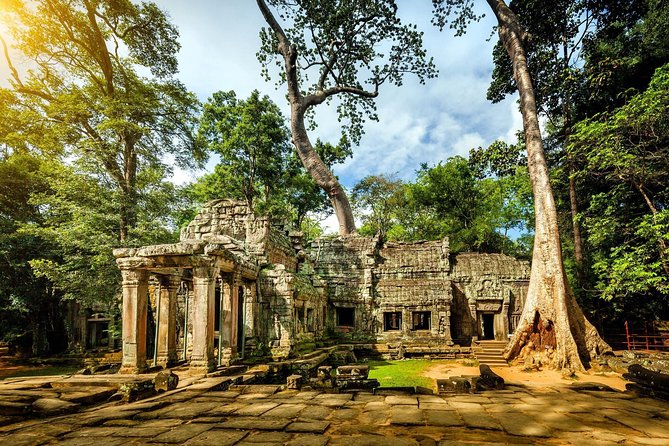
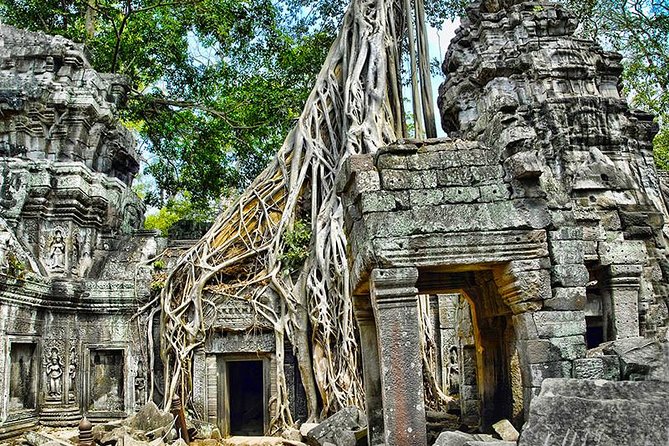
Ta Prohm receives about one hour, and it is a fitting final temple stop. Built in the 12th century, it was deliberately left in a condition where the power of the jungle could be seen working against the stone.
That decision gives Ta Prohm a very different mood from Angkor Wat and Bayon. Tree roots and masonry share the same space, and the temple feels less controlled and more exposed. French archaeologists left much of the site in this condition to show how nature affects abandoned buildings.
The hour should let you experience the main sections without turning the visit into a hurried walk. I would listen closely to your guide here, because the site raises useful questions about preservation. Should an old temple be repaired into a neat monument, or should some evidence of decay remain visible? Ta Prohm lets you see that debate in physical form.
By this point, you will have had a substantial day of walking, heat, carved stone, and historical explanation. The private car matters more after several hours on your feet. You can return to your hotel with your own group instead of waiting for a large coach to gather everyone.
Kampong Phluk changes the pace on day two
The second day begins with another 8 a.m. hotel pickup. You travel about 45 minutes through the countryside to the quay, then board a local boat for a listed 1.5-hour ride toward Tonlé Sap Lake.
The schedule describes the actual village and lake portion as about 1.5 hours, while the stop itself is listed as five minutes. I would read the longer boat ride as the useful measure of time on the water. In practical terms, day two includes the drive, boarding, and a substantial boat journey, not a five-minute visit.
Kampong Phluk gives you a look at a community whose daily routes are tied to the water. Along the way to the lake, you pass through the floating village area before reaching the open lake. The boat trip is not simply a scenic add-on. It is the part of the tour that shows how different life around Siem Reap can be from the temple circuit.
The private boat is included, as is the private vehicle. That makes the second day easier for a family or small group, since you can stay together and ask your guide questions as the setting changes.
You should also keep your expectations practical. This is a guided visit to Kampong Phluk and Tonlé Sap, not a multi-day lake expedition. The tour offers a concise introduction to the village and lake environment. If your main interest is Angkor’s architecture, day two may feel less essential. If you want a broader picture of Cambodia beyond the monuments, it adds useful balance.
What the private format adds
The private setup is one of the strongest reasons to consider this tour. Only your group participates, and the vehicle is reserved for you. That means you are not following a large crowd through every stop or listening to questions that have nothing to do with your interests.
Private touring also helps families. Children must be accompanied by an adult, and the moderate fitness requirement applies to everyone, but your group can communicate directly with the guide and driver. A family can ask for explanations at a simpler level, while adults with a strong interest in architecture can request more detail.
The available feedback points to two qualities worth emphasizing: punctuality and clear explanations. One guest described the tour as well conducted, with interesting stops, a safe driver, and plenty learned about the Siem Reap area. Another gave special credit to Sophy for being attentive and well informed during a family tour.
That does not guarantee a particular guide on every date, but Sophy is a name worth noting if you are able to request a guide. The praise suggests that the human side of the tour can make a real difference. Temples are easier to appreciate when someone explains why a place matters and notices when your group needs a pause.
Is $99 per person a fair price?
The headline price is $99 per person, but you need to add the $37 Angkor Pass. That brings the basic combined cost to $136 per person, before food, drinks, or travel insurance.
The price includes an English-speaking guide, hotel pickup and drop-off, an air-conditioned private vehicle, a private Tonlé Sap boat trip, and bottled water in the car. Those inclusions matter because transport is needed on both days, and the itinerary covers locations outside central Siem Reap.
I consider the value strongest for a couple, family, or small group that wants a guide without joining strangers. You are paying for two organized sightseeing days and private transport, not just entry to a temple. Group discounts are available, though the exact amount is not provided, so you should check the final price before booking.
The value is weaker if you only want Angkor Wat and have no interest in Tonlé Sap. In that case, a single temple day may suit you better. This package earns its price by combining two different parts of the area.
Food is not included, so plan for meals separately. Bottled water is supplied in the vehicle, but the tour does not promise drinks beyond that. Bring enough for the day, especially during the temple visits.
Who should book this experience?
I would recommend this tour if you have two days in Siem Reap and want a clear introduction without arranging separate guides, cars, and boats. It fits first-time visitors who want the main Angkor sights, plus a second day that shows life around Tonlé Sap.
It also suits families and small groups that value privacy. The private format gives you more control over questions and conversation, while hotel pickup removes the need to organize transport each morning.
You may want another plan if you prefer a very slow pace at one temple, want to visit many lesser-known monuments, or dislike structured schedules. The first day covers important highlights, but it does not attempt to show the entire archaeological park.
Wear clothing that covers your knees, prepare for moderate physical activity, and allow time for the Angkor Pass purchase before sightseeing begins. Free cancellation is available if you cancel at least 24 hours before the local start time. Changes or cancellations inside that window are not accepted for a refund.
FAQ
Is the Angkor Pass included in the tour price?
No. The required Angkor Pass costs $37 per person and must be paid separately at the Angkor Wat Ticket Office.
Does the tour include hotel pickup and drop-off?
Yes. Hotel pickup and drop-off in Siem Reap are included on both days.
Is this a private tour?
Yes. Only your group participates in the activity, with a private air-conditioned vehicle and a private boat trip on Tonlé Sap Lake.
What clothing can I wear at the temples?
Only trousers or a knee-length skirt or dress are permitted. Plan temple clothing accordingly.
How long is the Tonlé Sap boat ride?
The day two plan describes about a 45-minute drive to the countryside, followed by a local boat ride of about 1.5 hours toward Tonlé Sap Lake.
Can I cancel for a full refund?
Yes, if you cancel at least 24 hours before the experience start time. Cancellations or changes made less than 24 hours in advance are not accepted for a refund.
Should you book the two-day Angkor and Tonlé Sap tour?
Book it if you want the main Angkor temples explained by a guide, private transport both days, and a second day devoted to Kampong Phluk and Tonlé Sap. The strongest features are the sensible temple lineup, the private format, and the attentive service associated with guide Sophy.
Before paying, remember that the $99 price becomes $136 after adding the Angkor Pass, with meals and insurance still separate. If that total fits your budget and you want both temples and lake life, this is a well-focused introduction to Siem Reap. If your time or money is tight, choose a temple-only plan and save Tonlé Sap for another visit.
More 2-Day Experiences
- Angkor 2-Day Sunset & Sunrise Small-Group Tour
★ 5.0 · 2,567 reviews - 2 Days Exclusive Temple Highlights with Sunset and Sunrise Tour
★ 5.0 · 1,157 reviews - Siem Reap: Angkor Sunrise 1- or 2-Day Guided Temples Tour
★ 4.9 · 1,132 reviews - 2 Days Guided Historical Tour in Angkor
★ 5.0 · 855 reviews
Just added around Siem Reap
- Private Battambang Full-Day Guided Tour★ 4.5 · 3 reviews
- Kulen Mountain, Beng Mealea and Banteay Srei Full Day Tour★ 5.0 · 3 reviews
- Kompong Pluk Tour★ 5.0 · 3 reviews
- Private 3 Day Tour to Discover the ancient temples★ 5.0 · 3 reviews
- Kulen National Park Ticket -Waterfall & 1000 Lingas★ 5.0 · 3 reviews
- Cambodia: Absolute Traditional Dance Show with Buffet Dinner★ 5.0 · 3 reviews
- Border Transfer (Siem Reap to Laos/Laos to Siem Reap)★ 3.5 · 3 reviews
- Best Taxi Siem Reap to Battambang – English Speaking Driver★ 4.5 · 3 reviews
Angkor Wat Tours, compared.

Angkor Wat Sunrise or Sunset Tour with Guide from Siem Reap
Read our review →
Angkor Wat: Small-Group Sunrise or Sunset Tour
Read our review →
Angkor Wat 2-Day Tour with Sunrise and Sunset
Read our review →

Angkor Wat Sunrise tour with Small – Group and Guide tours
Read our review →
Angkor Wat Highlights and Sunrise Guided Tour from Siem Reap
Read our review →
Angkor Wat Sunset Small Group Tour with Lunch Included
Read our review →
Full-Day Angkor Wat Sunrise Private Tour with Guide from Siem Reap
Read our review →Browse the lists this tour appears in