
Reviewed · ANGKOR WAT TOURS
Angkor Wat: Sunrise 2.5 Days Temples & Tonle Sap-Small Group
Angkor rewards an early start. This 2.5-day small-group tour pairs the famous sunrise at Angkor Wat with lesser-visited temples, a boat trip on Tonle Sap, and a licensed English-speaking guide. I like the sensible mix of major sights and quieter ruins, and I like the small group limit of 15 people, which should make temple visits easier to manage. The main catch is cost: the $69 tour price does not include the required $62 three-day temple pass or breakfast.
I also appreciate the practical care built into the experience. Drivers such as Keal, Ro, and Mao have been praised for providing cold water and refreshing towels after temple walks, while guides including Pal Saruon, Pireak, Sam, AJ, and Pi have been singled out for clear explanations and friendly service. You should still expect long walks, rough temple surfaces, heat, and a very early start.
In This Review
- Key points to know before booking
- Why the 2.5-day format works well
- Day one: Pre Rup, Banteay Srei, Neak Pean, and Preah Khan
- Pre Rup and the idea of a mountain temple
- Banteay Srei, Cambodia’s detailed carving lesson
- Neak Pean and a temple on water
- Preah Khan, where trees and ruins share the stage
- Day two: Sunrise at Angkor Wat
- Angkor Thom and the many faces of Bayon
- Ta Prohm and the power of a jungle ruin
- Day three: Tonle Sap and Kampong Phluk
- The dry-season alternative: Cambodia Phare Circus
- Price, temple pass, and what is included
- Who will get the most from this tour
- Should you book the Angkor sunrise tour?
- FAQ
- How long does the tour last?
- Is hotel pickup included?
- How large is the group?
- Is an English-speaking guide included?
- Is the Angkor temple pass included?
- Is breakfast included?
- What happens during the Tonle Sap visit?
- What replaces Tonle Sap during the dry season?
Key points to know before booking
- Sunrise at Angkor Wat: Enter the temple before dawn and approach through the less-used eastern side while the complex is still dark.
- Banteay Srei is the artistic highlight: Its finely carved sandstone reliefs are among the most detailed in Cambodia.
- A useful three-part route: You see outer temples on the first day, Angkor Thom and Ta Prohm on the second, then Tonle Sap or Phare Circus on the final half-day.
- Small groups matter here: The tour accepts no more than 15 people, a manageable size for narrow corridors and busy temple paths.
- The advertised price is not the full cost: Add $62 per person for the three-day Angkor temple pass, plus breakfast and personal meals.
- The final activity changes by season: Tonle Sap is replaced by Cambodia Phare Circus from March 1 to June 31, according to the tour information.
Why the 2.5-day format works well
Siem Reap is easy to underestimate. Angkor Wat may be the name everyone knows, but the archaeological park spreads across a large area and contains temples with very different moods. A single morning can give you a famous photograph, but it rarely gives you much sense of how the ancient Khmer capital was arranged.
This tour gives you two full temple days, then a shorter third day for Tonle Sap or the circus. That pacing is useful. You get time for the headline sights without cramming every temple into one exhausting circuit.
The small-group setup is another practical advantage. With a maximum of 15 people, you are not dealing with a huge coach party spilling through every doorway. You can hear the guide more easily, ask questions, and move through tight temple passages with less fuss.
The air-conditioned vehicle is important, not decorative. Siem Reap can be hot, and temple visits involve walking on stone, climbing steps, and crossing open courtyards. Having a cool ride between sites gives your feet and head a break. Cold bottled water and chilled towels are small comforts, but after a hot walk they become part of the experience you remember.
More Angkor Wat tours we have reviewed:
- Angkor Wat Sunrise or Sunset Tour with Guide from Siem Reap
★ 5.0 · 12,109 reviews - Siem Reap: Angkor Wat: Small-Group Sunrise or Sunset Tour
★ 5.0 · 9,444 reviews - Siem Reap: Angkor Wat 2-Day Tour with Sunrise and Sunset
★ 4.9 · 4,429 reviews
Day one: Pre Rup, Banteay Srei, Neak Pean, and Preah Khan
The first temple day focuses on sites outside Angkor Thom. That is a smart choice because it begins away from the most crowded core and lets you see how varied Khmer temple design can be.
Pre Rup and the idea of a mountain temple
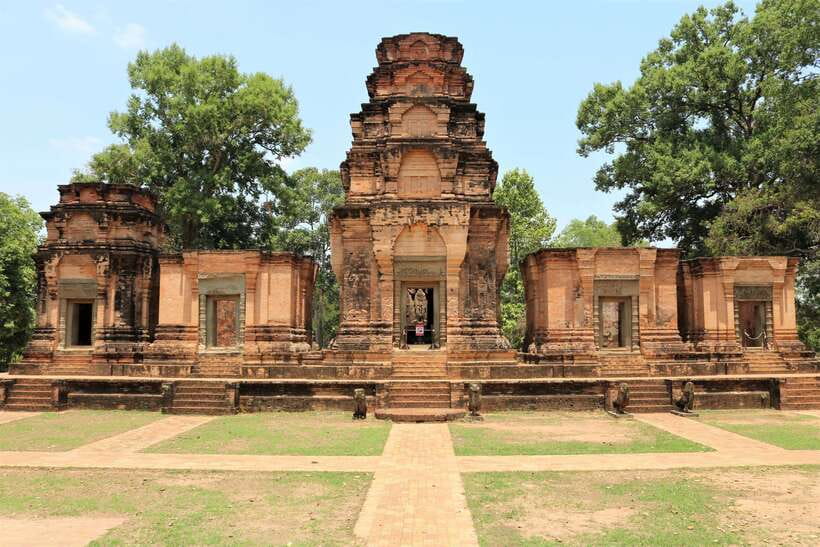
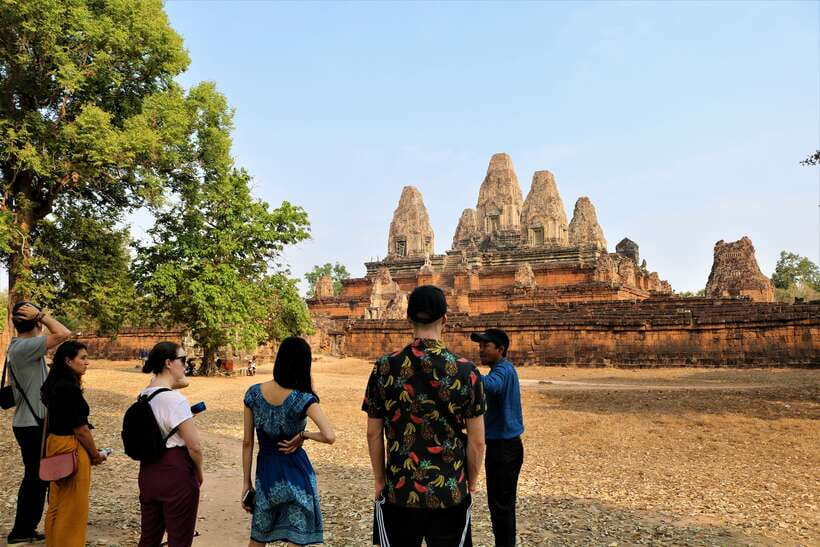
Pre Rup was built as a Hindu state temple and uses a strong combination of brick, laterite, and sandstone. Its tiered form gives you the feel of a temple mountain, a design meant to link earthly worship with the realm of the gods.
I would pay attention to the materials here. The brick sections look different from the carved sandstone found at other temples, and the laterite gives parts of the structure a heavier, rougher appearance. Your guide can help explain how these materials were used and why Pre Rup differs from the more polished monuments later in the route.
The climb and uneven surfaces may be tiring. Comfortable shoes are essential, and this is not a good outing for anyone with limited mobility.
Banteay Srei, Cambodia’s detailed carving lesson
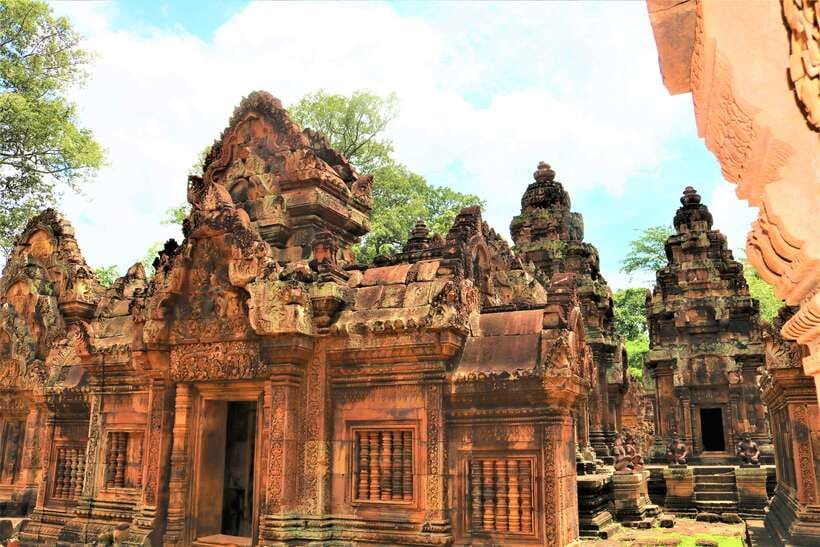
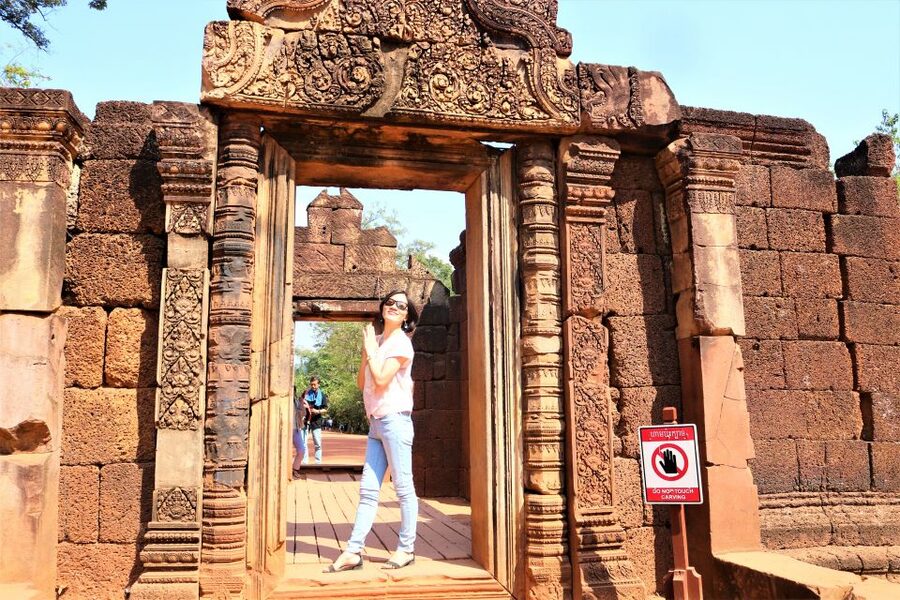
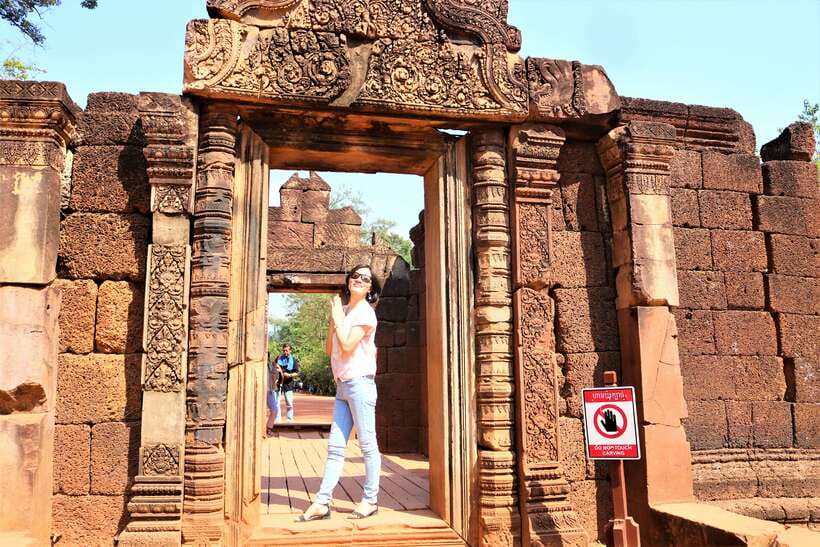
Banteay Srei is smaller than Angkor Wat, but its carvings are often the artistic high point of the trip. The temple is built from pinkish sandstone, and the relief work is unusually fine, with carefully cut figures and decorative patterns covering the walls.
I like that the route includes Banteay Srei rather than focusing only on the biggest monuments. Its scale makes the craftsmanship easier to study. Instead of being overwhelmed by enormous courtyards, you can look closely at the stonework and notice how much detail the carvers managed to fit into a relatively small building.
The temple was only accessible to visitors from the late 1990s, after the Khmer Rouge left the area. That fact adds modern Cambodian context to the visit. This is not simply an old ruin isolated from recent history. Access, safety, and local life have shaped how Cambodia’s temple areas are visited today.
Banteay Srei is also a good place to listen closely to your guide. Past guide assignments have included Pal Saruon, Pireak, Sokpee Sumsot, and Sam, all praised for explaining temple history and Cambodian culture in clear English. Names are not guaranteed, but the guide is a major part of how much you get from the carvings.
More Tonle Sap floating village trips:
- From Siem Reap: Kampong Phluk Floating Village Tour by Boat
★ 4.9 · 6,979 reviews - Sunset tour of Kampong Phluk stilts home village on the Tonle Sap
★ 5.0 · 4,865 reviews - Siem Reap: Kampong Phluk Floating Village Tour with Boat
★ 4.9 · 3,843 reviews - Siem Reap Floating Village Kampong Phluk Sunset with Boat
★ 5.0 · 1,962 reviews
Neak Pean and a temple on water
Neak Pean sits on an artificial island, with a Buddhist temple arranged around a circular island setting. It is quite different from the massive stone temples. Water, channels, and the island plan shape the visit, giving the site a quieter and more unusual character.
This stop is less about climbing through grand halls and more about seeing how water was used in temple design. Your guide can connect the layout to Khmer religious ideas and the importance of water management.
Conditions can affect how the area feels. The route to the temple may involve walking along a raised path, and the surrounding water can change the view depending on the season. It is worth bringing patience and listening to the explanation rather than expecting another Angkor Wat-style monument.
Preah Khan, where trees and ruins share the stage
Preah Khan closes the first temple day with one of Angkor’s most atmospheric settings. The temple is partly ruined, with tree roots, crumbling stone, corridors, and open spaces blending into one another.
I find this kind of stop valuable because it shows the site as a living ruin rather than a perfectly restored monument. You can see how vegetation has taken hold and how the original plan still survives despite damage and collapse.
By this point, you may be hot and tired. That is why the vehicle breaks matter. The included water and towels, praised by people who took the tour with drivers such as Keal and Ro, are especially useful after Preah Khan’s long walk.
Day two: Sunrise at Angkor Wat
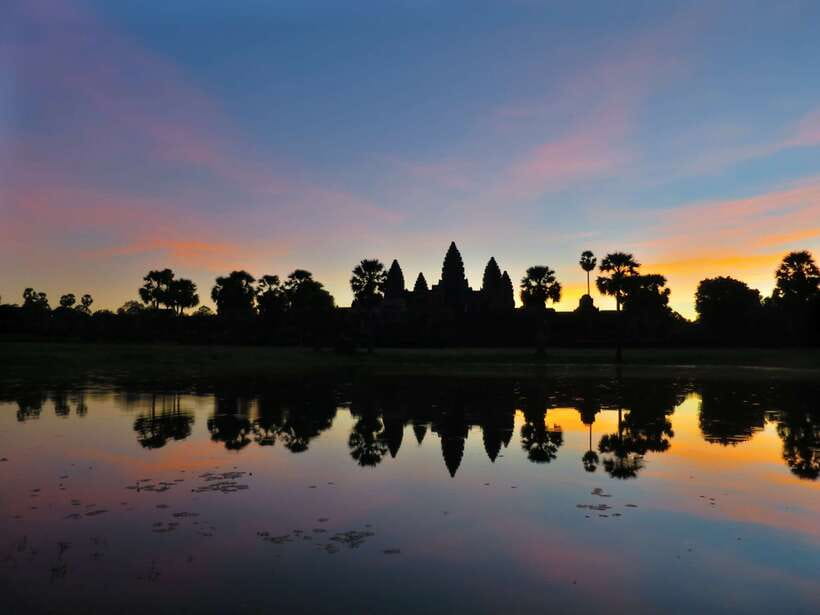
Day two begins before dawn. You leave your hotel in darkness, enter Angkor Wat with a torch, and approach the temple through the eastern side, which is described as less frequently visited at that hour.
This early start is the emotional center of the tour, but it is not only about standing outside for a sunrise photograph. Entering in the dark changes the way the building feels. Corridors and towers appear gradually, and the first light helps you understand the scale of the complex.
You then pass through cloistered corridors beside an exceptionally long stretch of bas-reliefs. These carvings depict religious stories and scenes linked to the Khmer Empire. Without a guide, it is easy to see them as rows of worn figures. With a good explanation, the walls become a sequence of stories, battles, ceremonies, and beliefs.
The guide’s role here is crucial. Sam and Usa have been praised for answering questions about Khmer history and culture, while Pal Saruon has been noted for detailed explanations and helping with photographs. A strong guide can also tell you where to pause, what to look for, and how the scenes connect.
Breakfast is not included, so plan for that expense. The morning portion ends with breakfast outside the temple and a short rest. Since the first departure is pre-dawn, you should not treat breakfast as a minor detail. You will need food and water to keep going.
Angkor Thom and the many faces of Bayon
After Angkor Wat, the route continues to the southern gate of Angkor Thom. The entrance is lined with 54 figures of gods and demons, creating a long stone procession toward the fortified city.
This gate is one of the best places to understand Angkor Thom as more than a collection of separate ruins. The causeway, gate, walls, and temple plan all work together. Your guide can explain the symbolism and the role of the city during the Khmer Empire.
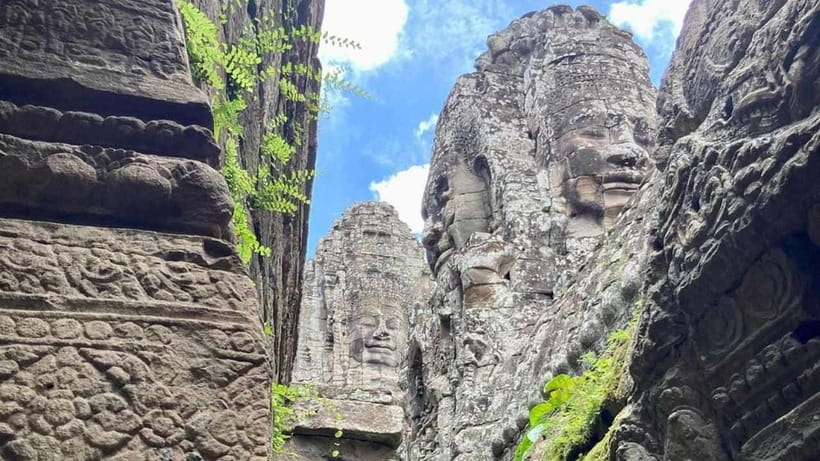
Inside Angkor Thom, Bayon is the star. More than 200 enormous faces cover its central towers, creating one of the most memorable sights in the complex. The faces appear from different angles as you move through the narrow passages, so take your time instead of rushing straight to the most obvious viewpoint.
Bayon is also a place where group size makes a difference. The corridors can feel tight, and a large party would make it harder to stop without blocking others. A group limited to 15 people should be easier to manage, though the temple can still be busy.
The stone floors are uneven, and some steps are steep. Wear shoes with a firm grip, and expect to walk slowly in places.
Ta Prohm and the power of a jungle ruin
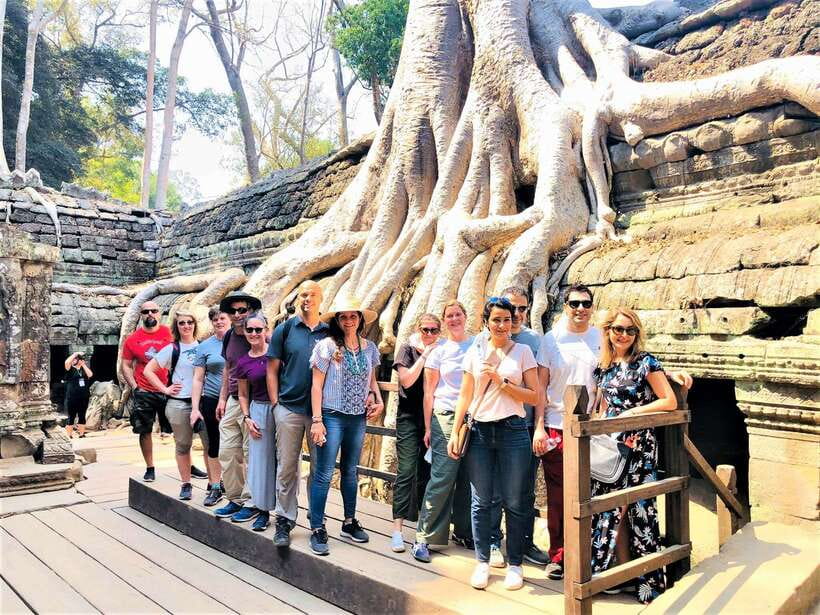
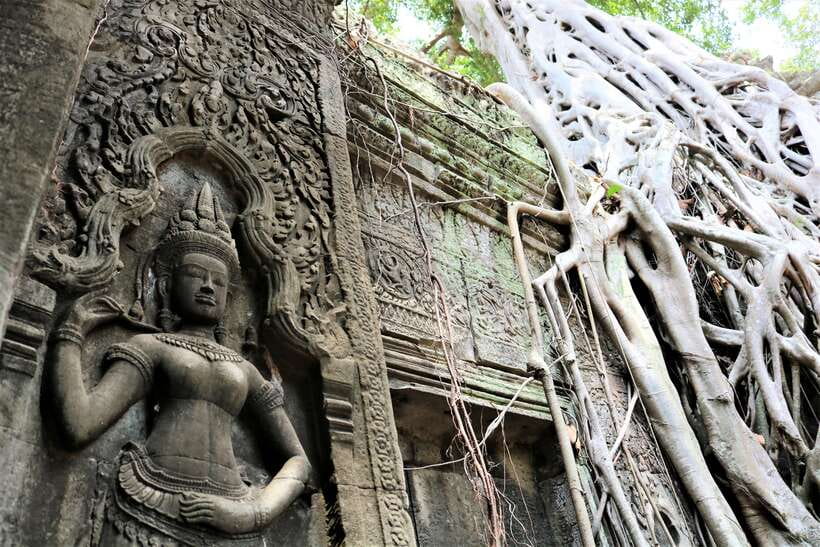
After lunch and a rest break, you visit Ta Prohm. This is the temple most closely associated with trees growing through ancient stone. Its appeal comes from the tension between carved architecture and the forest pressing into it.
Ta Prohm is highly atmospheric, but it is also one of the most popular stops. You may find crowded passages and queues around the best-known tree-root views. The tour cannot remove that pressure, but the guide can help you understand the temple beyond its most photographed corners.
I like Ta Prohm after Angkor Wat, Bayon, and Angkor Thom because the mood changes sharply. Angkor Wat feels planned and monumental. Bayon feels crowded with faces. Ta Prohm feels broken, enclosed, and shaped by nature.
Again, the day is physically demanding. You should be comfortable walking for long periods and managing heat. The tour is specifically not suitable for people with mobility impairments.
Day three: Tonle Sap and Kampong Phluk
The final half-day heads through the countryside to Tonle Sap, one of the world’s largest freshwater lakes. The boat trip visits Kampong Phluk, a group of three fishing villages set among a flooded forest.
This is not a temple add-on. It gives you a look at a different side of Cambodian life, with houses on stilts, floating homes, fishing activity, and local work shaped by the lake’s changing water levels. You cruise through the village and flooded forest rather than simply stopping for a quick photograph.
The experience depends on the water and the season. The lake and village setting may look different at different times of year, so keep your expectations flexible. The value is in seeing how homes, transport, and fishing are linked to the water.
AJ has guided this part of the route and explained village life, fishing methods, local produce, and the community around the floating settlement. That sort of local context matters. Without it, a boat ride can become a view of houses. With it, you gain a better sense of how people use and adapt to the lake.
The boat cruise and Tonle Sap entrance fee are included. That helps the $69 price feel more useful, since this part of the day includes both transport and the activity itself.
The dry-season alternative: Cambodia Phare Circus
From March 1 to June 31, the tour information says Cambodia Phare Circus replaces Tonle Sap. The date range includes an unusual June 31, so I would confirm the seasonal arrangement before booking if your visit falls near that period.
The circus is a cultural alternative rather than a lake excursion. If you want floating villages and rural scenery, check that Tonle Sap is operating during your dates. If you are happy with a performance instead, the alternative gives the final half-day a different focus.
The choice affects the character of the tour. Tonle Sap is outdoors and community-based. Phare Circus is an evening cultural performance. Neither is automatically better, but you should know which experience you are paying for.
Price, temple pass, and what is included
The tour costs $69 per person, but the required three-day Angkor pass costs another $62. That brings the basic combined cost to $131 per person before breakfast and other meals.
At that total, the tour is not a bargain in the narrowest sense. It becomes better value if you want a guide, hotel pickup and drop-off, air-conditioned transport, Tonle Sap admission and boat costs, and a planned route across two and a half days.
The temple pass is a significant extra, but it covers the main Angkor access needed for this multi-day visit. Buying the tour without understanding that fee can make the final price feel higher than expected.
Included services are:
- Licensed English-speaking guide
- Small group of no more than 15 people
- Hotel pickup and drop-off
- Air-conditioned vehicle
- Mineral water
- Tonle Sap entrance fee and boat cruise, or Phare Circus seat C, depending on season
Breakfast is not included. Bring comfortable shoes, avoid short skirts, and dress in a way suitable for temple visits.
Who will get the most from this tour
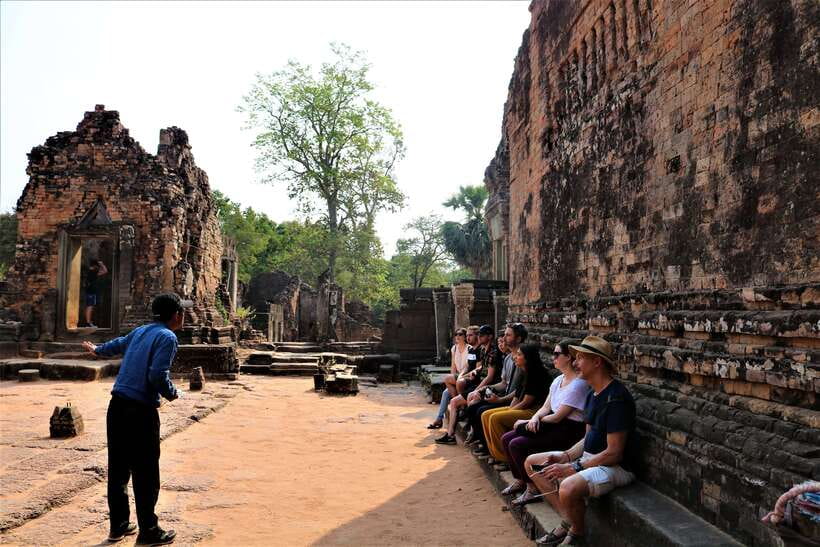
I would choose this tour if you want the major Angkor temples but also want a guide to explain what you are seeing. It suits first-time visitors who prefer a planned route and do not want to arrange separate transport for distant temples.
It is also a good fit if you value small groups and practical care. Cold water, towels, and a cool vehicle matter after several hours outdoors. The tour has earned a perfect rating from 10 verified bookings, with repeated praise for friendly guides, clear English explanations, helpful drivers, and photo assistance.
I would think twice if you dislike pre-dawn departures, long walks, or fixed schedules. You also need to budget for the temple pass and breakfast. The tour is not suitable for people with mobility impairments, and short clothing is not allowed at the temples.
Should you book the Angkor sunrise tour?
I would book it if you have two and a half days in Siem Reap and want a broad first look at Angkor without arranging each ride yourself. The best features are the early Angkor Wat entry, Banteay Srei, the atmospheric outer temples, Bayon, Ta Prohm, and the chance to add Tonle Sap or Phare Circus.
Before paying, check three things: the $62 temple pass, the seasonal final activity, and your ability to handle the walking. If those points work for you, the tour offers a well-planned introduction to Cambodia’s temples and lake culture, with the kind of guide and driver support that makes hot sightseeing much easier.
FAQ
How long does the tour last?
The experience lasts 2.5 days and includes temple visits, followed by Tonle Sap or Cambodia Phare Circus depending on the season.
Is hotel pickup included?
Yes. Pickup and drop-off are included, and you should wait in your hotel lobby for the vehicle.
How large is the group?
The tour is limited to 15 participants.
Is an English-speaking guide included?
Yes. A licensed, experienced English-speaking guide accompanies the tour.
Is the Angkor temple pass included?
No. The required three-day temple pass costs $62 per person and is paid separately.
Is breakfast included?
No. Breakfast is not included in the tour price.
What happens during the Tonle Sap visit?
You take a boat to Kampong Phluk, a group of three fishing villages, and see stilted homes, floating homes, fishing activity, and flooded forest.
What replaces Tonle Sap during the dry season?
Cambodia Phare Circus replaces Tonle Sap from March 1 to June 31, according to the tour information. The alternative includes a seat in section C.
More 5-Day Experiences
- Angkor Wat Sunrise and Tonle Sap Lake 1.5 Days
★ 5.0 · 39 reviews - Private Cambodia 5 Days Tour from Siem Reap to Phnom Penh
★ 5.0 · 19 reviews - 5-Day All Major Temples & Kulen Mount Waterfall & Koh Ker & Beng Mealea
★ 5.0 · 13 reviews - 5-Day ‘All The Sights’ Tour
★ 5.0 · 11 reviews
More Morning
- Angkor Wat Sunrise tour with Small – Group and Guide tours
★ 5.0 · 3,655 reviews - Angkor Wat Highlights and Sunrise Guided Tour from Siem Reap
★ 5.0 · 3,213 reviews - Full-Day Angkor Wat Sunrise Private Tour with Guide from Siem Reap
★ 5.0 · 2,920 reviews - Angkor Wat Sunrise & 3 Main Temples with Breakfast – Small Group
★ 5.0 · 2,857 reviews
Just added around Siem Reap
- Private Battambang Full-Day Guided Tour★ 4.5 · 3 reviews
- Kulen Mountain, Beng Mealea and Banteay Srei Full Day Tour★ 5.0 · 3 reviews
- Kompong Pluk Tour★ 5.0 · 3 reviews
- Private 3 Day Tour to Discover the ancient temples★ 5.0 · 3 reviews
- Kulen National Park Ticket -Waterfall & 1000 Lingas★ 5.0 · 3 reviews
- Cambodia: Absolute Traditional Dance Show with Buffet Dinner★ 5.0 · 3 reviews
- Border Transfer (Siem Reap to Laos/Laos to Siem Reap)★ 3.5 · 3 reviews
- Beng Melea, Rolous Group & Kompong Phluk Floating Village★ 5.0 · 3 reviews
Angkor Wat Tours, compared.

Angkor Wat Sunrise or Sunset Tour with Guide from Siem Reap
Read our review →
Angkor Wat: Small-Group Sunrise or Sunset Tour
Read our review →
Angkor Wat 2-Day Tour with Sunrise and Sunset
Read our review →

Angkor Wat Sunrise tour with Small – Group and Guide tours
Read our review →
Angkor Wat Highlights and Sunrise Guided Tour from Siem Reap
Read our review →
Angkor Wat Sunset Small Group Tour with Lunch Included
Read our review →
Full-Day Angkor Wat Sunrise Private Tour with Guide from Siem Reap
Read our review →Browse the lists this tour appears in