
Reviewed · ANGKOR WAT SUNRISE TOURS
Private 2 Days Angkor Wat Sunrise and Discover all Major Temples
Angkor rewards early risers. This private two-day tour gives you sunrise at Angkor Wat, the famous stone faces of Bayon, finely carved Banteay Srei, and a long list of major temples without the strain of arranging every transfer yourself. I especially like the private air-conditioned vehicle and the chance to visit quieter places such as Ta Nei and Banteay Kdei. I also like the personal guide service, with guides such as Sara and Leap praised for clear English, historical explanation, and genuine care.
The main drawback is the pace. You cover a huge archaeological area in two packed days, starting around 4:30 a.m. on the first morning. The Angkor Pass and meals cost extra, so the $149.46 price is not the final bill. Still, for a private group wanting a broad first look at Angkor, this is a strong and practical choice.
In This Review
- Key points to know before booking
- Why this two-day plan works
- Day one begins at Angkor Wat before dawn
- Angkor Thom brings royal power into view
- Bayon and Baphuon provide the day’s visual punch
- The royal terraces explain Angkor Thom’s civic side
- Ta Nei and Banteay Kdei slow the rhythm
- Day two reaches Banteay Srei and Banteay Samre
- Preah Khan shows Jayavarman VII at full scale
- Neak Pean and Ta Som bring different moods
- Eastern Mebon and Pre Rup close the temple circuit
- The guide and driver make the difference
- What the $149.46 price really covers
- Who should book this Angkor tour?
- Should you book it?
- FAQ
- How long does the tour last?
- What time does the first day begin?
- Is the Angkor Pass included?
- Are meals included?
- Is transportation private?
- Are drinks provided?
- Can the tour be cancelled for a refund?
Key points to know before booking
- Sunrise starts around 4:30 a.m. at Angkor Wat, so plan a short night and an early breakfast arrangement at your hotel.
- The tour covers both icons and quieter ruins, including Ta Nei, Banteay Kdei, Banteay Samre, and Preah Dak Village.
- Your guide and driver stay with your private group, allowing the route to feel more personal and flexible than a large coach tour.
- Air-conditioning, bottled water, and cool towels matter in Cambodia’s heat, especially across two full days of temple walking.
- The Angkor Pass is not included, and lunch at local restaurants costs extra, generally $3 to $10 per dish.
- The schedule is ambitious, with roughly 15 named stops across two days, so comfortable shoes and sensible expectations are important.
Why this two-day plan works
Angkor is not one temple. It is a vast archaeological zone spread across roughly 390 square miles, or 1,000 square kilometers. The site was once the center of the Khmer Empire and is described as the largest preindustrial city in the world.
That scale changes the value of a private tour. You are not simply walking through one monument and returning to Siem Reap. You are crossing broad sections of the park, moving between different periods of Khmer construction, and seeing how religious ideas changed from Hindu temple mountains to Buddhist monuments.
The route also avoids making Angkor Wat the whole story. You get the grand entrance to Angkor Wat, but you also see royal terraces, reservoirs, small forest temples, and carefully carved pink sandstone. I like that balance. The famous places deliver the drama, while the less-visited stops give the days some breathing room.
A private vehicle is particularly useful here. After sunrise, the air-conditioned car provides a place to cool down between temples. Bottled water and fresh cool towels are included, small comforts that become much more useful after several hours outside.
More sunrise starts at Angkor Wat:
- Angkor Wat Sunrise or Sunset Tour with Guide from Siem Reap
★ 5.0 · 12,109 reviews - Angkor Wat Sunrise tour with Small – Group and Guide tours
★ 5.0 · 3,655 reviews - Full-Day Angkor Wat Sunrise Private Tour with Guide from Siem Reap
★ 5.0 · 2,920 reviews
Day one begins at Angkor Wat before dawn
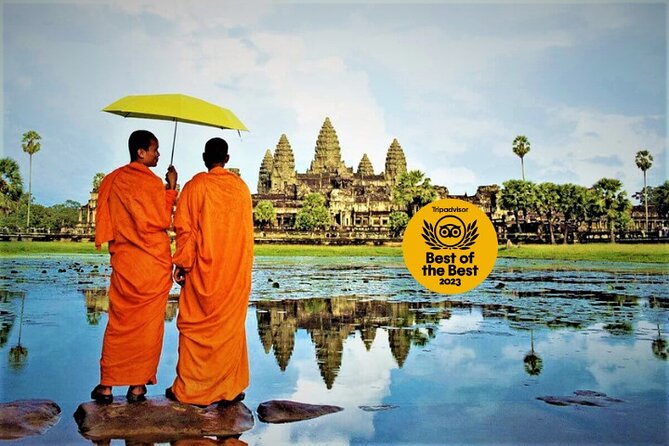
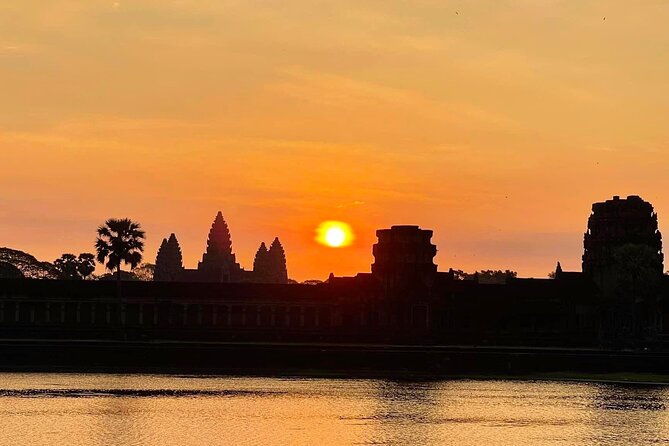
The first pickup is scheduled for about 4:30 a.m. You head to Angkor Wat in darkness, aiming for the temple’s sunrise view. The five-tower silhouette is Cambodia’s national emblem, and the approach across the water is one of the essential Angkor experiences.
The sunrise itself depends on clouds and timing, but the early start gives you the right setting. You can see the temple change from a dark outline into a detailed stone monument as morning light arrives. The visit lasts about two hours, enough time to appreciate the exterior and begin exploring the temple grounds.
Admission is not included. Your guide assists with buying the Angkor Pass at the park entrance before the tour begins, but you should budget for it separately. Since every listed temple requires the pass, this is a necessary extra rather than an optional add-on.
After the sunrise visit, the day moves to Angkor Thom. You may want to ask your guide about breakfast timing before departure, since the tour begins before most normal sightseeing schedules.
Angkor Thom brings royal power into view
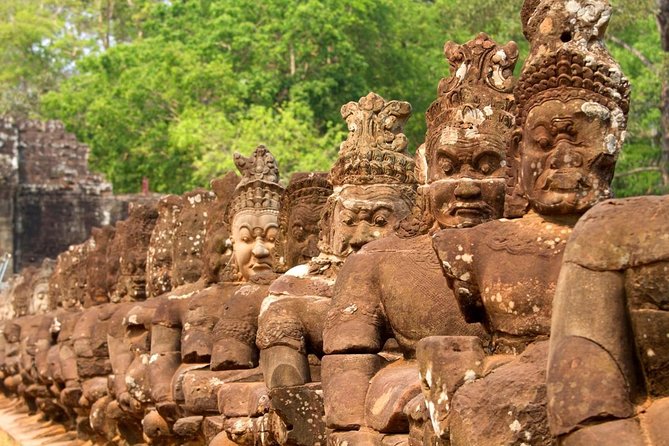
The South Gate of Angkor Thom is a strong transition from the open scale of Angkor Wat to the fortified royal city. The gate crosses a moat about 100 meters wide, with rows of giant figures forming the stone balustrade.
Allow around 40 minutes here. The causeway sculptures are not just decoration. They connect to the famous Hindu story of the Churning of the Ocean of Milk, in which gods and demons pull a serpent in opposite directions. Your guide can help you read the scene rather than treating it as a quick photo stop.
Inside the city, a further 40-minute visit introduces Angkor Thom itself. The name means Great City or Great Capital. It became the Khmer capital under the later Angkor kings, and the scale of its walls, gates, and central monuments gives you a sense of royal ambition.
Bayon and Baphuon provide the day’s visual punch
Bayon is likely to be one of your most memorable stops. Built around 1200 in the center of Angkor Thom, it is famous for its many large stone faces. The faces appear from different angles as you move through the towers, creating a temple that feels both monumental and strangely intimate.
The planned visit lasts about 90 minutes. That is useful because Bayon needs time. You will want to look upward, pass through narrow galleries, and study the bas-reliefs. The surrounding stone can feel crowded with visual information, so a guide such as Leap or Sara can help separate the temple’s construction, religious purpose, and carvings into a story you can follow.
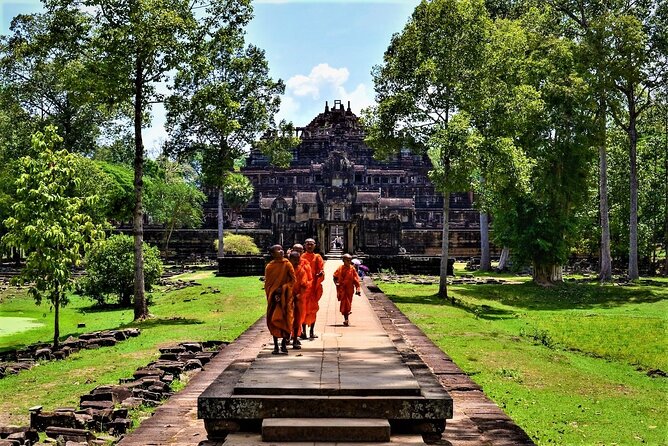
Baphuon is only about 300 meters northwest of Bayon, but it has a different character. Before Angkor Wat was built, Baphuon was the largest Khmer temple. Its long elevated approach leads toward a massive temple mountain, and the setting makes the monument’s size easier to grasp.
The visit lasts about an hour. Some parts may feel demanding after the early start, particularly because the tour continues through several more sites. Take your time on the approach and do not assume every stop must be rushed.
Phimeanakas follows with a shorter 20-minute visit. Its name means Aerial Palace or Celestial Temple, and it occupies the former royal area. It is less visually dominant than Bayon or Baphuon, but it helps complete the picture of Angkor Thom as a functioning royal capital rather than a collection of isolated temples.
More Angkor Wat tours we have reviewed:
- Siem Reap: Angkor Wat: Small-Group Sunrise or Sunset Tour
★ 5.0 · 9,444 reviews - Siem Reap: Angkor Wat 2-Day Tour with Sunrise and Sunset
★ 4.9 · 4,429 reviews - Siem Reap: Full-Day Angkor Wat Guided Tour with Sunset
★ 4.9 · 3,803 reviews - Angkor Wat Highlights and Sunrise Guided Tour from Siem Reap
★ 5.0 · 3,213 reviews
The royal terraces explain Angkor Thom’s civic side

The Terrace of the Elephants forms much of the western edge of Angkor Thom’s Royal Square. Its carved elephants and long platform suggest ceremonial use and royal display. The planned stop is about 30 minutes, enough for a close look at the reliefs and a walk along the terrace.
Immediately north is the Terrace of the Leper King. It is another 30-minute stop and is worth studying for its layered carvings. The outer wall can conceal additional figures behind the first row, so do not judge it from a quick glance at the front.
These terraces are not enclosed temple interiors. They are open platforms, and the heat can be intense. Your guide’s explanation matters here because the remains may seem simple until you understand their place in the royal square.
Ta Nei and Banteay Kdei slow the rhythm
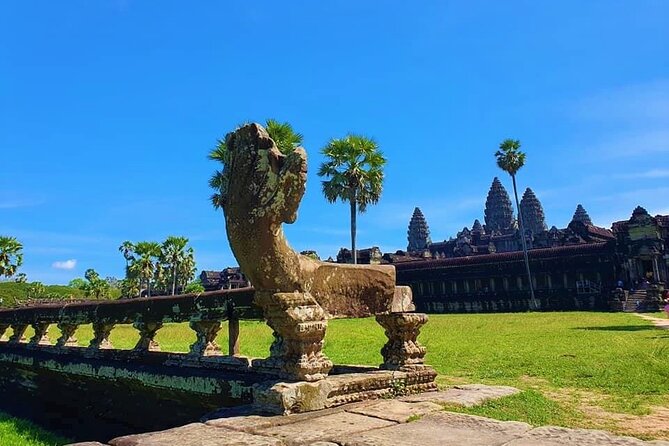
Ta Nei is a late 12th-century stone temple built during the reign of King Jayavarman VII and dedicated to the Buddha. Its smaller scale and forest setting provide a welcome change after the grand monuments of Angkor Thom.
The stop lasts about 50 minutes. I value this part of the route because it gives you room to notice stone details without the same pressure created by Angkor Wat and Bayon. The information provided does not promise a completely empty site, so you should think of Ta Nei as quieter, not guaranteed to be deserted.
Banteay Kdei adds another 50 minutes. Its eastern gate is near the meeting point of the Small Circuit and Grand Circuit, opposite the Srah Srang reservoir. The temple has the atmospheric quality many people seek at Angkor, with worn corridors and stonework that feels less polished than the headline monuments.
By this point, day one has included a sunrise and a long series of temples. The tour also promises a sunset from one of Angkor’s best viewpoints, though the supplied schedule does not identify the exact sunset location or duration. Confirm that detail with the operator if sunset is a deciding factor for you.
Day two reaches Banteay Srei and Banteay Samre

Day two moves farther from the central temple group. Banteay Srei is the artistic highlight for many people because of its fine carvings and pink sandstone. It is smaller than Angkor Wat, but its decoration is unusually detailed, with carefully cut figures and ornamental patterns.
The visit lasts about two hours, giving you time to appreciate the workmanship rather than treating the temple as a quick roadside stop. Your guide can also place it within the wider Khmer tradition, which makes the difference between size and craftsmanship easier to understand.
Banteay Samre follows for about 50 minutes. Built during the reigns of Suryavarman II and Yasovarman II, this Hindu temple dates to the early 12th century. Its design has a more enclosed, fortress-like feeling than Banteay Srei, and the contrast between the two makes the morning more interesting.
A stop at Preah Dak Village is also included in the day. It is known for souvenirs, objects, and local arts, and gives the temple route a connection to present-day community life. This is a useful place to browse, but remember that shopping is optional and any purchases are your own responsibility.
Preah Khan shows Jayavarman VII at full scale
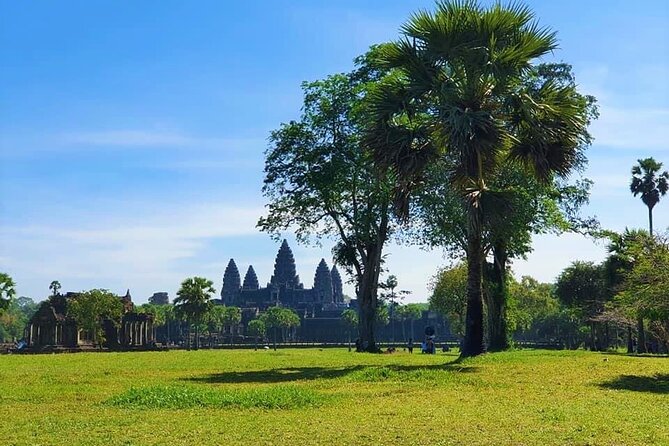
Preah Khan is one of the largest and most important stops on day two. It was dedicated in 1191 to Jayavarman VII’s father, represented by a central statue called Jayavarmeshvara.
The one-hour visit lets you move through long galleries, courtyards, and carved stone spaces. Preah Khan can feel like a maze, which is exactly why a private guide helps. You can ask questions as you go instead of trying to interpret every doorway and inscription alone.
The temple also gives you a strong sense of Jayavarman VII’s building program. After seeing Bayon and several smaller temples, Preah Khan helps connect the monuments to one powerful king and his religious and political goals.
Neak Pean and Ta Som bring different moods
Neak Pean is unusual among Angkor monuments. It was built on an artificial island about 350 meters in diameter in the large Baray reservoir. Its layout differs from the standard temple mountain, and the approach across the water gives the visit a more open feel.
The scheduled time is one hour. Much of the interest comes from understanding the water system and the symbolic design, so listen closely to the guide’s explanation. Neak Pean is not the place for grand towers or long carved walls. Its appeal lies in the plan and setting.
Ta Som is smaller and receives about 40 minutes. Built during the late 12th century by Jayavarman VII, it may have been dedicated to his father or one of his teachers, though its exact purpose is not certain. The shorter stop works well after Preah Khan and Neak Pean, giving you a more manageable monument to explore.
Eastern Mebon and Pre Rup close the temple circuit
Eastern Mebon is a 10th-century mountain temple built by Rajendravarman II and dedicated to Shiva. It once stood in the middle of the East Baray, though the reservoir is now dry. The 30-minute visit gives you a look at an earlier architectural period than the Jayavarman VII temples seen elsewhere on the route.
Pre Rup is the final listed stop, with about an hour to explore. Founded in 961, it is the major surviving work of Rajendravarman II. Its layered brick and stone structure makes it a fitting final temple because it gives you one last strong view of Angkor’s temple-mountain tradition.
The itinerary covers a lot, and the final afternoon may feel full. That is the tradeoff for seeing so many major sites in only two days. If you prefer long, unhurried visits at just three or four monuments, this schedule may feel too ambitious. If you want a broad foundation for a first visit, it makes good use of your time.
The guide and driver make the difference
The strongest part of this experience is the personal service. Sara is praised for combining strong historical knowledge with interesting conversation, while Leap is described as an excellent English-speaking guide who made the past easier to understand. Other guide and driver combinations include Mr La, Mr Ry, Mr Pheap, Mr Sophal, and Mr Paul.
The praise is consistent on a few practical points: guides are friendly and informative, drivers are careful, and families with young children felt well looked after. One two-day visit was also described as flexible and connected to local food and culture along the route.
You should still communicate your preferences clearly. The tour is private, and the route can be adjusted to your group’s interests according to the information provided. Ask for more time at a favorite temple, or tell your guide if you need a shorter break. Flexibility is one of the main reasons to choose a private tour instead of a large group departure.
What the $149.46 price really covers
At $149.46 per person, the value depends on group size. The price includes hotel pickup and drop-off, a licensed English-speaking guide, private air-conditioned transport, bottled water, cool towels, service charges, and current government VAT.
It does not include the Angkor Pass, tips, or meals. Lunch is available at local restaurants, with vegetarian and non-vegetarian choices, and dishes generally cost $3 to $10. That makes meals manageable, but you should include them in your budget.
For a couple or small private group, the price is reasonable for two long days of transport and guiding across a very large site. The private vehicle also saves you from arranging separate rides between distant temples. Group discounts may improve the value for a larger party, so check the final per-person cost before booking.
Who should book this Angkor tour?
I would choose this tour if you want to see the major Angkor monuments but also care about smaller sites and historical context. It suits couples, families, and private groups who value a dedicated guide and do not want to plan a complex temple route themselves.
It is less suitable if you dislike early mornings, long sightseeing days, or frequent stops. The first day begins around 4:30 a.m., and the two-day plan has little empty space. Wear comfortable walking shoes, carry sun protection, and use the cool towels and air-conditioning as part of your pacing strategy.
Free cancellation is available up to 24 hours before the local start time. After that point, the amount paid is not refunded, and late changes are not accepted.
Should you book it?
Book this experience if you want a private, well-supported introduction to Angkor with sunrise, sunset, major temples, and several less familiar sites. The guides and drivers are the main strength, and the air-conditioned vehicle makes the packed schedule easier to handle.
Skip it if you want a slow temple holiday with late starts. For everyone else, the combination of Bayon, Angkor Wat, Banteay Srei, Preah Khan, Pre Rup, and smaller stops such as Ta Nei gives you an excellent two-day overview. Just add the Angkor Pass and meals to the advertised price, and go in ready for two very full days.
FAQ
How long does the tour last?
The experience lasts approximately two days.
What time does the first day begin?
The first day begins around 4:30 a.m. for the sunrise visit at Angkor Wat.
Is the Angkor Pass included?
No. The Angkor Pass is not included. Your guide assists you with purchasing it at the entrance to Angkor Park.
Are meals included?
No. Lunch is at your own expense. Local restaurants offer vegetarian and non-vegetarian dishes, generally priced from $3 to $10 per dish.
Is transportation private?
Yes. Transfers are private and use an air-conditioned vehicle. Hotel pickup and drop-off are included when you provide your hotel name.
Are drinks provided?
Yes. Bottled water and fresh cool towels are included.
Can the tour be cancelled for a refund?
Yes, if you cancel at least 24 hours before the experience start time. Cancellations made less than 24 hours before the start time are not refunded.
More 2-Day Experiences
- 2 Days Exclusive Temple Highlights with Sunset and Sunrise Tour
★ 5.0 · 1,157 reviews - Siem Reap: Angkor Sunrise 1- or 2-Day Guided Temples Tour
★ 4.9 · 1,132 reviews - 2 Days Guided Historical Tour in Angkor
★ 5.0 · 855 reviews - 2-Day Angkor Wat With Small, Big Circuit and Banteay Srei Tour
★ 5.0 · 545 reviews
More Morning
- Angkor Wat Sunrise & 3 Main Temples with Breakfast – Small Group
★ 5.0 · 2,857 reviews - Siem Reap: Angkor Wat Sunrise and Full-Day Sightseeing Tour
★ 4.9 · 2,828 reviews - Angkor 2-Day Sunset & Sunrise Small-Group Tour
★ 5.0 · 2,567 reviews - Siem Reap: Angkor Wat Sunrise or Sunset Guided Tour
★ 4.9 · 2,123 reviews
Just added around Siem Reap
- Private Battambang Full-Day Guided Tour★ 4.5 · 3 reviews
- Kulen Mountain, Beng Mealea and Banteay Srei Full Day Tour★ 5.0 · 3 reviews
- Kompong Pluk Tour★ 5.0 · 3 reviews
- Private 3 Day Tour to Discover the ancient temples★ 5.0 · 3 reviews
- Cambodia: Absolute Traditional Dance Show with Buffet Dinner★ 5.0 · 3 reviews
- Kulen National Park Ticket -Waterfall & 1000 Lingas★ 5.0 · 3 reviews
- Border Transfer (Siem Reap to Laos/Laos to Siem Reap)★ 3.5 · 3 reviews
- Best Taxi Siem Reap to Battambang – English Speaking Driver★ 4.5 · 3 reviews
Angkor Wat Sunrise Tours, compared.

Angkor Wat Sunrise or Sunset Tour with Guide from Siem Reap
Read our review →
Angkor Wat Sunrise tour with Small – Group and Guide tours
Read our review →
Full-Day Angkor Wat Sunrise Private Tour with Guide from Siem Reap
Read our review →
Angkor Wat Sunrise & 3 Main Temples with Breakfast – Small Group
Read our review →
Angkor Wat Sunrise and Full-Day Sightseeing Tour
Read our review →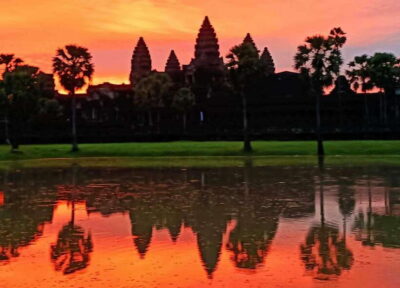
Siem Reap Tour: Angkor Wat Sunrise, Bayon, Ta Prohm, Banteay Srei
Read our review →
Angkor Wat Sunrise Explore The Most Iconic Temples
Read our review →Browse the lists this tour appears in