
Reviewed · 2-DAY EXPERIENCES
Private Tour: (Avoid Crowds & Heat) 2-Day Angkor Temples
The quiet temples come first. This private two-day tour gives you a smart way to see Angkor beyond the usual postcard stops, starting with Banteay Srei and the remote temples north and east of the main complex before tackling Angkor Wat, Angkor Thom, Bayon, Ta Prohm, and Ta Nei. I especially like the private format, which lets your guide adjust the pace, and the air-conditioned vehicle, snacks, and hotel pickup that make Cambodia’s heat easier to handle.
I also like the route design. The first day builds toward the main event, while the second day focuses on the great monuments. The main drawback is cost: the tour is listed at $62, but the Angkor Archaeological Park pass costs another $62 per person for a two or three-day visit. You should also be comfortable with stairs, uneven ground, and temple climbing.
In This Review
- Key points to know before booking
- Why this two-day route works well
- Day one: Banteay Srei and the remote temples
- Banteay Srei, the Citadel of Beauty
- Banteay Samre, a peaceful Angkor Wat cousin
- Pre Rup, brick, laterite, and sandstone
- Preah Khan, a former Buddhist university and city
- Neak Pean, a small monument surrounded by water
- Day two: Angkor Wat, Angkor Thom, and jungle ruins
- Angkor Wat, the essential two-hour visit
- Angkor Thom, a walled capital with several major monuments
- Bayon, the face-filled temple at the city center
- Ta Prohm, trees and fallen galleries
- Ta Nei, a small Buddhist temple away from the crowds
- Guides, transport, and the private-tour advantage
- The real cost: $62 plus the Angkor pass
- Who should book this temple tour?
- Should you book it?
- FAQ
- Does the $62 price include the Angkor entrance ticket?
- What time does the tour start?
- Is this a private tour?
- What temples are visited on day one?
- What temples are visited on day two?
- Can I request sunrise or sunset?
Key points to know before booking
- Quiet ruins before the famous sights: Day one reaches Banteay Srei, Banteay Samre, Pre Rup, Preah Khan, and Neak Pean.
- Angkor Wat gets proper time: You have about two hours at the world’s largest religious monument, rather than a rushed photo stop.
- Private means flexible: Only your party joins, so you can ask questions, adjust the pace, and request sunrise or sunset for the following day at no extra charge.
- Strong guide service: Guides named in guest feedback include Tay, Sopheara, Viet, and Kim, with particular praise for clear English, temple knowledge, and patient explanations.
- Transport keeps the heat manageable: Hotel pickup, air-conditioned private transport, snacks, and refreshments are included.
- Budget for the park pass: The $62 tour price does not include the separate $62 Angkor entrance ticket per person.
Why this two-day route works well
Angkor is not one temple. It is a huge collection of sanctuaries, gates, reservoirs, terraces, and former city spaces scattered around Siem Reap. If you try to see only Angkor Wat and Ta Prohm, you get the famous images but miss much of the scale and variety.
This tour handles the site in a sensible order. Day one takes you farther from the central monuments, where the setting feels quieter and the temples are smaller. Day two gives you the major names, including Angkor Wat and Angkor Thom, when you already have some context for how Khmer architecture changed over time.
That order also helps your energy. Angkor Wat can be overwhelming on a first visit. Seeing less crowded temples first gives you time to learn how to read the carvings, towers, galleries, and courtyards before you reach the biggest monuments.
The tour begins at about 7:30 a.m. with pickup in Siem Reap. Since it is a private activity, the only people in your vehicle and touring group are those you book with. That matters here. A guide can spend longer on a carving that interests you, move along when the heat becomes too much, or change the order to reduce crowd exposure when conditions allow.
The tour is marketed around avoiding crowds and heat, but no Angkor route can promise empty temples. Angkor Wat, Ta Prohm, and Bayon are major attractions. The real benefit is the ability to use timing and route choices intelligently, especially at the quieter sites.
A few more trips worth weighing up
- Siem Reap: Angkor Wat 2-Day Tour with Sunrise and Sunset
★ 4.9 · 4,429 reviews - Angkor 2-Day Sunset & Sunrise Small-Group Tour
★ 5.0 · 2,567 reviews - 2 Days Exclusive Temple Highlights with Sunset and Sunrise Tour
★ 5.0 · 1,157 reviews
Day one: Banteay Srei and the remote temples
Banteay Srei, the Citadel of Beauty
Banteay Srei is more than 20 kilometers north of Angkor and is often considered one of the finest small temples in Cambodia. Built in the second half of the 10th century, it is famous for pink sandstone and unusually precise decorative carving.
You get about an hour here. That is enough time to appreciate the detail without turning the visit into a rushed walk-through. The scale is smaller than Angkor Wat, but the carving is the point. Look closely at the doorways, lintels, and pediments, where the sandstone decoration feels especially delicate.
Banteay Srei is also useful as an early lesson in Khmer art. Your guide can explain the period, style, and religious imagery before you reach the larger temple cities. The trip north adds driving time, but I think this is one of the strongest reasons to choose a two-day route instead of a short central circuit.
Banteay Samre, a peaceful Angkor Wat cousin
Banteay Samre takes about 45 minutes. It is an isolated temple with a calmer setting, and its tower style reflects some of the visual language later associated with Angkor Wat.
The temple was built in the first half of the 12th century. Its more contained layout makes it easier to understand than the enormous central monuments. I like this stop because it gives you a quieter architectural comparison after Banteay Srei.
Do not expect the same scale or fame as Angkor Wat. You visit Banteay Samre for its peaceful atmosphere and for the chance to look at Khmer design without the same level of attention found at the headline sites.
A completely different kind of day out from Siem Reap:
- Angkor Wat Sunrise or Sunset Tour with Guide from Siem Reap
★ 5.0 · 12,109 reviews - Siem Reap: Angkor Wat: Small-Group Sunrise or Sunset Tour
★ 5.0 · 9,444 reviews - From Siem Reap: Kampong Phluk Floating Village Tour by Boat
★ 4.9 · 6,979 reviews - Sunset tour of Kampong Phluk stilts home village on the Tonle Sap
★ 5.0 · 4,865 reviews
Pre Rup, brick, laterite, and sandstone
Pre Rup receives about 30 minutes. Built in the middle of the 10th century, it is a strong example of how Khmer builders combined laterite, brick, and sandstone.
The name is commonly translated as turning the body, a reference connected with funerary practice. The warm color mix gives the structure a different feel from the pale sandstone at some other temples.
This stop involves steps and uneven surfaces, so take your time. The visit is brief, but it breaks up the day nicely and shows how much architectural variety exists within the Angkor area.
Preah Khan, a former Buddhist university and city
Preah Khan gets about an hour, and it deserves that time. Jayavarman VII built it in the late 12th century as a Buddhist university and city. The complex has the atmospheric quality people often seek at Ta Prohm, but it also has its own unusual features, including a round-columned, two-story building.
Preah Khan is a place where a guide adds real value. The walls, corridors, courtyards, and religious symbols can blur together without an explanation of how the site functioned. With a private guide, you can ask why certain spaces were built and how the temple related to the surrounding city.
The drawback is that the complex can require considerable walking. Wear sturdy shoes and save some energy for the later stops.
Neak Pean, a small monument surrounded by water
Neak Pean takes about 30 minutes. Built in the late 12th century by Jayavarman VII, it was associated with healing. The central monument appears in the middle of a pond, creating one of the most unusual settings on the route.
The design carries symbolic meaning connected with purity and healing. Rather than entering a vast enclosure, you approach a compact structure framed by water and open space. It is a short stop, but it gives day one a welcome change of pace.
By this point, you will have seen temples from different periods and with different purposes. That variety makes the second day easier to appreciate.
Day two: Angkor Wat, Angkor Thom, and jungle ruins
You can ask your guide on day one about adding sunrise or sunset on the following day. This is complimentary, but the request needs to be made in advance during the tour. Since the exact timing is not guaranteed in the details provided, confirm how it will fit with the main schedule.
Angkor Wat, the essential two-hour visit
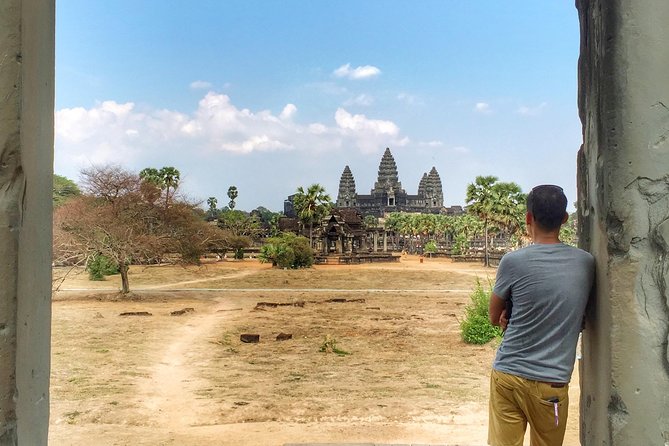
Angkor Wat receives about two hours. That is a reasonable amount of time for a first look, though you should not expect to inspect every gallery and carving in a monument this large.
Built as a Hindu temple and later used as a Buddhist site, Angkor Wat is the most famous expression of Khmer architecture. Its towers, long galleries, bas-reliefs, and broad approach make the scale clear before you even reach the inner areas.
Two hours lets you focus on the main route and ask questions along the way. I would use the time for the approach, the galleries, the central sanctuary, and the major carved scenes rather than trying to cover every corner.
Heat can become a serious factor here. The stone reflects the sun, and walking distances add up quickly. Carry water, use the supplied refreshments, and follow your guide’s advice about where to pause.
Angkor Thom, a walled capital with several major monuments
Angkor Thom gets about two hours. This is not a single temple but a former Khmer capital enclosed by walls and approached through monumental gates.
Inside are several important sites, including Bayon, Phimeanakas, Baphuon, the Terrace of the Elephants, the Terrace of the Leper King, and smaller temples such as Prah Palilay. The itinerary names Bayon and Baphuon in particular, but your guide may help you decide how to use the available time within the city.
This part of the tour is valuable because it shifts your focus from one religious monument to an entire urban center. You can begin to picture Angkor as a working capital, not simply a group of ruins placed in the forest.
Baphuon includes stairs and climbing, and the broader Angkor Thom visit involves uneven paths. A comment from one guest specifically warned about the amount of climbing across the temples, so take that seriously if mobility is a concern.
Bayon, the face-filled temple at the city center
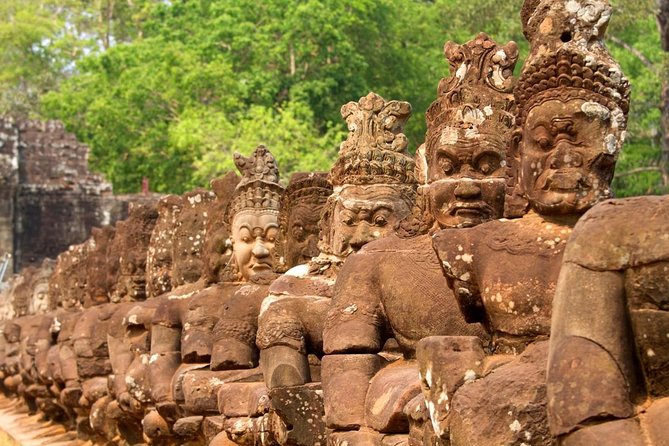
Bayon is within Angkor Thom and is one of the most memorable stops. Its towers carry large carved faces, while the galleries show scenes from Khmer life and warfare.
The temple can feel confusing at first. Towers crowd one another, corridors turn sharply, and the structure changes as you move inward. A good guide helps you find the main faces and understand how the temple fits into Jayavarman VII’s reign.
You will not get a separate hour listed for Bayon, because it is part of the Angkor Thom visit. That makes the private format useful. If Bayon is the place you most want to study, tell your guide early so the two-hour block is used well.
Ta Prohm, trees and fallen galleries
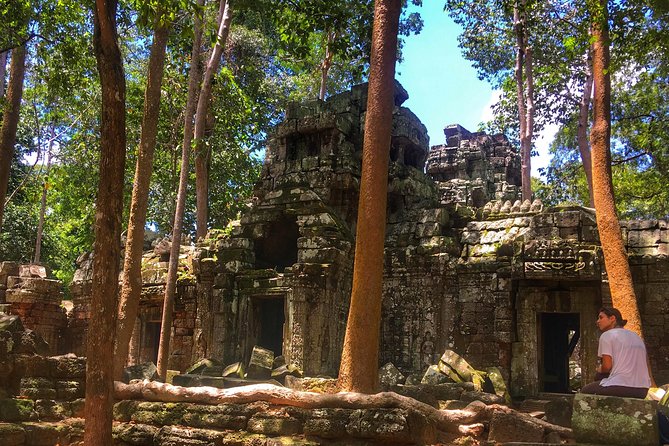
Ta Prohm receives about an hour. Its appeal comes from the way silk-cotton and strangler fig trees have grown among the stone galleries and walls. The result is dramatic, but the atmosphere is not only about trees. You are also seeing a large religious complex that has been partly left in a more unrestored condition.
Ta Prohm is associated with the film Tomb Raider, which adds to its fame. That fame also brings crowds, so timing matters. Your guide can try to route the visit around the busiest periods, but expect this to be one of the more popular stops.
Watch your footing. Roots, broken stone, and uneven paths are part of the experience. This is another place where closed shoes and a steady pace help.
Ta Nei, a small Buddhist temple away from the crowds
Ta Nei takes about 30 minutes and is one of the smartest details in the route. Built during the reign of Jayavarman VII in the late 12th century, it is a Buddhist temple in a quieter setting.
It does not have the scale of Angkor Wat or the famous tree scenes of Ta Prohm. That is exactly why it works. After the major monuments, Ta Nei gives you a chance to slow down and look at a less polished, less crowded ruin.
The stop also supports the tour’s main idea. You are not simply collecting famous temple names. You are getting a sense of how the Angkor area feels when you step away from the main visitor flow.
Guides, transport, and the private-tour advantage
The guide service is the most praised part of this experience. Guides named in guest accounts include Tay, Sopheara, Viet, and Kim. The strongest compliments focus on clear English, detailed explanations of Cambodian history and culture, and the ability to shape the route around the group.
One guide, Tay, was praised for managing temple visits and finding better views with fewer people. Sopheara was described as highly educated and especially well informed, while Viet received praise for turning the history and culture into a personal experience. Kim was noted for patience, professionalism, and careful answers to questions.
Those details matter because Angkor can become a blur of stone towers without context. A private guide can explain what you are looking at instead of giving you only a list of construction dates.
Hotel pickup and drop-off in Siem Reap are included. Transport is by private air-conditioned vehicle, with snacks and refreshments provided. One detailed account also described cold water and lemongrass-scented cool towels, which would be welcome after a hot temple walk, though the formal inclusions specifically promise snacks and refreshments.
The private setup is best for couples, families, or friends who want control over the day. It is less useful if you prefer wandering alone with no commentary or if you want a very cheap shared ride.
The real cost: $62 plus the Angkor pass
The listed tour price is $62. That covers a professional licensed guide, private transport, hotel pickup and drop-off, snacks, refreshments, and the two-day service.
The Angkor Archaeological Park entrance pass is not included. The supplied cost is $62 per person for a two or three-day visit. That means you need to budget for the tour and the separate park ticket, not treat $62 as the full cost of the experience.
Even with the pass added, the value can be good for a first visit. You are paying for private transport over two long days, a guide, route planning, and relief from arranging each temple yourself. The value is strongest if you care about explanations and want to reduce the strain of heat, driving, and navigation.
It is less appealing if you already have transport, know the temples well, or want to visit only Angkor Wat. In that case, a shorter or self-arranged plan may cost less.
Who should book this temple tour?
I would recommend it most strongly to first-time visitors who want a broad introduction to Angkor. It suits anyone who wants the major monuments but also wants Banteay Srei, Banteay Samre, Preah Khan, Neak Pean, and Ta Nei included.
It is also a good fit for people who value history and architecture. The guide can connect the temples to different Khmer rulers, religious traditions, and building periods, which gives the ruins more meaning.
You should think twice if you dislike early starts, long temple walks, stairs, or hot conditions. The route is thorough, and the two days involve plenty of movement. The air-conditioned car helps between sites, but it cannot remove the physical demands of walking over old stone surfaces.
Free cancellation is available if you cancel at least 24 hours before the experience begins. Changes or cancellations made less than 24 hours before the start are not accepted for a refund.
Should you book it?
Book this tour if you want Angkor explained, not simply photographed. The combination of a private guide, a sensible two-day route, quieter temples, and air-conditioned transport gives first-time visitors a strong introduction.
Before paying, remember the separate $62 park pass and ask on day one about sunrise or sunset for the following day. I would also tell your guide which sites matter most, especially Bayon, Banteay Srei, or Ta Prohm.
If you are physically able to handle stairs and uneven ruins, and you want more than the standard Angkor Wat stop, this is a well-priced private option. If your priority is the lowest possible cost or a very relaxed schedule, choose a shorter plan instead.
FAQ
Does the $62 price include the Angkor entrance ticket?
No. The Angkor Archaeological Park pass costs $62 per person for a two or three-day visit and must be purchased separately.
What time does the tour start?
The stated start time is 7:30 a.m., with pickup in Siem Reap.
Is this a private tour?
Yes. Only your group participates in the activity.
What temples are visited on day one?
Day one includes Banteay Srei, Banteay Samre, Pre Rup, Preah Khan, and Neak Pean.
What temples are visited on day two?
Day two includes Angkor Wat, Angkor Thom, Ta Prohm, and Ta Nei. Bayon and Baphuon are within Angkor Thom.
Can I request sunrise or sunset?
Yes. You should tell your guide on day one if you would like sunrise or sunset on the following day. This addition is complimentary.
Just added around Siem Reap
- Private Battambang Full-Day Guided Tour★ 4.5 · 3 reviews
- Kulen Mountain, Beng Mealea and Banteay Srei Full Day Tour★ 5.0 · 3 reviews
- Kompong Pluk Tour★ 5.0 · 3 reviews
- Private 3 Day Tour to Discover the ancient temples★ 5.0 · 3 reviews
- Kulen National Park Ticket -Waterfall & 1000 Lingas★ 5.0 · 3 reviews
- Cambodia: Absolute Traditional Dance Show with Buffet Dinner★ 5.0 · 3 reviews
- Border Transfer (Siem Reap to Laos/Laos to Siem Reap)★ 3.5 · 3 reviews
- Beng Melea, Rolous Group & Kompong Phluk Floating Village★ 5.0 · 3 reviews
2-Day Experiences, compared.

Angkor Wat 2-Day Tour with Sunrise and Sunset
Read our review →
Angkor 2-Day Sunset & Sunrise Small-Group Tour
Read our review →
2 Days Exclusive Temple Highlights with Sunset and Sunrise Tour
Read our review →
Angkor Sunrise 1- or 2-Day Guided Temples Tour
Read our review →
2-Day Angkor Wat With Small, Big Circuit and Banteay Srei Tour
Read our review →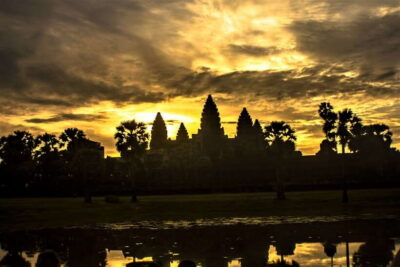
2-Day Temple Highlights Sunrise and Sunset Option
Read our review →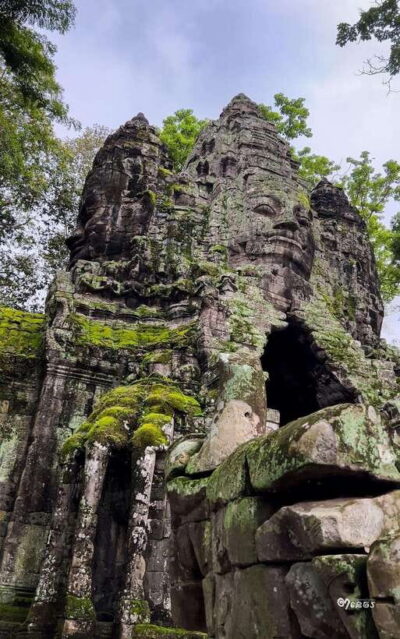
Angkor Wat 2-Day complex Sun rise & Sun set with Guided Tour
Read our review →Browse the lists this tour appears in